Mathematics skills Worksheets for Ages 3-8
3 filtered results
-
From - To
Our Mathematics Skills Worksheets for Ages 3-8 are designed to make learning math engaging and fun for young learners. Tailored to support the educational needs of children, these worksheets cover essential math concepts such as counting, addition, subtraction, patterns, and shapes. Ideal for early grade students, the activities are expertly crafted to help build foundational skills through playful and interactive exercises. With colorful visuals and age-appropriate challenges, our resources provide a fantastic platform for kids to develop confidence and proficiency in math, ultimately fostering a love for learning in a stress-free manner. Explore our vast collection and watch your child thrive!
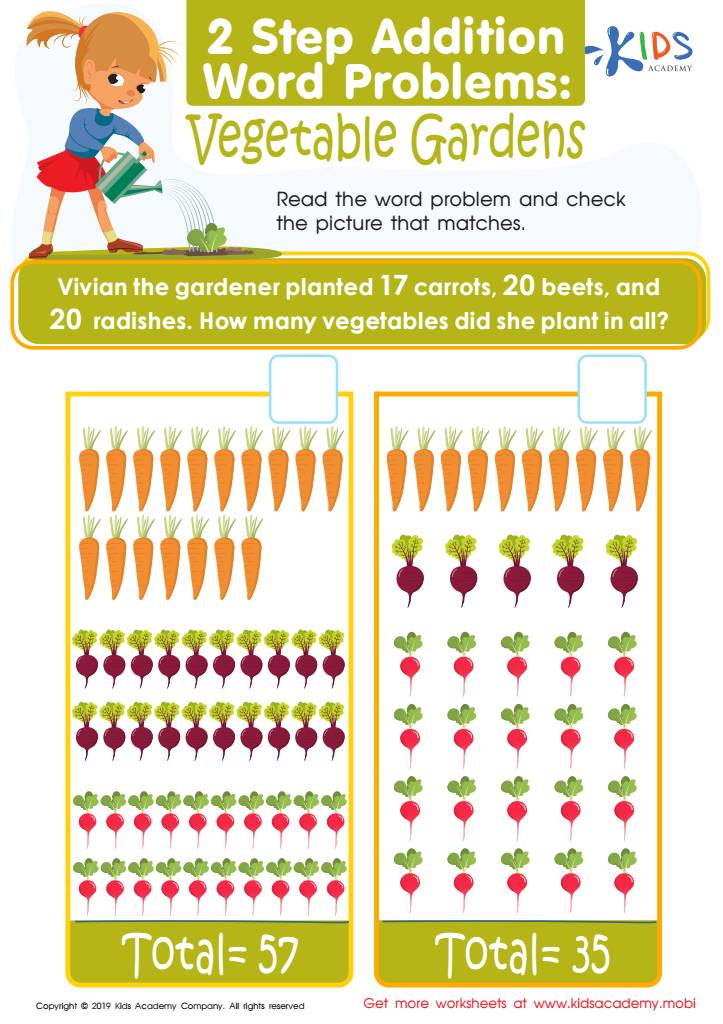
Vegetable Gardens Worksheet
 Assign to My Students



.jpg)



Mathematics skills in children aged 3-8 form the bedrock for essential cognitive development and problem-solving abilities that are crucial for their overall academic growth and everyday life. During these formative years, children's brains are exceptionally receptive to learning new concepts, and early exposure to mathematics can significantly enhance their numeracy and logical reasoning skills.
Engagement with math activities such as counting, sorting, and pattern recognition fosters a child's aptitude for identifying relationships and understanding order, which are foundational skills not only for advanced mathematics but for science, technology, engineering, and mathematics (STEM) disciplines. These experiences also enhance children's spatial awareness and their ability to think critically and solve problems systematically, contributing to their academic success in multiple subjects.
Moreover, developing math skills early on can boost children's confidence and interest in the subject, countering math anxiety that often develops in later years. Practical math applications, such as measuring ingredients for a recipe or calculating change during shopping, offer parents and teachers natural opportunities to incorporate math learning in engaging and meaningful contexts. Nurturing these skills from a young age lays the groundwork for lifelong mathematical literacy, equipping children with the tools they need to navigate and understand the world more effectively, ensuring they are well-prepared for future educational challenges.








