
Vowel differentiation Worksheets for Ages 3-8
3 filtered results
Difficulty Level
Grade
Age
-
From - To
Subject
Activity
Standards
Discover engaging and educational "Vowel Differentiation Worksheets for Ages 3-8" designed to help young learners master the essential skill of identifying vowels. Ideal for preschoolers and early elementary students, these vibrant and interactive worksheets make learning fun. Kids will enhance their reading and phonics skills through activities that involve sorting, matching, and recognizing vowels in various contexts. Perfect for both classroom and home use, our worksheets cater to different learning styles and keep children motivated. Give your child a strong foundation in literacy with these expertly crafted resources from Kids Academy.
Favorites
With answer key
Interactive
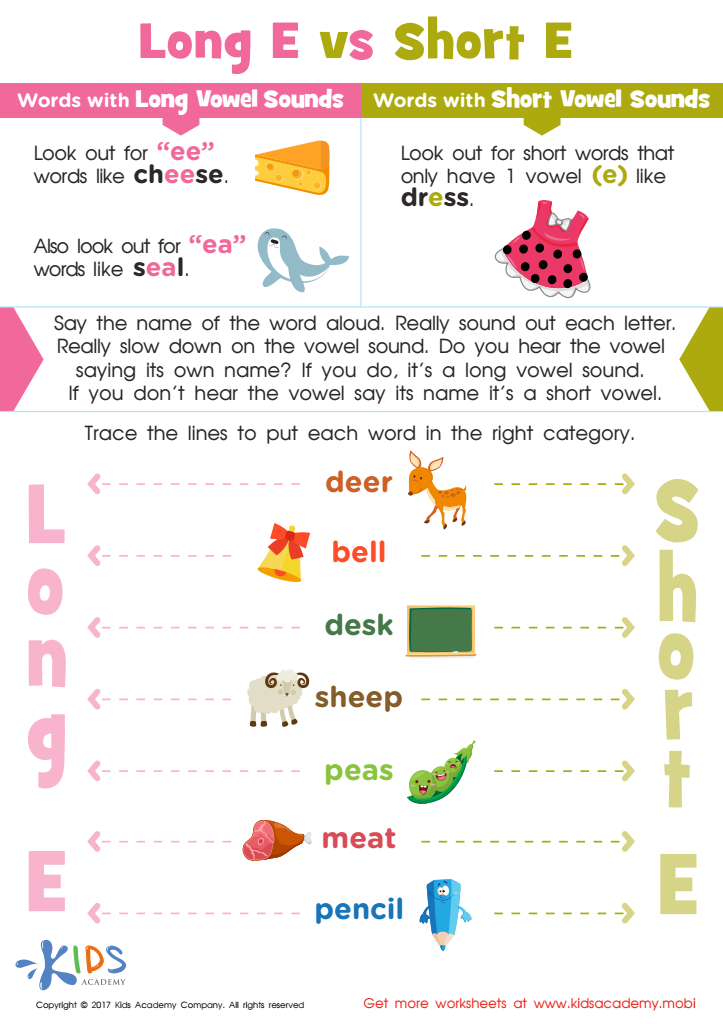
Long and Short Vowel E Spelling Worksheet
This worksheet helps kids master spelling with the letter "E". They read about long and short vowel sounds, view examples and sound out words to complete it. Two vowels distinguish long "E" sounds from its short vowel counterparts with just one.
Long and Short Vowel E Spelling Worksheet
Worksheet
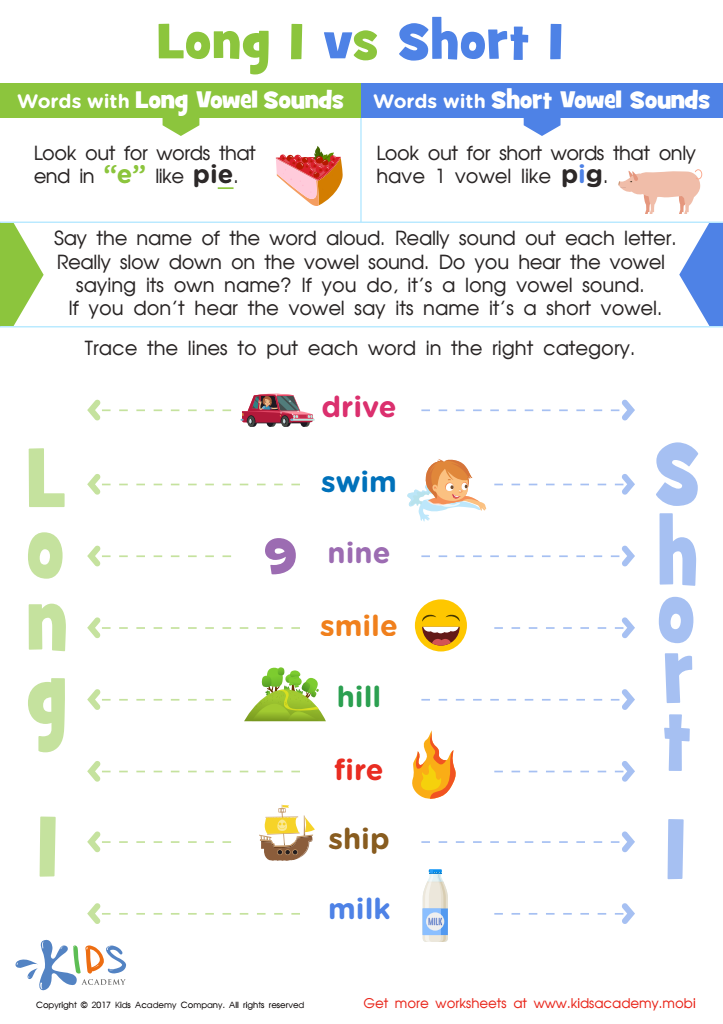
Long and Short Vowel I Spelling Worksheet
When it comes to long "I" sounds, kids should look out for the letter "E" at the end. With examples and sounding out words, kids will improve spelling skills with this long/short "I" worksheet!
Long and Short Vowel I Spelling Worksheet
Worksheet

Long and Short E Worksheet
This fun printout makes learning phonics enjoyable for Grade 3 students. Get them to read the words “tree” and “bed” to recognize the different sounds of the letter “E”. After hearing the words they can color the words and the pictures to understand differences between long and short vowels.
Download (PDF)
 Assign to My Students
Assign to My Students
Long and Short E Worksheet
Worksheet
Join Kids Academy for Free
Who is primarily going to use this learning content?





.jpg)


Vowel differentiation is crucial for children aged 3-8 because it lays the foundation for essential language skills, including reading, writing, and speaking. During these early years, children's brains are incredibly receptive to linguistic input, making it a prime time for developing phonemic awareness—the ability to hear, identify, and manipulate individual sounds in words. Vowel sounds are particularly important because they are the core of syllables and words in English.
When parents and teachers emphasize vowel differentiation, they help children discern subtle differences between sounds like "a" in "cat" and "e" in "bed," improving their pronunciation and comprehension. This ability strengthens reading skills as children learn to decode words with greater accuracy and fluency. Without a strong grasp of vowel sounds, children may struggle with word recognition, leading to potential difficulties in reading progression and academic performance.
Moreover, differentiation of vowel sounds aids with spelling and vocabulary expansion. Children become more confident writers once they can correctly sound out and spell words. Culturally and socially, clear vowel sounds enhance communication, allowing children to express themselves more effectively.
In summary, focusing on vowel differentiation provides young children with the linguistic tools necessary for fluent reading, accurate writing, and articulate speaking, establishing a strong educational foundation that will benefit them throughout their academic careers and beyond.








