Understanding symmetry Adding up to 100 with Regrouping Worksheets for Ages 3-8
3 filtered results
-
From - To
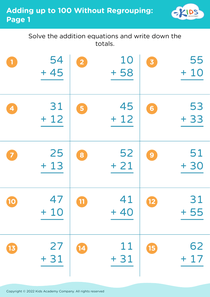
Discover the perfect educational tools with our "Adding up to 100 with Regrouping Worksheets for Ages 3-8," designed to enhance your child's mathematical skills through engaging activities. Tailored to young learners, these worksheets cover the essential concepts of addition and symmetry, ensuring a solid foundation in math. Interactive exercises make learning fun and effective, breaking down complex ideas into manageable tasks. Kids will improve their numeracy, spatial awareness, and problem-solving abilities with these expertly-crafted resources. Watch your child's confidence grow as they explore math creatively and systematically with our comprehensive worksheet collection.
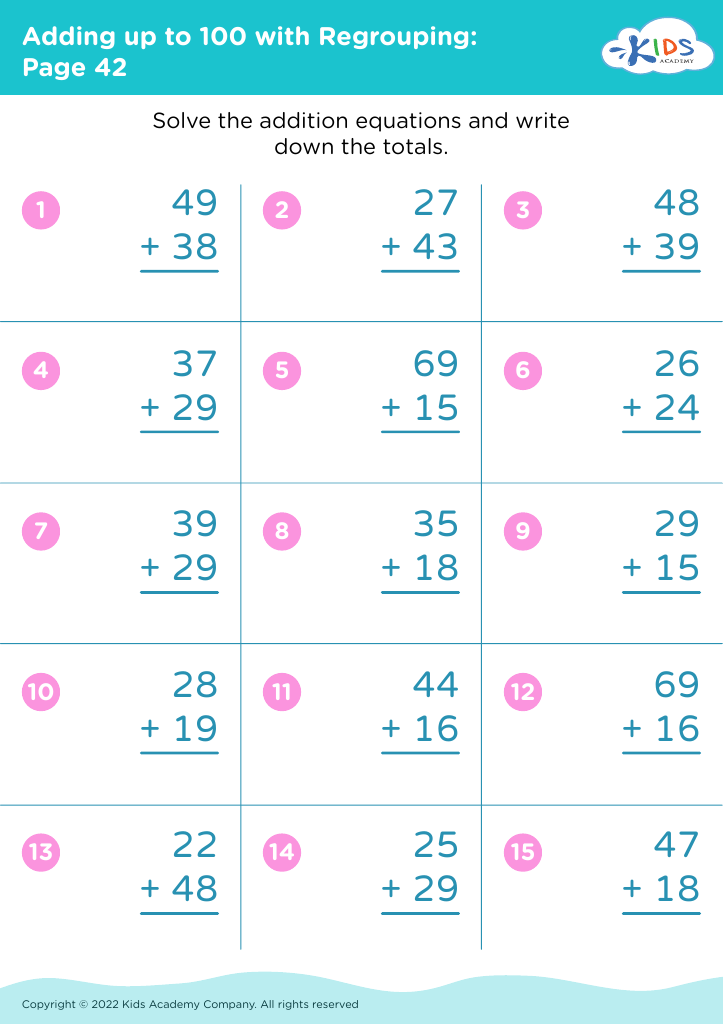
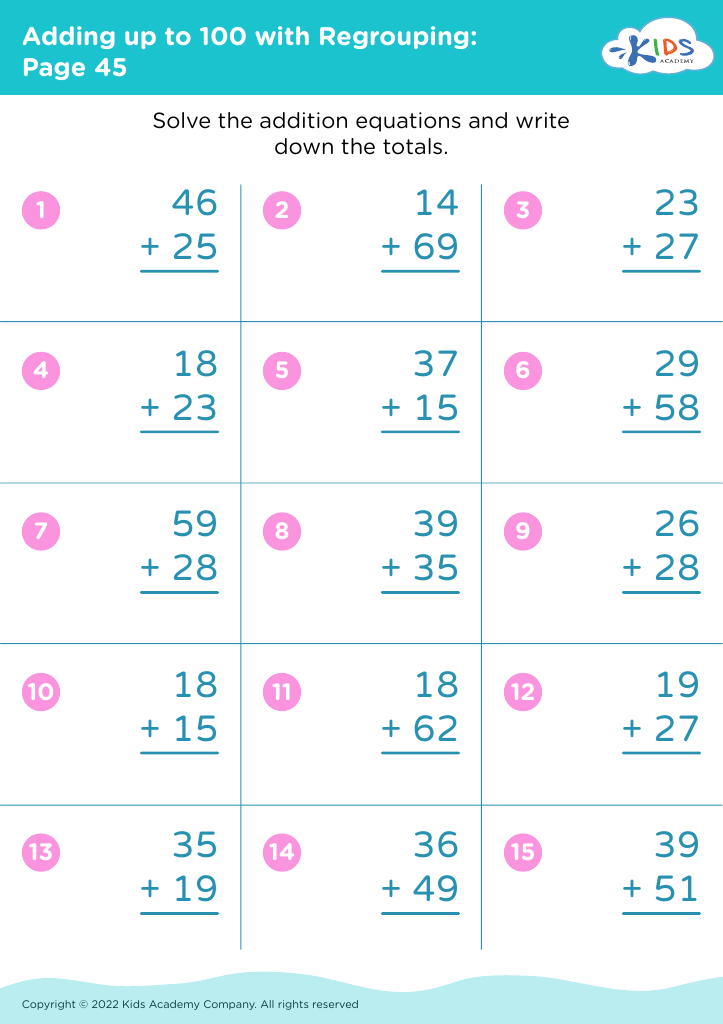
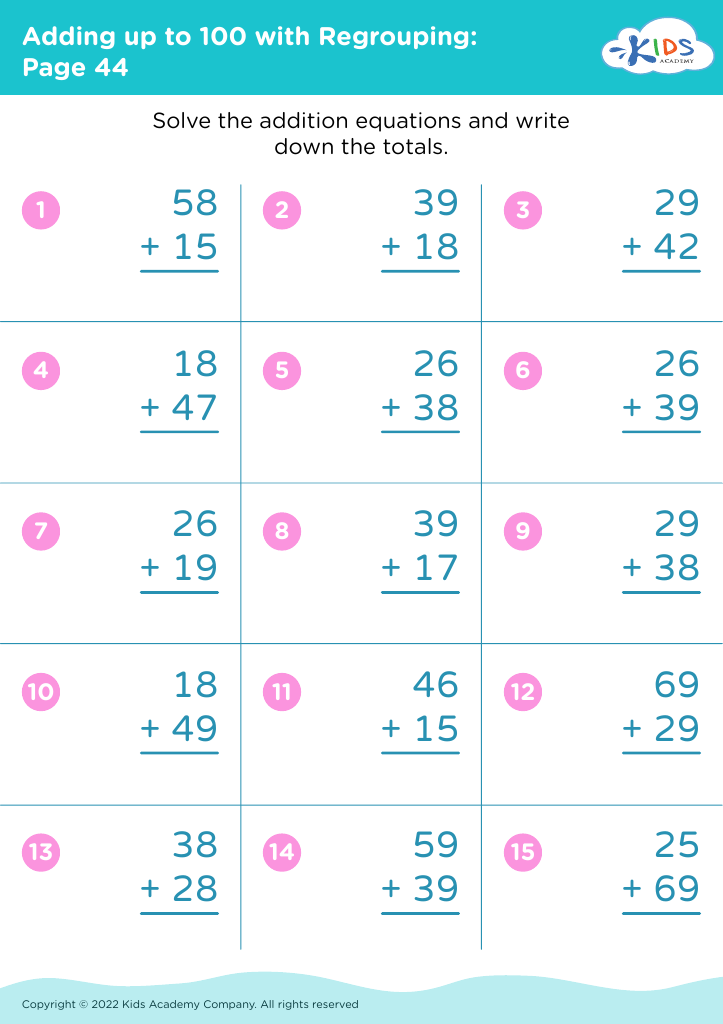




Understanding symmetry and learning addition with regrouping are fundamental mathematical concepts for young children, particularly those aged 3-8. Symmetry helps develop spatial awareness and geometric understanding. When children recognize patterns and symmetrical shapes, they enhance their visual discrimination skills, which are crucial for reading and writing. This understanding lays the groundwork for more complex math concepts and logical reasoning, fostering an essential part of cognitive development.
Learning to add up to 100 with regrouping (also known as carrying) introduces young learners to place value, which is a cornerstone of the number system. Understanding place value helps children make sense of larger numbers, fostering confidence and competence in various arithmetic operations. The ability to regroup ensures children can tackle more complex calculations with ease, greatly improving their problem-solving skills.
Moreover, mastering these concepts at an early age can boost a child's self-esteem. When children feel competent in their mathematical abilities, they approach learning with a positive mindset, reducing math anxiety. Early exposure sets a strong foundation for future academic success, as math is integral to many subjects. Thus, parents and teachers should prioritize these areas to support a child's holistic educational journey.