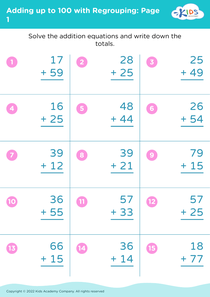
Critical Thinking Adding up to 100 Without Regrouping Worksheets for Ages 3-8
3 filtered results
-
From - To
Enhance your child's analytical skills with our Critical Thinking Adding up to 100 Without Regrouping Worksheets, designed for ages 3-8! These engaging activities not only strengthen basic arithmetic but also foster critical thinking. By solving problems that avoid regrouping, young learners develop a deeper understanding of numbers and fundamental math concepts. Each worksheet provides fun and educational exercises, empowering children to approach mathematical challenges with confidence and creativity. Ideal for early learners, these resources support cognitive growth and a love for learning, ensuring kids build a strong foundation in the essentials of math while honing important critical thinking skills.
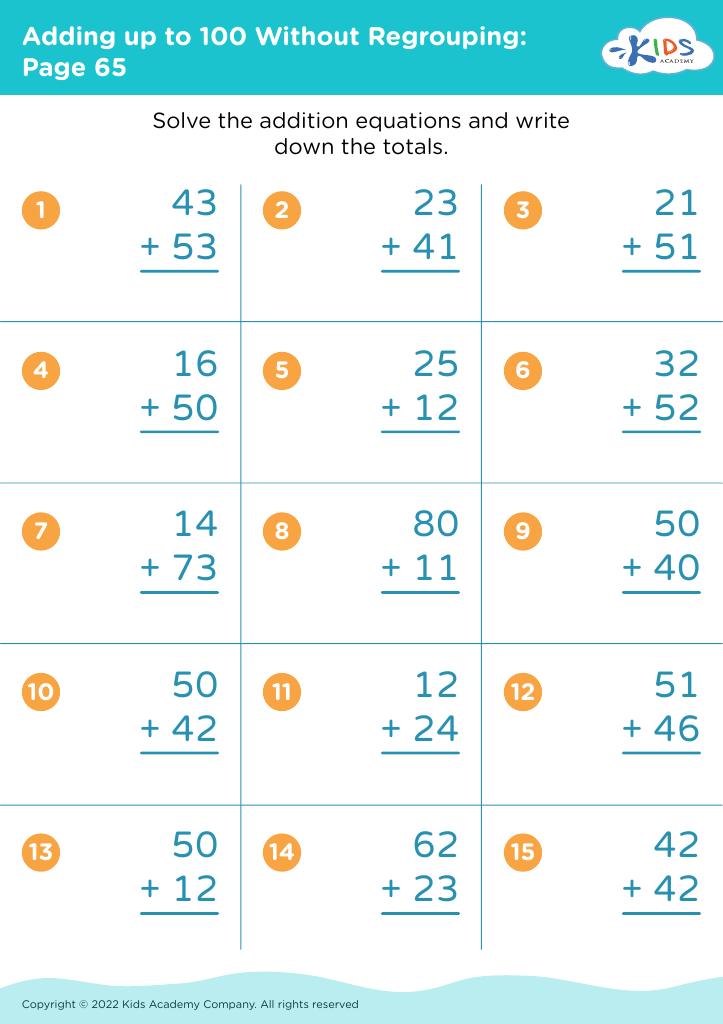
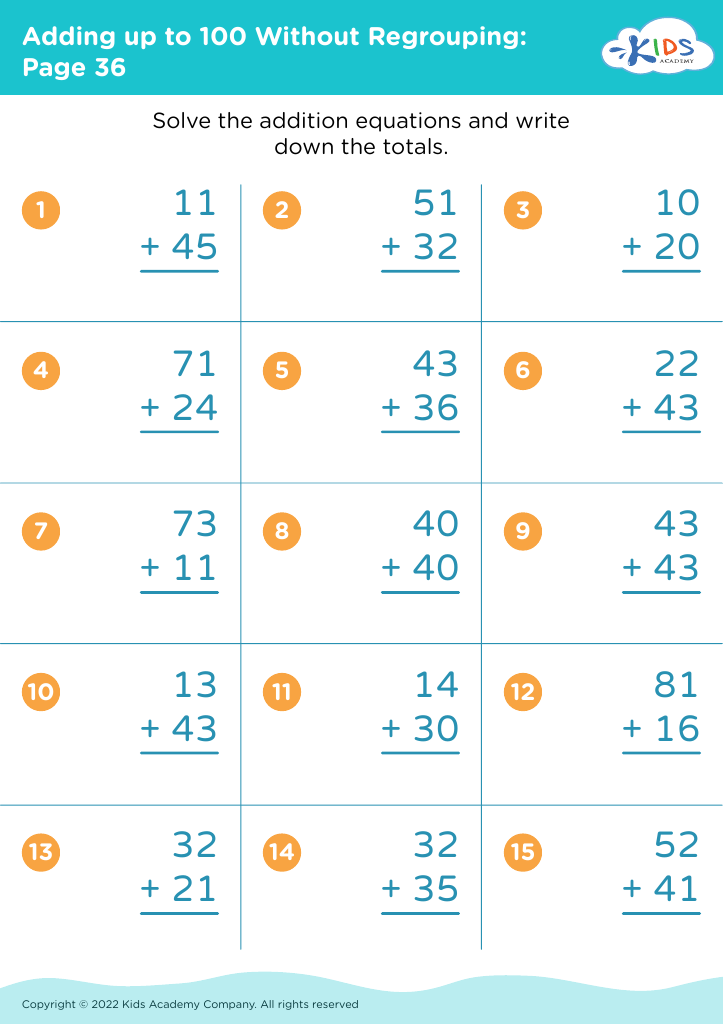
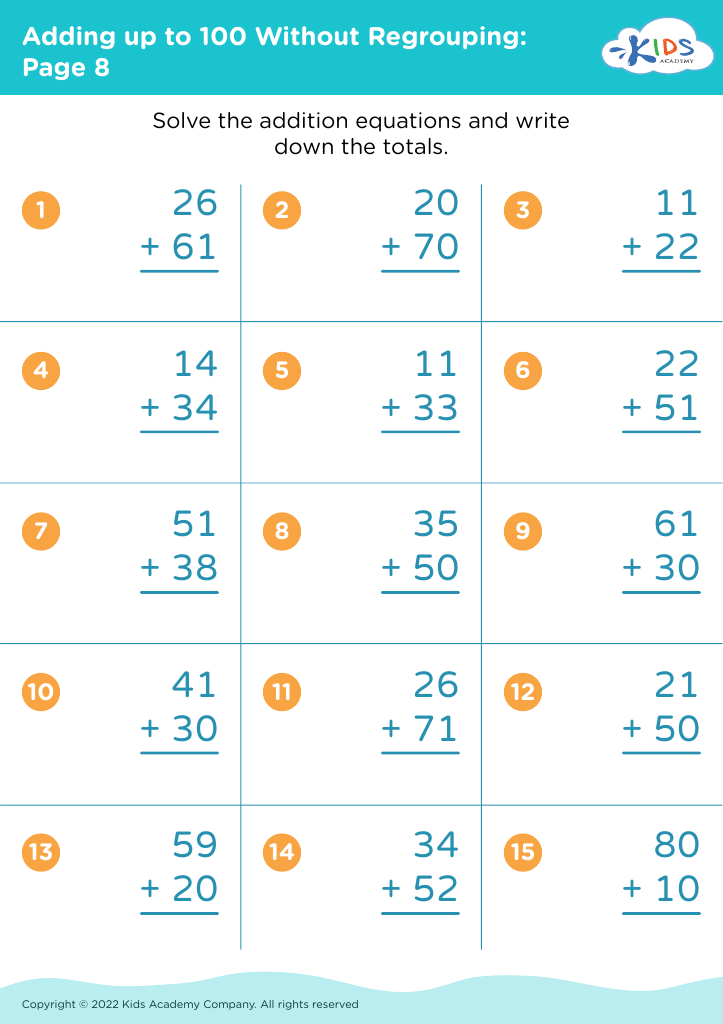




Critical thinking in early math skills, such as adding up to 100 without regrouping, is crucial for children aged 3-8 because it lays a strong foundation for their future academic success and cognitive development. At this stage, developing critical thinking skills in addition helps children understand numerical relationships and patterns, boosts problem-solving abilities, and encourages logical reasoning.
When parents and teachers emphasize these skills, they help children build confidence in their mathematical abilities, fostering a positive attitude toward learning more complex concepts in the future. Mastery of addition without regrouping ensures that foundational math concepts are ingrained, setting the stage for understanding more advanced operations like subtraction, multiplication, and division.
Critical thinking activities in math also hone a child’s attention to detail and improve their ability to follow multi-step processes, which are essential skills not just in math but in everyday decision-making and problem-solving. Furthermore, the sense of achievement children gain from performing accurate calculations strengthens their intrinsic motivation and academic resilience.
Thus, fostering these skills through addition activities supports holistic cognitive development and equips children with essential tools for lifelong learning. The ability to break down and work through numerical problems with confidence dramatically impacts other areas of study and everyday life, making it an invaluable focus for educators and parents alike.