Identifying shapes Adding up to 100 Without Regrouping Worksheets for Ages 3-8
4 filtered results
-
From - To
Our "Identifying Shapes and Adding Up to 100 Without Regrouping Worksheets" are perfect for children ages 3-8. These educational worksheets are designed to help young learners develop essential math skills while identifying basic geometric shapes and practicing arithmetic without regrouping. Through engaging and vibrant activities, children can confidently enhance their understanding of shapes and improve their addition skills up to 100. These resources support foundational learning, making math exciting and accessible. Ideal for both classroom and home settings, our worksheets ensure your child builds a strong mathematical and cognitive foundation.
Explore these interactive materials at Kids Academy and give your child the tools to succeed!
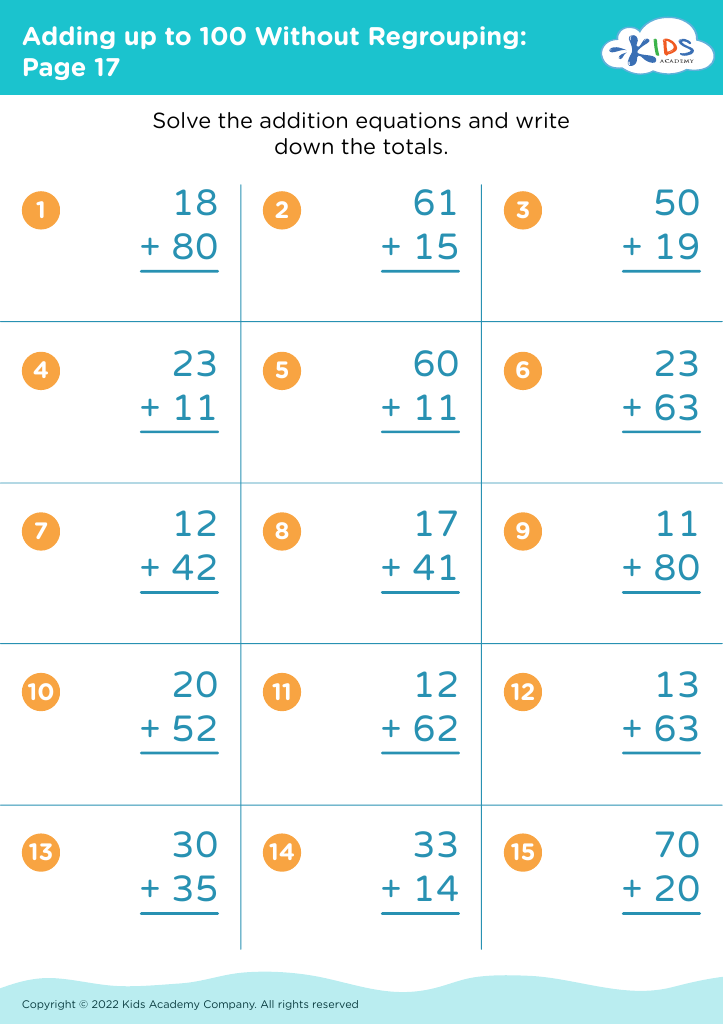
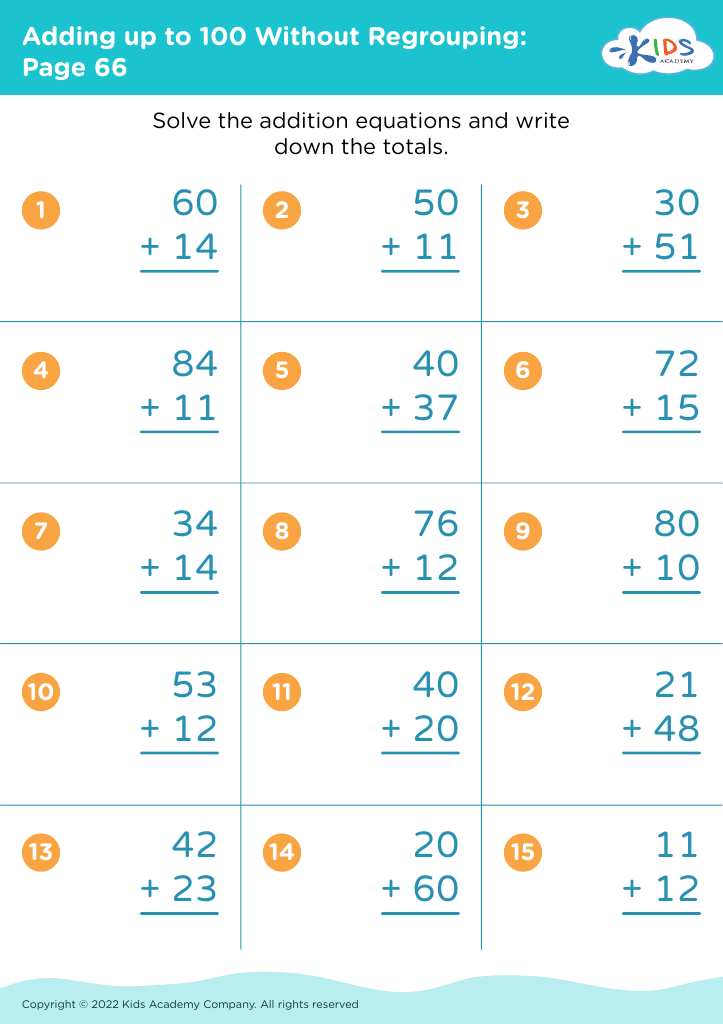
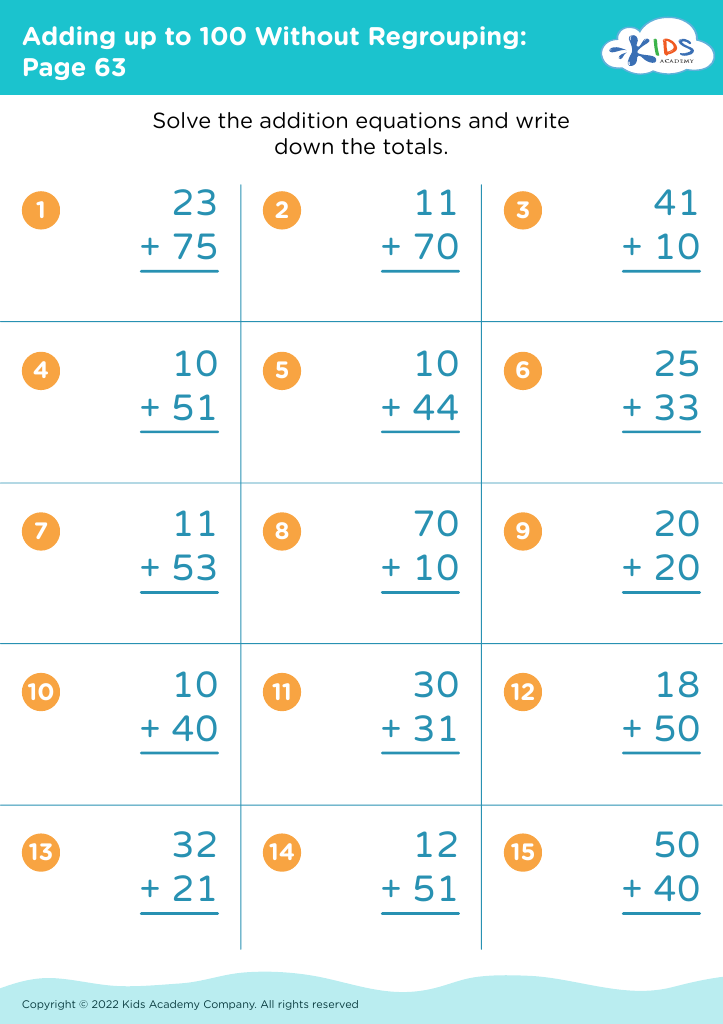
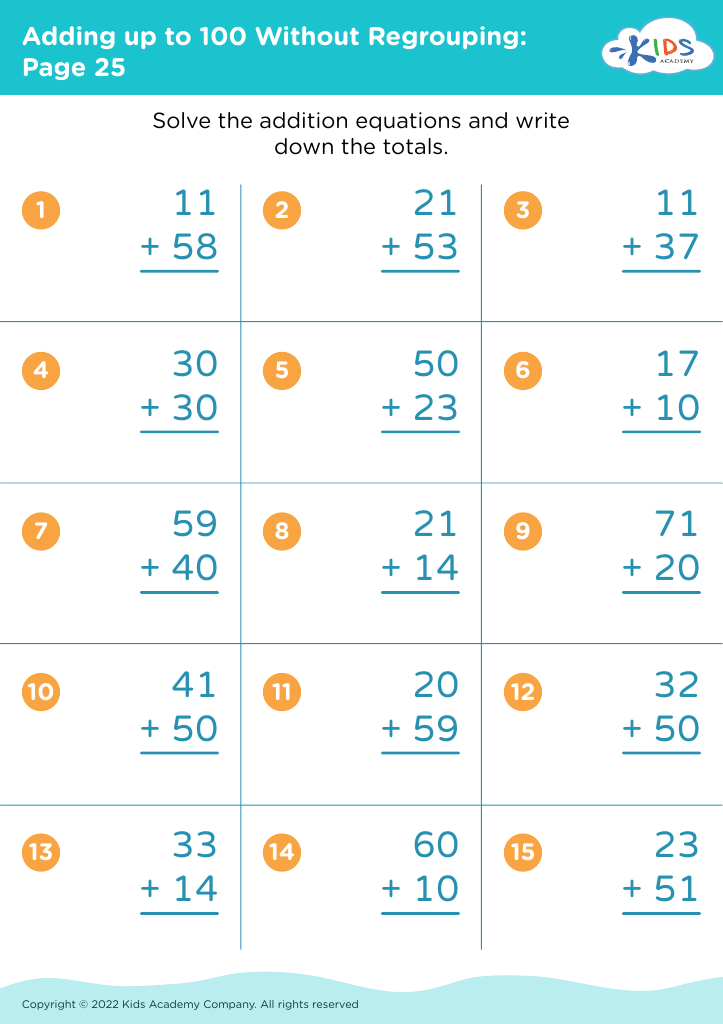




Identifying shapes and adding up to 100 without regrouping are fundamental skills that form the building blocks of early childhood education, crucial for ages 3-8.
Firstly, understanding shapes is imperative as it helps young children differentiate and categorize objects in their environment. Skills like shape recognition help in the cognitive development by enhancing spatial awareness and problem-solving abilities. For instance, recognizing circles, squares, and triangles is a prelude to geometry skills used later in more complex mathematics, art, and daily life.
Addition up to 100 without regrouping strengthens a child’s number sense and arithmetic foundations. It fosters an understanding of number hierarchy, relationships, and straightforward calculation skills. During this age range, mastering addition lays the groundwork for more complex operations involving larger numbers, regrouping, and concepts like multiplication and division later on.
For teachers and parents, focusing on these skills supports children in achieving early mathematical proficiency and fosters confidence in their abilities. It helps young learners develop a positive association with math, reducing anxiety around the subject as they grow older. Engaging in these practices can also be fun and interactive, nurturing a lifelong love for learning.
Thus, prioritizing these fundamental skills ensures that children are equipped with essential cognitive tools, setting the stage for future academic success.