Mathematical reasoning Adding up to 100 Without Regrouping Worksheets for Ages 3-8
3 filtered results
-
From - To
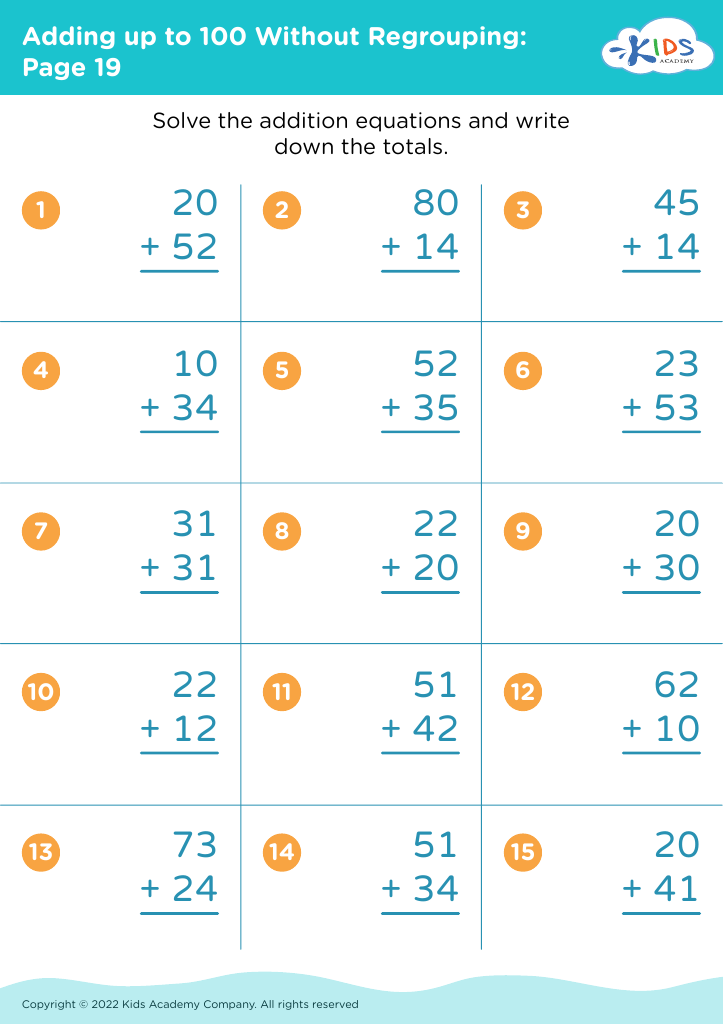
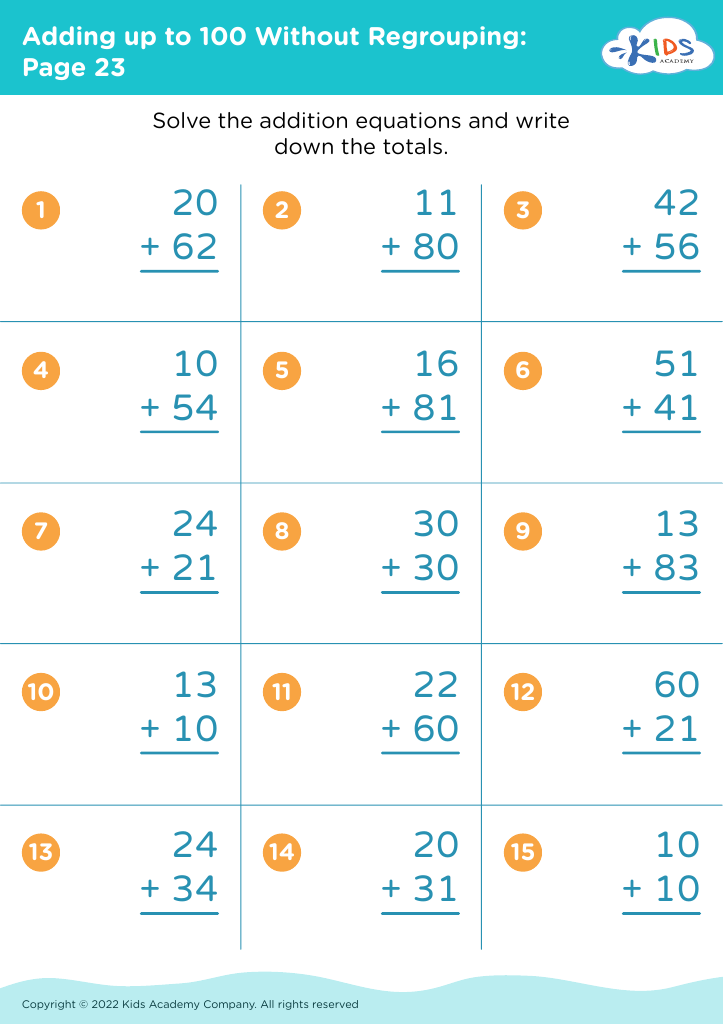
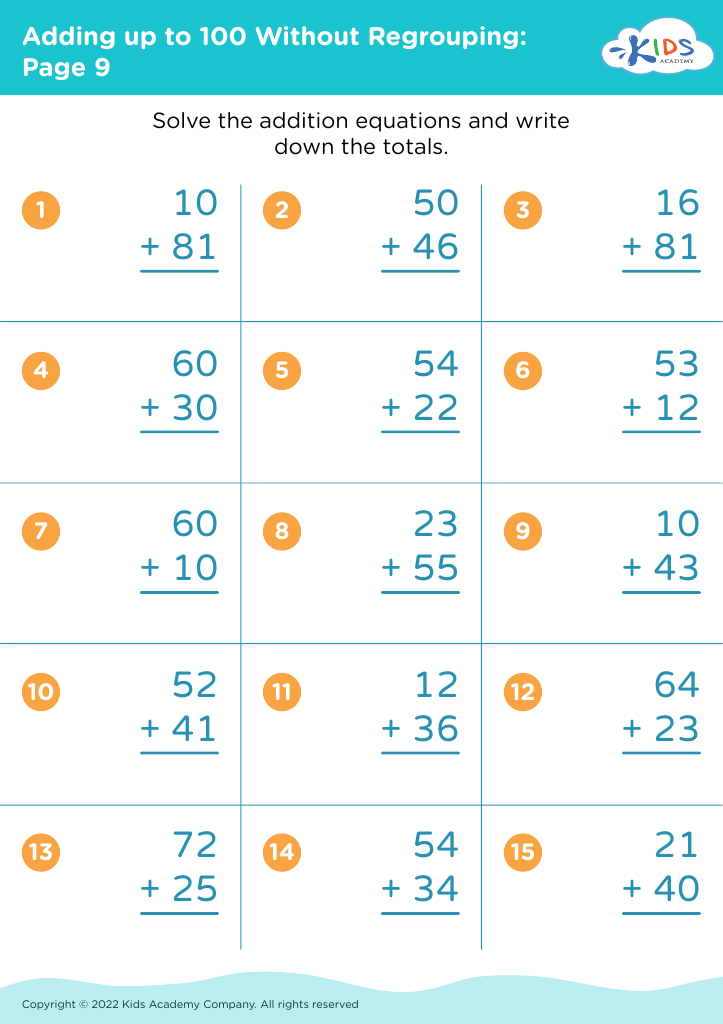
Discover our engaging "Mathematical Reasoning Adding Up to 100 Without Regrouping Worksheets," specially designed for children ages 3-8. These thoughtfully crafted worksheets help young learners develop essential math skills by practicing simple addition without regrouping. Fun and interactive, they encourage critical thinking and strengthen conceptual understanding of numbers. Ideal for home or classroom use, our worksheets are tailored to boost confidence and proficiency in math. Each worksheet promotes logical reasoning and helps children visually grasp concepts, making learning enjoyable. Enhance your child's mathematical journey with our user-friendly resources and watch their skills flourish as they reach new numerical milestones!




Mathematical reasoning skills, especially the ability to add up to 100 without regrouping, are crucial for children ages 3-8, as they lay the foundation for future mathematical understanding and problem-solving abilities. Parents and teachers should care about this for several reasons.
Firstly, it fosters a strong grasp of number sense. At this age, children are developing their ability to understand numbers, quantities, and relationships, which is essential for more complex mathematical operations later on. By learning to add without regrouping, children can develop a concrete understanding of quantity and addition, rather than relying solely on rote memorization.
Moreover, adding up to 100 without regrouping helps build confidence in young learners. Mastery of basic addition empowers children, encouraging them to tackle more challenging concepts and engage more actively in math-related activities.
Additionally, enhancing mathematical reasoning promotes critical thinking skills. It encourages children to approach problems strategically and explains why certain methods work, creating a more profound connection to the subject matter.
Ultimately, by emphasizing mathematical reasoning at an early age, parents and teachers equip children with the necessary tools to succeed academically, fostering a love for learning that will serve them well throughout their educational journey.