Developing critical thinking Addition & Subtraction Worksheets for Ages 3-8
3 filtered results
-
From - To
Explore our "Developing Critical Thinking Addition & Subtraction Worksheets" designed for children ages 3-8! Our engaging worksheets not only reinforce basic math skills but also promote critical thinking by encouraging young learners to analyze problems, identify patterns, and make connections. Each worksheet is tailored to different learning levels, with fun and colorful activities that captivate children's attention, fostering their love for math. These resources support early math education and enhance problem-solving skills, preparing kids for future academic success. Empower your child’s learning journey today with these interactive worksheets that blend fun with essential educational skills!
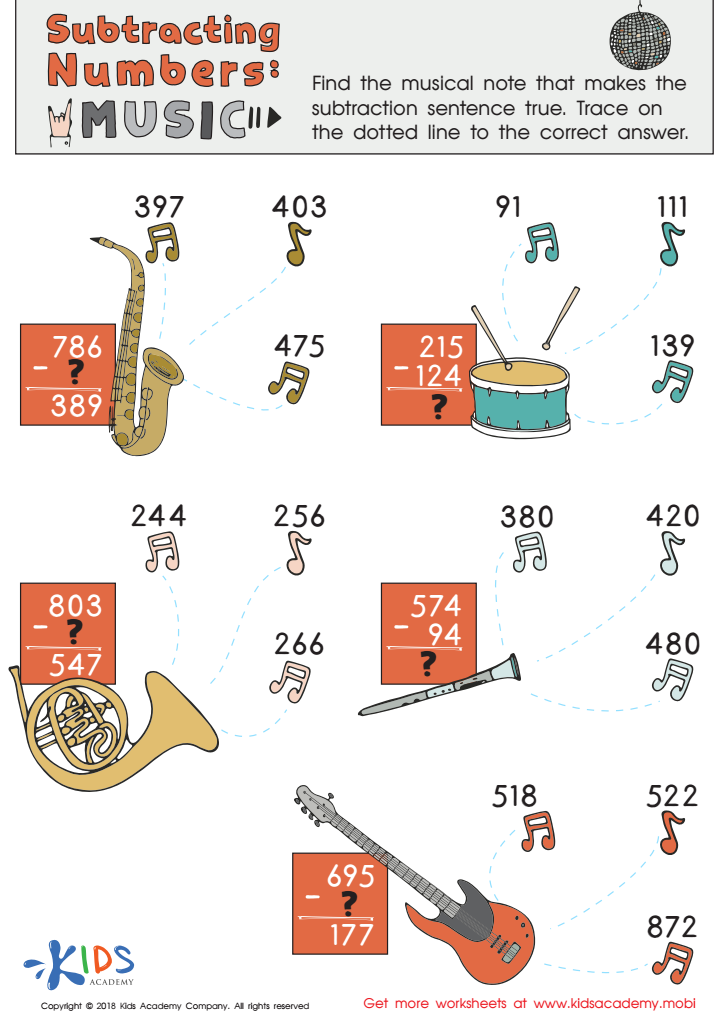
Subtracting Numbers: Music Worksheet
 Assign to My Students








Developing critical thinking skills in young children, particularly in the context of addition and subtraction, is essential for their overall cognitive development. For ages 3-8, this phase of learning is foundational; it sets the stage for future mathematical understanding and problem-solving abilities. When parents and teachers focus on fostering critical thinking in early mathematics, they help children learn to analyze, reason, and approach problems with creativity.
Critical thinking in addition and subtraction goes beyond mere rote memorization of facts. It encourages children to comprehend concepts, recognize patterns, and understand the relationships between numbers. This fosters a deeper grasp of mathematics which is crucial as they progress to more complex topics in higher grades.
Moreover, strong critical thinking skills have implications beyond math. Children learn to make connections, evaluate options, and apply logic, preparing them for real-world challenges. Encouraging an inquisitive mindset helps instill a love for learning, as children feel empowered to ask questions and search for solutions.
In today’s world, where problem-solving and analytical skills are critical, parents and teachers have an opportunity to equip children with the tools needed not just for academic success but for making thoughtful decisions in all aspects of life.








