
Fine motor development Addition & Subtraction Worksheets for Ages 3-8
4 filtered results
Difficulty Level
Grade
Age
-
From - To
Subject
Activity
Standards
Enhance your child's fine motor skills while introducing the foundational concepts of addition and subtraction with our engaging worksheets designed for ages 3-8. These printables marry learning with play, encouraging little ones to practice counting, number identification, and basic math operations through creative activities. Each worksheet promotes hand-eye coordination, dexterity, and cognitive development, ensuring a well-rounded learning experience. Filled with colorful illustrations and user-friendly formats, these worksheets keep young learners engaged and motivated. Perfect for home or classroom use, they are an essential tool for any early-grade teacher looking to enrich their math curriculum while supporting fine motor development.
Favorites
With answer key
Interactive
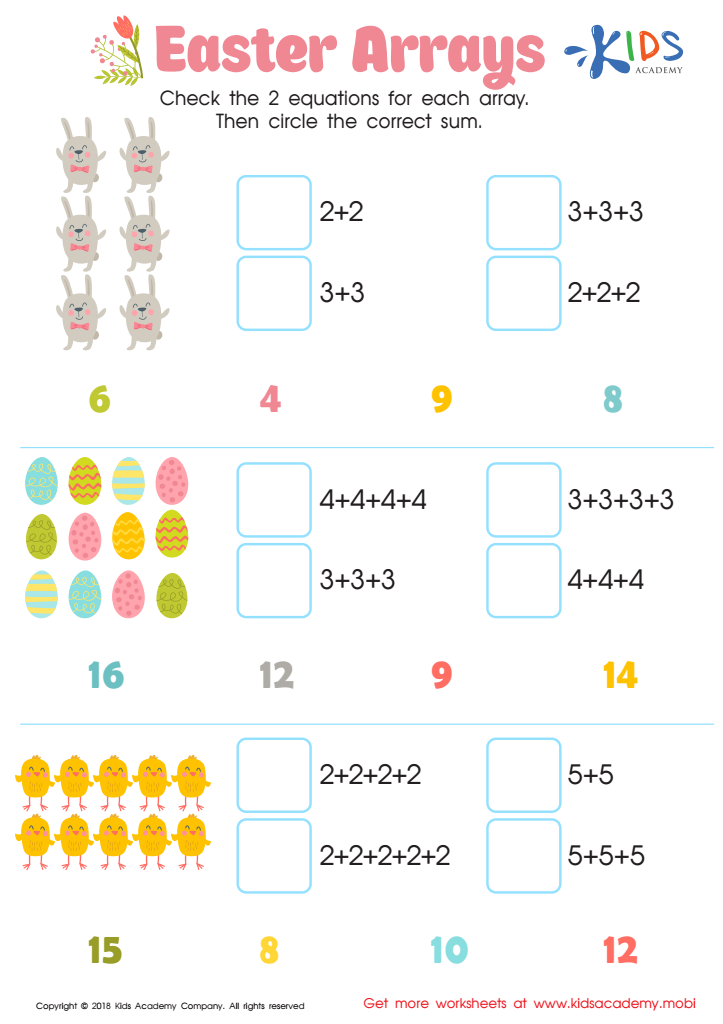
Easter Arrays Worksheet
Does your child love Easter? Do they adore the Easter bunny and egg hunts? Help them have fun with this worksheet! Go through it with them and check the equations for each array. Then, have them circle the correct sum. It's a great way to make the holiday extra exciting!
 Assign to My Students
Easter Arrays Worksheet
Worksheet
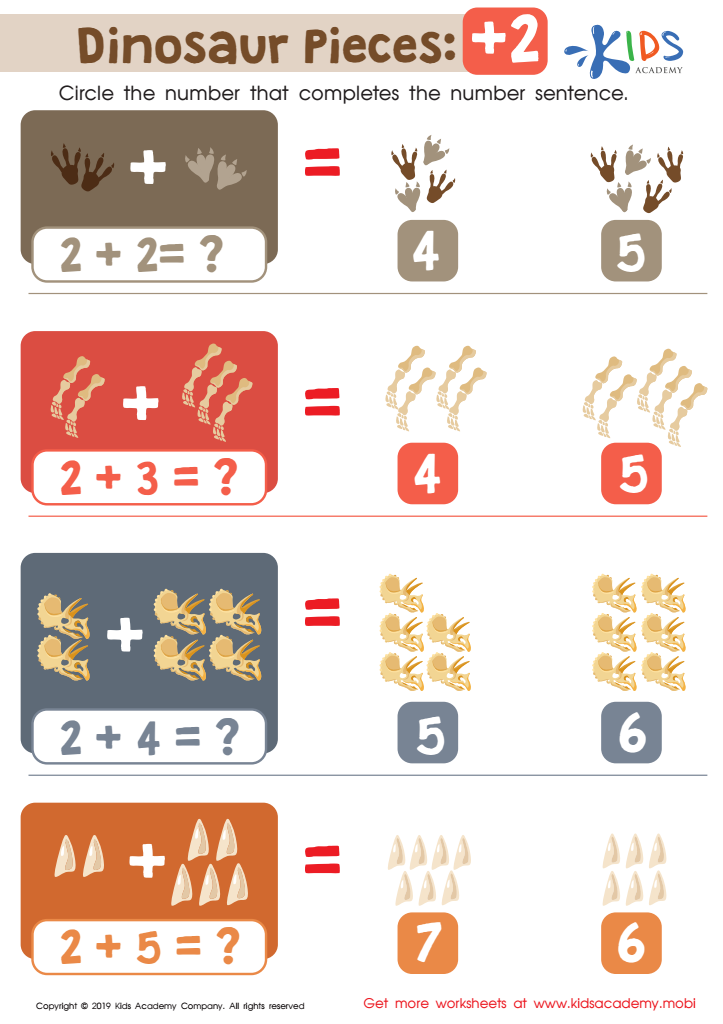
Dinosaur Pieces: +2 Worksheet
Kids love dinosaurs! See if your kids can solve these three equations featuring the mysterious creatures. Download the PDF and have them circle the number that completes each equation. Dinosaurs are extinct, not seen for thousands of years, but they can still help kids work on their math skills!
Dinosaur Pieces: +2 Worksheet
Worksheet
Join Kids Academy for Free
Who is primarily going to use this learning content?








Fine motor development is crucial for ages 3-8, as it lays the foundation for essential skills in both daily life and academic success. Parents and teachers should care about fine motor skills because they play a significant role in executing tasks that require hand-eye coordination, such as writing, drawing, and manipulating objects. These skills foster independence and boost children's confidence as they engage in self-care, like dressing or using utensils.
Moreover, fine motor skills seamlessly interconnect with early mathematical concepts, particularly addition and subtraction. When children handle objects—like counting blocks— they strengthen their grasping skills while also visualizing mathematical operations. As they manipulate physical items to solve problems, they develop a tangible understanding of quantity and relationships, which are foundational to arithmetic.
Inspiration from daily activities such as cooking or belt fastening can further encourage fine motor skill development while reinforcing basic arithmetic. Engaging in these playful activities creates a fun, integrated learning experience that is essential for cognitive development. Thus, prioritizing fine motor activities also enhances emotional and social skills, enabling children to thrive both inside and outside the classroom. In conclusion, nurturing these skills is vital for holistic childhood development and lifelong learning.








