
Observation skills Addition & Subtraction Worksheets for Ages 3-8
3 filtered results
Difficulty Level
Grade
Age
-
From - To
Subject
Activity
Standards
Enhance your child's mathematical foundation with our Observation Skills Addition & Subtraction Worksheets, tailored for ages 3-8. Carefully designed to build key observation skills, these engaging worksheets seamlessly blend fun with learning. Each activity encourages young learners to focus, analyze, and solve basic addition and subtraction problems, all while improving their attention to detail. By cultivating these crucial skills early on, children develop sharper problem-solving abilities and a solid understanding of fundamental math concepts. Discover a collection that makes math enjoyable and accessible for young minds, setting a strong groundwork for their educational journey.
Favorites
With answer key
Interactive
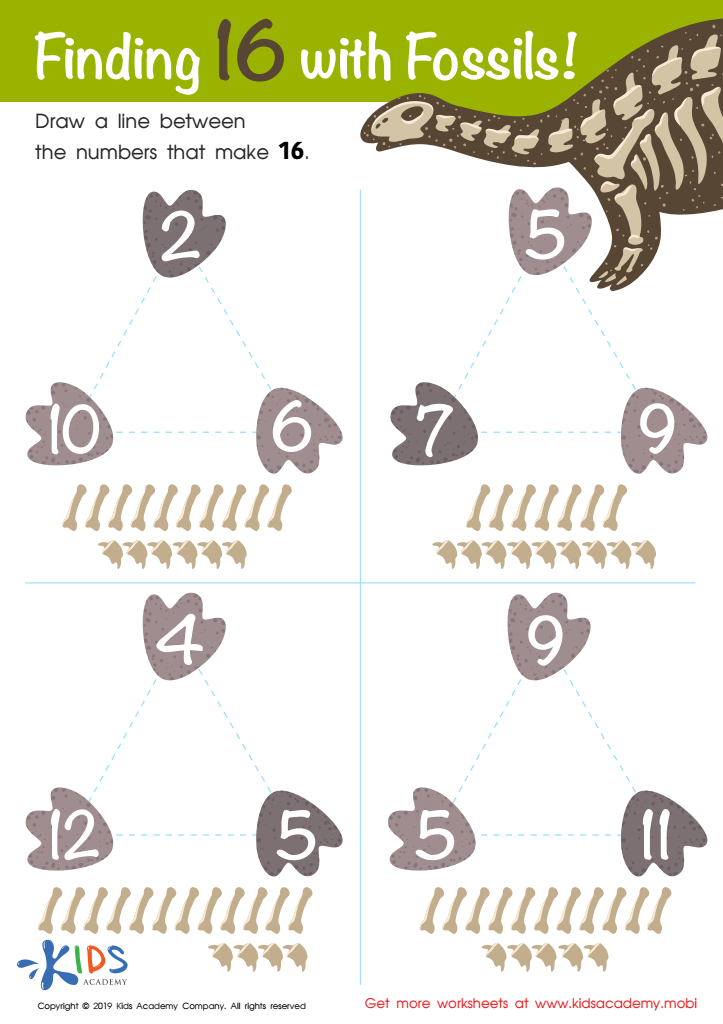
Finding 16 With Fossils Worksheet
Experts hunt for fossils, dig them up, and study them to learn more about past life forms - how they lived, what they looked like, and when they lived. Show kids the picture in this worksheet and point out the fossils. Help them count the bones and draw a line between the numbers that add up to 16 in each triangle.
 Assign to My Students
Finding 16 With Fossils Worksheet
Worksheet
Join Kids Academy for Free
Who is primarily going to use this learning content?








Parents and teachers should prioritize observation skills alongside addition and subtraction for children ages 3-8 because these fundamental abilities provide the foundation for future learning and cognitive development. Observation skills enable children to notice details, patterns, and changes in their environment, fostering critical thinking and curiosity. These abilities are pivotal for problem-solving and scientific inquiry, helping young learners to make connections and understand concepts deeply.
On the other hand, addition and subtraction are essential mathematical operations that form the basis for future arithmetic and more complex math skills. Mastery of these skills during the early years builds confidence and numeracy fluency, which are critical for academic success. Integrating observational skills with math allows children to see real-world applications of numbers, such as counting objects, recognizing shapes, or understanding mathematical relationships.
Combining these skills in meaningful ways makes learning engaging and relevant for young minds. For instance, observing and counting items during play or daily activities can illustrate the practical use of math. Moreover, honing these skills during early childhood enhances both academic performance and life skills, setting the stage for lifelong learning and adaptability.
In summary, fostering observation along with addition and subtraction in early childhood prepares children for comprehensive growth, weaving cognitive and practical skills into their learning journey.








