
Comparison Skills Addition Worksheets for Ages 3-8
5 filtered results
Difficulty Level
Grade
Age
-
From - To
Subject
Activity
Standards
Enhance your child's mathematical understanding with our Comparison Skills Addition Worksheets, designed for ages 3-8. These engaging and interactive resources help young learners develop essential skills by comparing quantities and solving addition problems. Our worksheets feature colorful graphics and age-appropriate challenges that make learning fun and effective. By practicing comparison skills, children strengthen their problem-solving abilities, learn to recognize numerical relationships, and build a solid foundation for future math concepts. Download our printable worksheets today and watch your child gain confidence and enthusiasm for learning while mastering addition skills in an enjoyable, playful manner!
Favorites
With answer key
Interactive
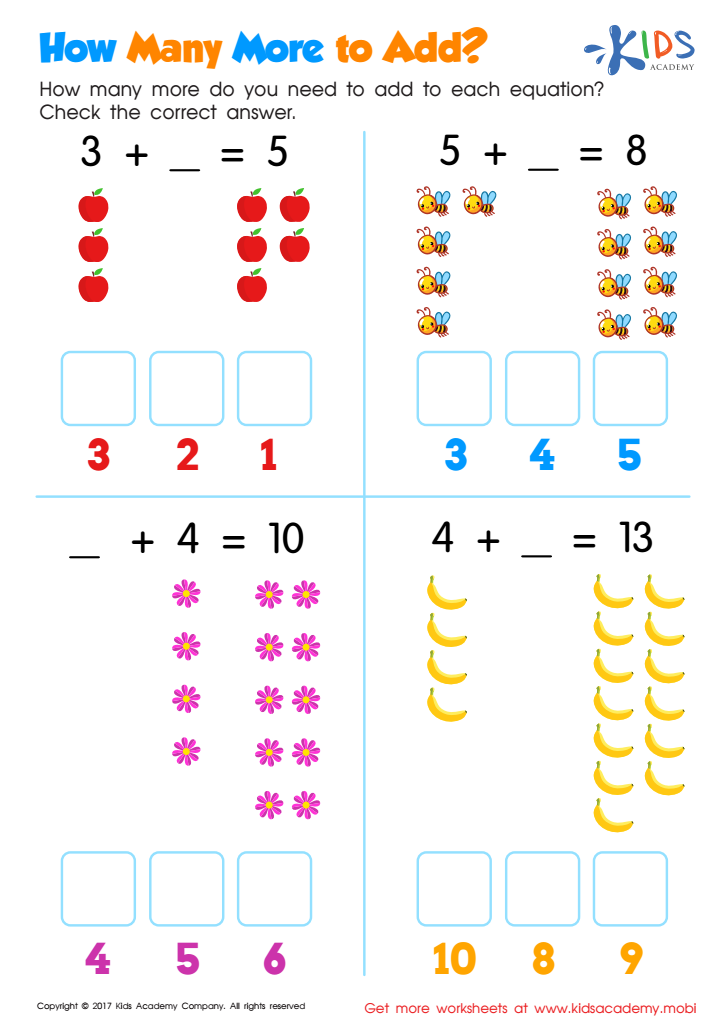
How Many More to Add Worksheet
Sharpen your child's math skills with this pdf worksheet. Help them figure out how many apples, bees, flowers and bananas are needed to reach the answer given. The possible answers are provided at the bottom of the boxes. Have some fun doing some addition and subtraction magic together and get those math skills sharpened!
 Assign to My Students
How Many More to Add Worksheet
Worksheet
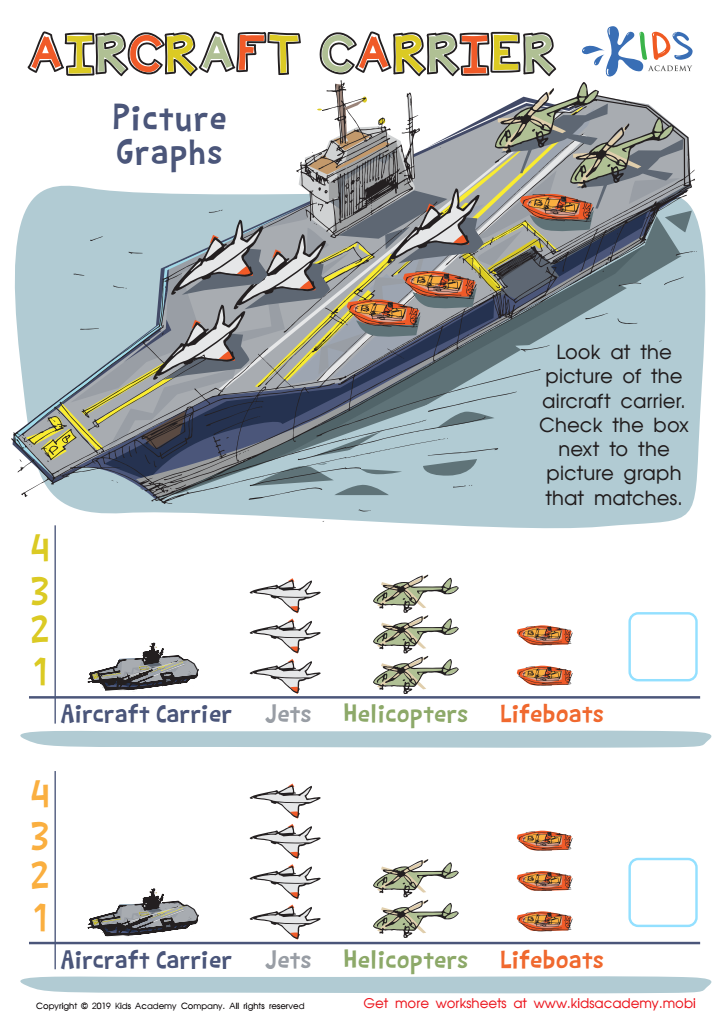
Aircraft Carrier Picture Graphs Worksheet
Kids love learning about jets and boats with this awesome worksheet! It's a great way to engage them as they work on picture graphs. Representing numerical values with pictures, this free PDF requires them to choose which picture graph and representation best match the carrier in the picture. It's also great practice for visual discrimination!
Aircraft Carrier Picture Graphs Worksheet
Worksheet
Join Kids Academy for Free
Who is primarily going to use this learning content?








Comparison skills in addition are vital for children aged 3-8 as they provide a foundational understanding of mathematics and foster critical cognitive abilities. At this young age, children are naturally curious and eager to understand how quantities relate to one another. Teaching them to compare numbers helps enhance their counting skills, number sense, and the ability to recognize patterns.
Parents and teachers should care about these skills because they play a crucial role in building confidence in problem-solving. Engaging children in activities that involve comparing numbers—such as using everyday objects or interactive games—makes learning fun and relatable. These comparisons can help children grasp the concepts of "more than," "less than," and "equal," leading to significant improvements in their arithmetic capabilities.
Moreover, developing comparison skills aids in critical thinking and logical reasoning. As children learn to evaluate numbers, they're not just memorizing; they're creating mental connections that contribute to their overall mathematical competence. Additionally, strong early mathematical skills are linked to academic success later on. Thus, fostering comparison skills is an investment in a child's educational journey, equipping them with the tools they need for future learning challenges.








