
Identifying Animals Addition Worksheets for Ages 3-8
5 filtered results
Difficulty Level
Grade
Age
-
From - To
Subject
Activity
Standards
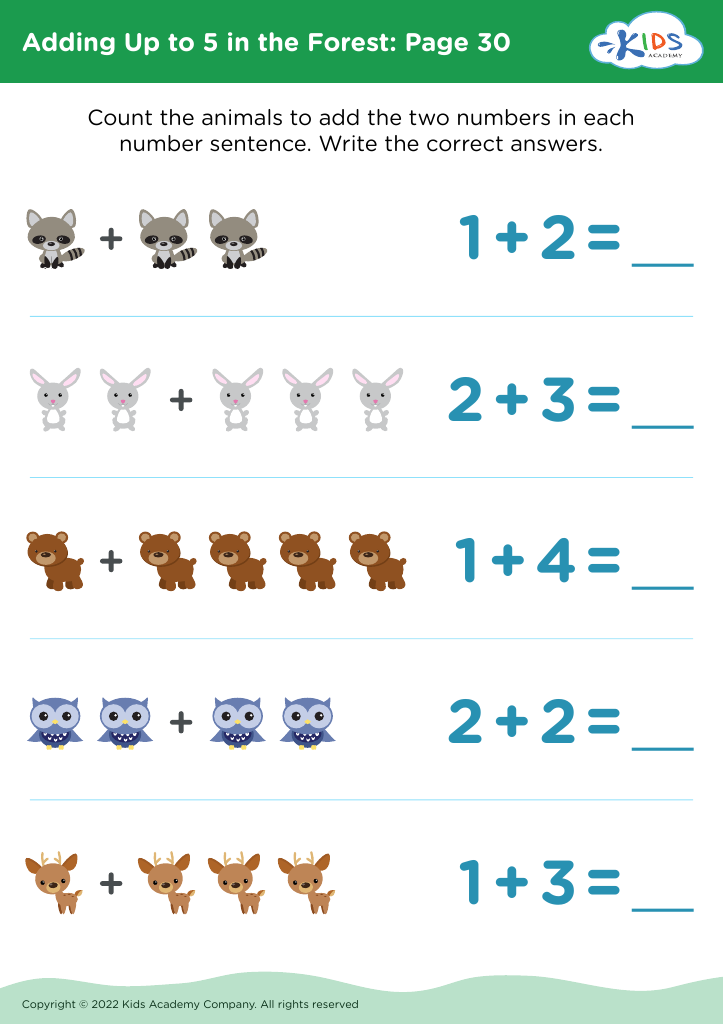
Discover our engaging "Identifying Animals Addition Worksheets" designed specifically for children aged 3-8! These fun and interactive worksheets seamlessly combine early math skills with the exciting world of animals, making learning enjoyable. Your little ones will effortlessly practice addition through colorful illustrations and simple exercises that capture their attention. As children identify various animals in the worksheets, they develop counting skills, improve their number recognition, and enhance their critical thinking. Perfect for at-home learning or classroom activities, these valuable resources will inspire young learners and foster a love for math while nurturing their curiosity about the animal kingdom.
Favorites
With answer key
Interactive
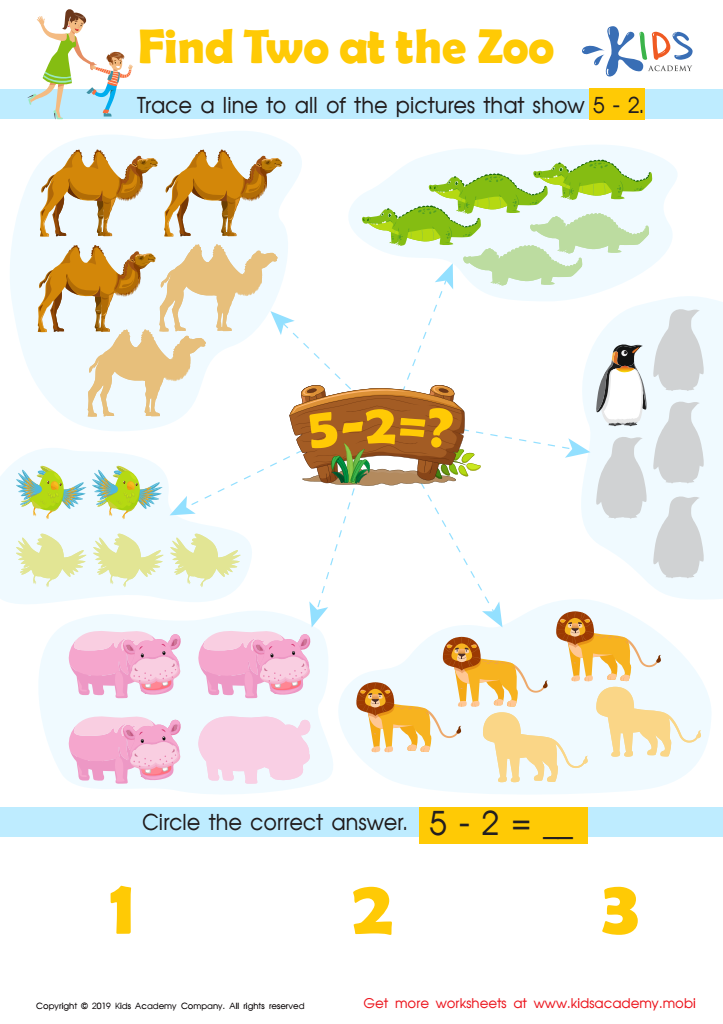
Find Two at the Zoo Worksheet
Help your kids overcome math fears and practice subtracting numbers with this traceable PDF. Ask them to identify the 6 groups of animals in the picture and count the animals in each group. Then, help them trace a line to all of the pictures that illustrate the equation 5-2.
 Assign to My Students
Find Two at the Zoo Worksheet
Worksheet
Join Kids Academy for Free
Who is primarily going to use this learning content?








Identifying animals through addition is a fundamental learning activity for young children aged 3-8, fostering both cognitive and emotional development. Engaging with animal-themed addition not only makes math captivating but also links it to the natural world, helping children to relate their learning to everyday life.
For parents and teachers, this activity promotes early numeracy skills, setting a solid foundation for future mathematical understanding. By combining math with animals, children enhance their observational skills as they learn to categorize and compare different species. This form of learning encourages curiosity and exploration, fostering a love for both math and science.
Additionally, identifying animals during activities provides an opportunity to discuss diverse habitats and ecosystems, enriching children's knowledge about the world around them. It can also open discussions on important topics such as conservation and the value of biodiversity.
Moreover, when children succeed in solving addition problems using relatable contexts like animals, it boosts their confidence and motivation to learn. Thus, incorporating animal-themed addition into educational activities can significantly enhance a child's overall development, making it an essential focus for both parents and educators.








