Enhance your child's mathematical prowess with our engaging Mental Math Skills Addition Worksheets tailored for ages 3-8. These fun and interactive worksheets help young learners develop essential addition skills through visual aids, games, and hands-on activities. Designed to build confidence and fluency in math, our resources encourage quick thinking and problem-solving. Ideal for at-home practice or classroom use, these worksheets cater to different learning styles, ensuring every child can grasp mathematical concepts with ease. Spark a love for learning and make math enjoyable for your little ones with our carefully crafted materials that lay the foundation for future success!

Check out this FREE Trial Lesson on Addition for age 3-8!

Standard Subtraction

Favorites
With answer key
Interactive
  • 3-8
  • Mental math skills
  • Addition
Subtracting with Regrouping: Magnetism Worksheet

Subtracting with Regrouping: Magnetism Worksheet

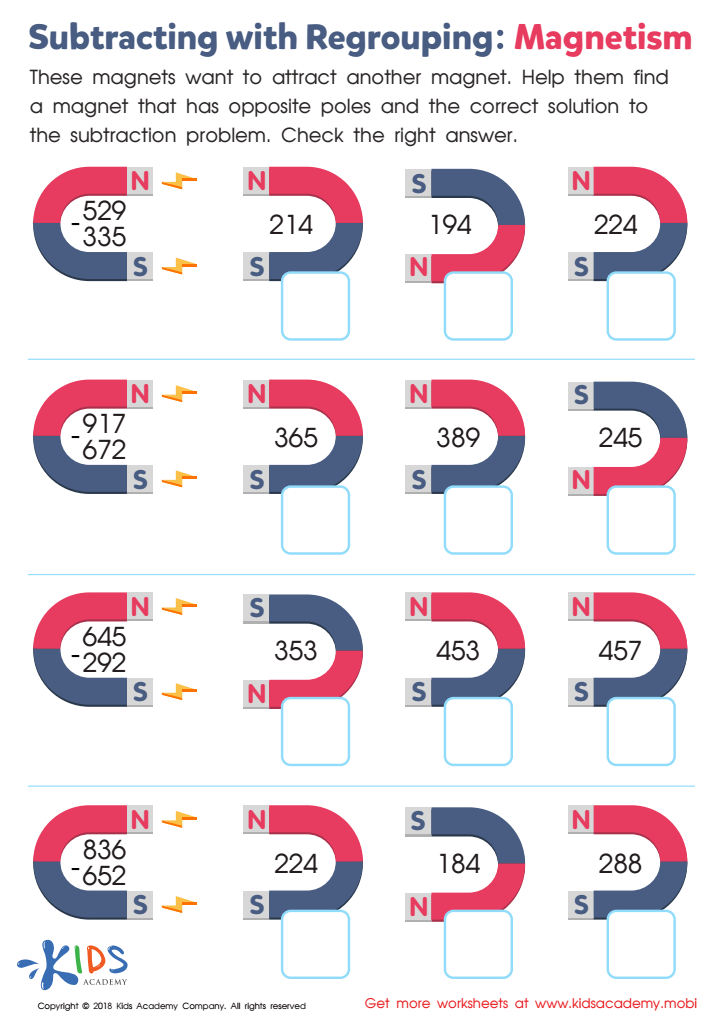
Download Kids Academy's worksheet for a fun way to review science and math! Look at the magnet and remember opposites attract. Find another with opposite poles, then solve the problem on the left and check the solution against the magnet. Check the box next to the correct answer to complete this page.
Subtracting with Regrouping: Magnetism Worksheet
Worksheet
Air Balloon Math Worksheet

Air Balloon Math Worksheet

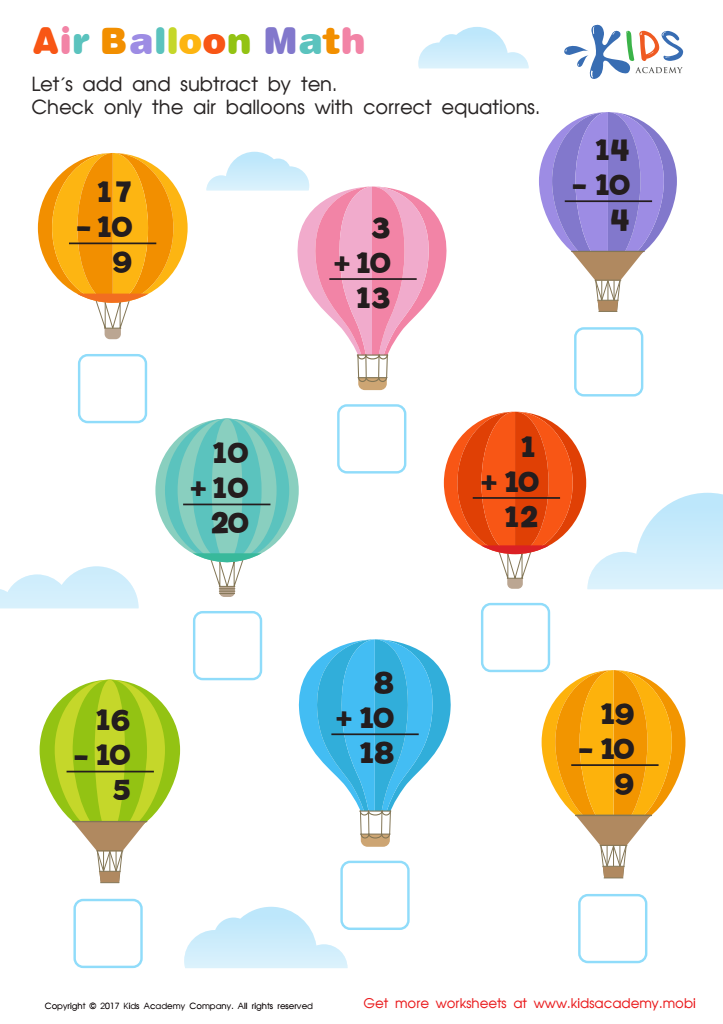
Revised: Review your child's addition and subtraction skills with this fun worksheet. Featuring hot air balloons filled with math equations, help your child add or subtract by ten before ticking the boxes with the right answers. Working through the equations one-by-one is a great way to make math practice enjoyable!
Air Balloon Math Worksheet
Worksheet
Sums and Differences Within 1 - Assessment 1 Worksheet

Sums and Differences Within 1 - Assessment 1 Worksheet

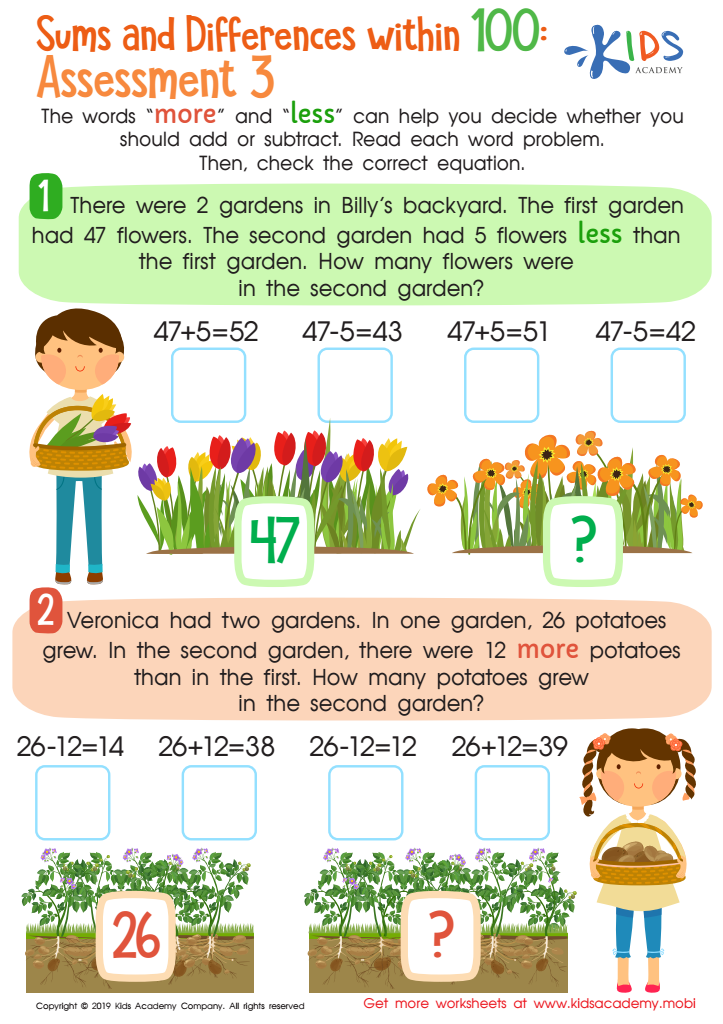
Help your child understand school topics better with your assistance. For math, go over their worksheet together and discuss the instructions and text. Solve the questions and check the right equation. This will take their learning to the next level.
Sums and Differences Within 1 - Assessment 1 Worksheet
Worksheet
Addition Facts: Double Dice Worksheet

Addition Facts: Double Dice Worksheet

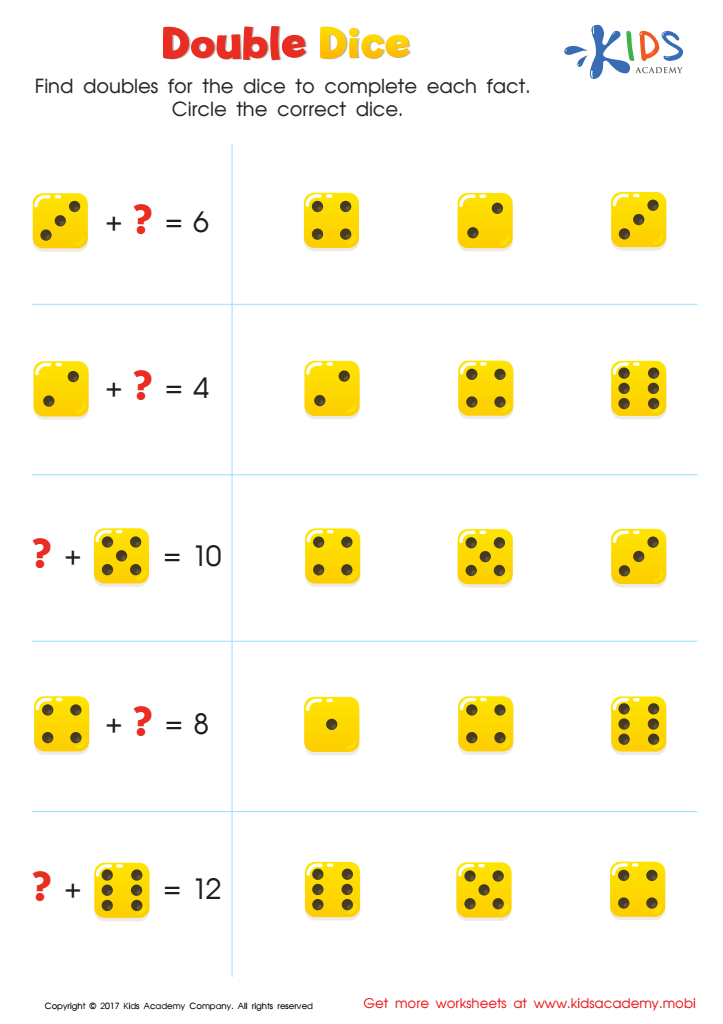
Are you looking for ways to make maths more engaging for kids? Maths can be a bore, but by teaching kids from an early age that it can be fun, they won't struggle with it. This worksheet is a great way to start: your child needs to identify the number on the left dice and find its double on the right. The sum of the two dice is also given.
Addition Facts: Double Dice Worksheet
Worksheet
Friendly Doubles Worksheet

Friendly Doubles Worksheet

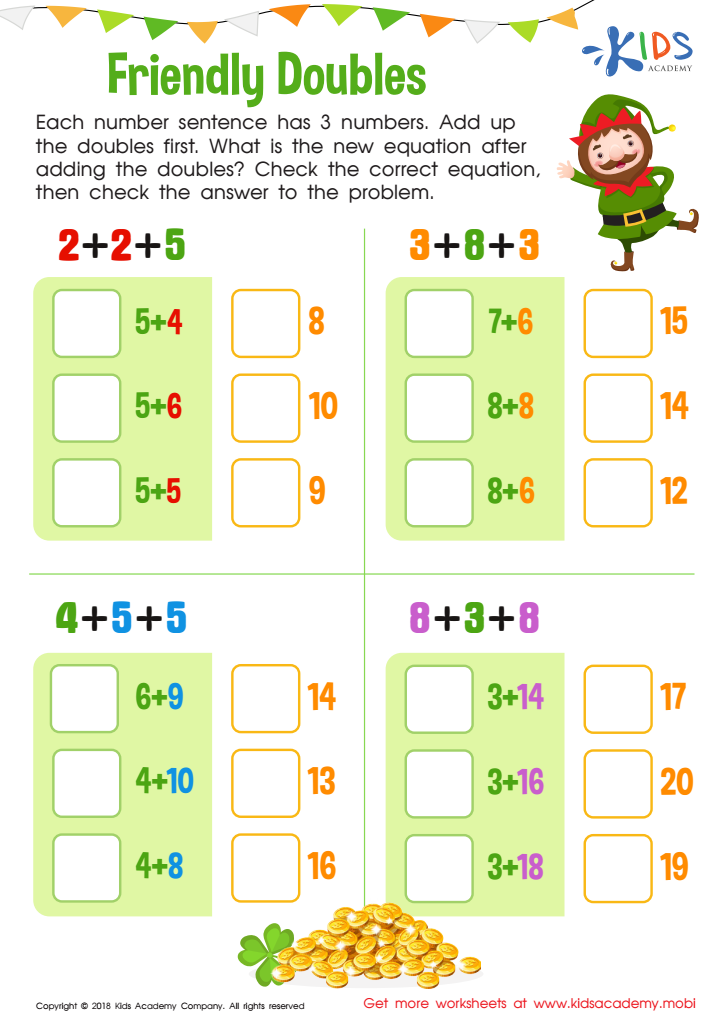
Kids will love this animated worksheet with bright colors! It helps them learn how to use doubles facts to answer three addend addition problems. It boosts their math skills, making computation easier, faster and more efficient. It also assists with adding and subtracting larger numbers. Let the power of doubles get them started!
Friendly Doubles Worksheet
Worksheet
Boomerang Addition Worksheet

Boomerang Addition Worksheet

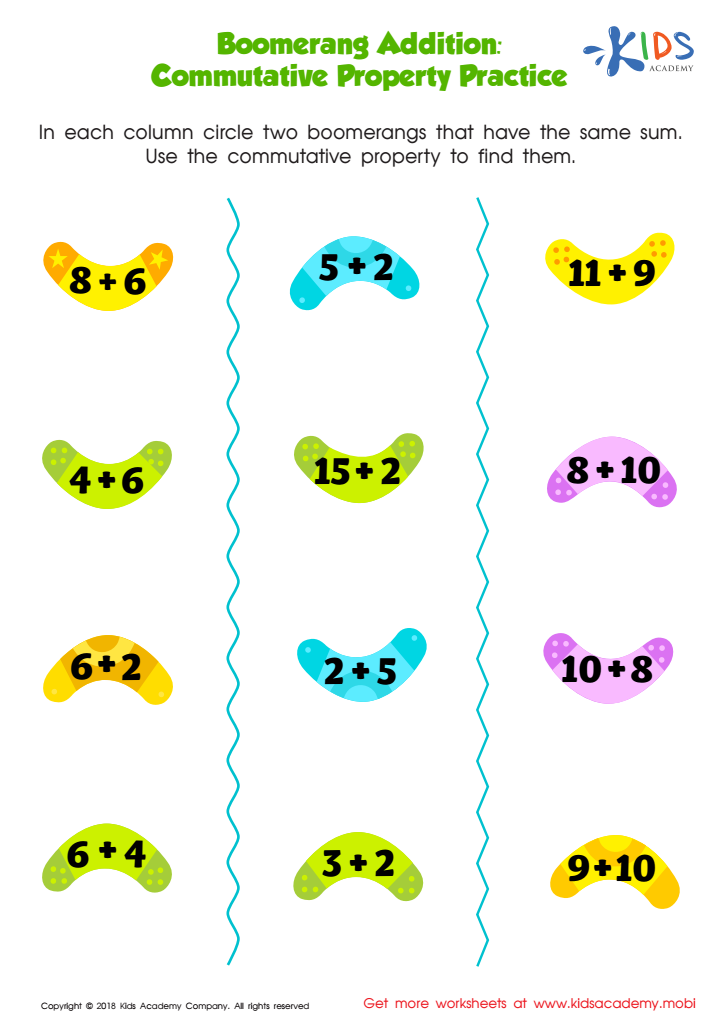
Kids know that when a boomerang is thrown, it reverses its path back. The same goes for addition: numbers can be rearranged and the sum will remain the same. Use this worksheet to find matching pairs of colorful boomerangs and equations. Look through each column and use the commutative property to find the pairs with the same sum.
Boomerang Addition Worksheet
Worksheet
Adding up to 100 Without Regrouping: Page 14
Worksheet


Mental math skills, particularly in addition for ages 3-8, play a fundamental role in a child's cognitive development and overall academic success. Developing mental math abilities fosters early numerical understanding and boosts confidence in handling numbers without reliance on calculators or tools. For young children, mastering addition mentally not only lays the groundwork for more complex mathematical concepts but also enhances critical thinking and problem-solving abilities—a necessity in today’s ever-evolving world.

Moreover, early proficiency in mental math fosters a positive attitude toward math, reducing anxiety and fostering engagement with the subject. This foundation can encourage a lifelong love for mathematics, crucial in later educational stages. Parents and teachers can support mental math skills by integrating playful activities, games, and everyday situations where addition is applicable. This approach makes learning enjoyable and meaningful, bridging the gap between education and real-life application.

Additionally, in our increasingly competitive educational environment, strong mental math skills can provide children with an edge, promoting better academic performances and opportunities for future learning. Ultimately, prioritizing mental math for young learners ensures they approach mathematics not just as a subject, but as an exciting adventure of exploration and discovery.