
Money identification Math Worksheets for Ages 3-8
4 filtered results
Difficulty Level
Grade
Age
-
From - To
Subject
Activity
Standards
Introducing our "Money Identification Math Worksheets for Ages 3-8", designed to make learning about money fun and engaging for young minds. These printable worksheets from Kids Academy help children identify and differentiate between coins and bills, hone their counting skills, and understand the value of money. Perfectly suited for classroom or at-home learning, our worksheets feature colorful, hands-on activities that cater to children’s varying skill levels. Foster financial literacy from a young age with these educational tools that build a solid foundation in math and practical life skills. Start your child's money-wise journey today!
Favorites
With answer key
Interactive
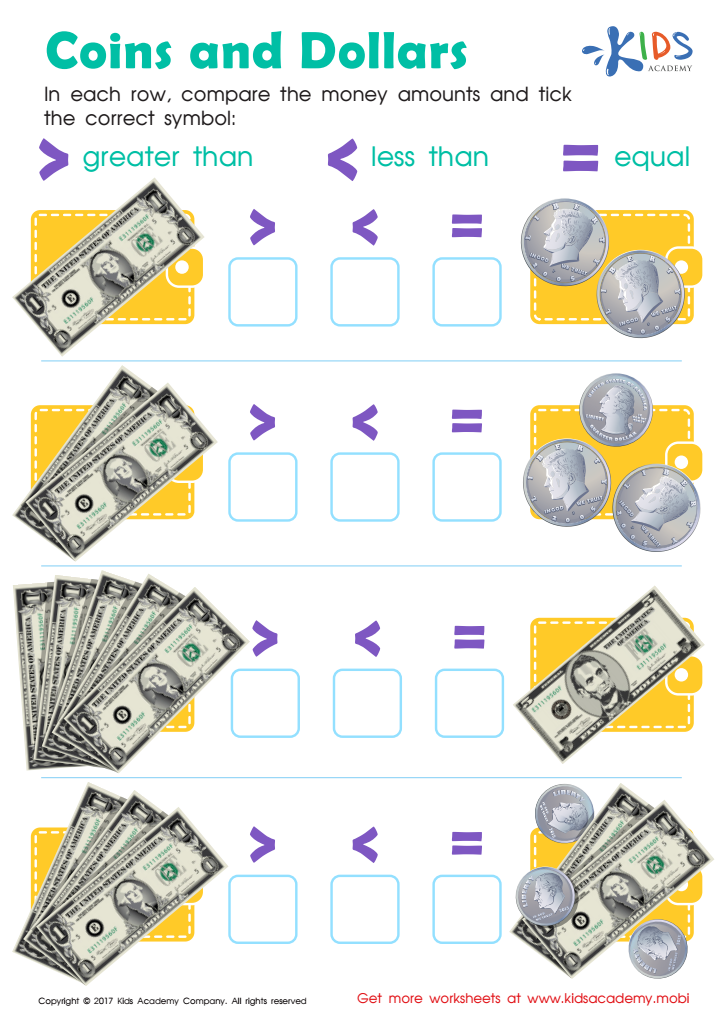
Money: Coins Dollars Printable
Motivate your kid to learn and practise essential math skills, like 'greater than' and 'less than', by introducing the importance of money! The money worksheet "Coins and Dollars" will give them a hands-on experience of counting coins and dollars, making math symbols more memorable.
 Assign to My Students
Money: Coins Dollars Printable
Worksheet
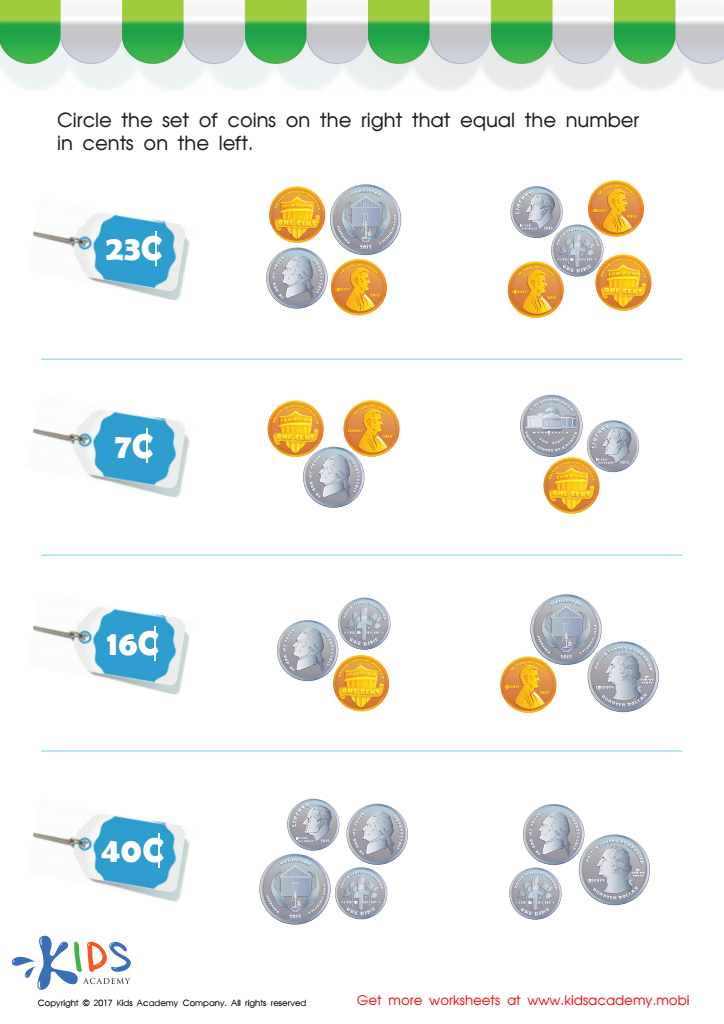
Picking the Coins You Need Money Worksheet
Let's learn to count money with Parents and Kids Academy! Investigate a real shop together: buy a globe, pencils, books, and a school bag using coins. Then, circle the coins you'll need. Visit our website for more free and fun money games for kids!
Picking the Coins You Need Money Worksheet
Worksheet
Join Kids Academy for Free
Who is primarily going to use this learning content?







.jpg)
Money identification and math skills for children aged 3-8 are crucial for several reasons. First, early familiarity with money terms like pennies, nickels, dimes, and quarters sets a foundational understanding of basic math concepts like addition, subtraction, and value comparison. Recognizing and counting money boosts number recognition and cognitive skills.
Additionally, it teaches important life skills. Knowing what money looks like, how to count it, and understanding its value helps children in real-life scenarios like buying a snack or understanding savings. This creates a basis for financial literacy, fostering responsible money management from a young age.
Language and social skills also benefit from money identification exercises. Interactive activities, such as role-playing in a ‘store’ setting, engage kids in conversations and cooperative play, essential for their overall development.
Parents and teachers thus ensure that children grow into financially literate and confident individuals by focusing on these skills early. Besides educational accomplishments, identifying money early also encourages critical thinking, problem-solving, and attentiveness. Overall, early engagement with money concepts shapes well-rounded, mathematically adept individuals prepared to navigate future financial responsibilities and academic challenges effectively.








