
Numerical reasoning Math Worksheets for Ages 3-8
3 filtered results
Difficulty Level
Grade
Age
-
From - To
Subject
Activity
Standards
Discover our engaging Numerical Reasoning Math Worksheets designed for children ages 3 to 8! These worksheets help young learners develop essential math skills through fun and interactive activities. From counting and number recognition to basic addition and subtraction, our worksheets are tailored to enhance numerical reasoning in a playful way. Ideal for home or classroom use, they foster critical thinking and problem-solving abilities while providing a solid foundation in mathematics. Parents and teachers will find a variety of colorful, age-appropriate exercises that keep kids motivated and excited about learning. Start your child's mathematical journey today with our printable worksheets!
Favorites
With answer key
Interactive
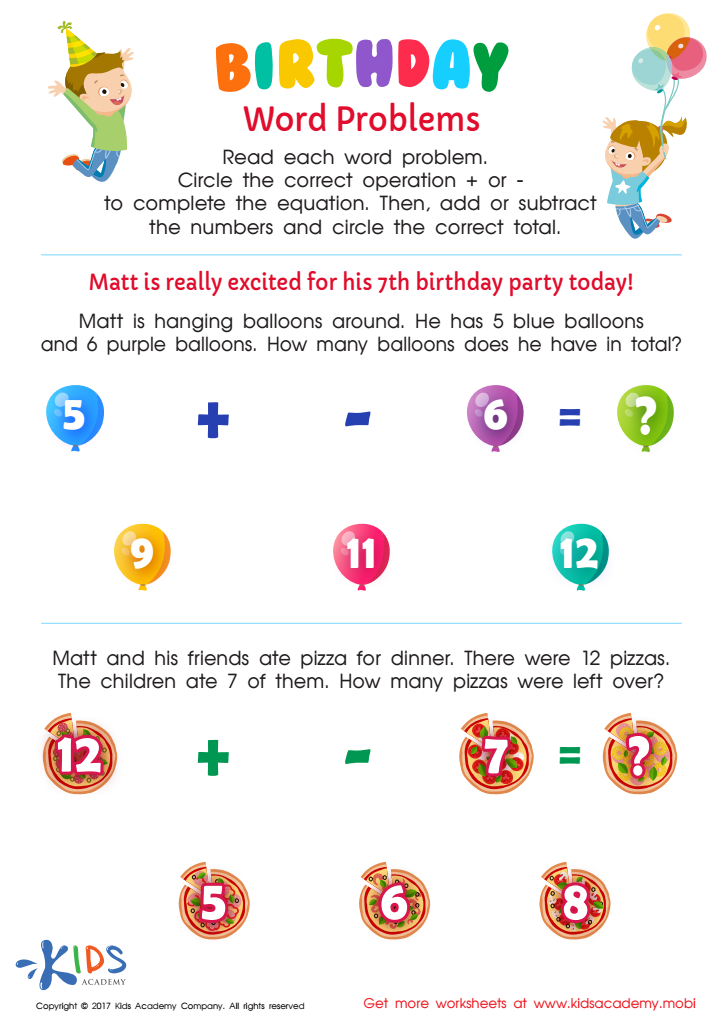
Birthday Word Problems Substraction Worksheet
This worksheet, Birthday Word Problems, is a great way to improve your child's math and literacy skills. It features tricky subtraction equations based on a birthday celebration - perfect for kids who love birthdays!
 Assign to My Students
Birthday Word Problems Substraction Worksheet
Worksheet
Join Kids Academy for Free
Who is primarily going to use this learning content?








Numerical reasoning, encompassing the ability to understand and work with numbers, is a crucial foundational skill for children aged 3-8. Parents and teachers should care about this aspect of math for several reasons.
Firstly, numerical reasoning fosters problem-solving abilities. Children learn to analyze situations, recognize patterns, and devise solutions, skills essential beyond mathematics and applicable in everyday life. Secondly, developing numerical reasoning boosts children’s confidence. Mastery of basic concepts leads to improved self-esteem as they engage with math, influencing their willingness to take on more complex challenges in the future.
Moreover, early mathematical understanding correlates with academic success later on. Research shows that a strong foundation in numeracy during the early years predicts future performance in mathematics and related subjects. Additionally, incorporating engaging, playful activities can make learning enjoyable, creating positive associations with math that last a lifetime.
Finally, with the increasing emphasis on STEM fields, equipping children with solid numerical reasoning sets them up for greater opportunities in education and careers. Encouraging curiosity about numbers and mathematical concepts isn't simply about math; it’s about nurturing thoughtful, capable learners prepared for the challenges of the future. It’s essential that both parents and teachers prioritize and support the development of these critical skills.








