Telling time Math Worksheets for Ages 3-8
4 filtered results
-
From - To
Discover a fun and interactive way to teach your young learners how to tell time with our Telling Time Math Worksheets for ages 3-8. These engaging worksheets are designed to help children master both analog and digital clocks, enhancing their understanding of hours and minutes. Each activity is tailored to develop essential time-telling skills through colorful visuals and stimulating exercises. Perfect for classroom or home learning, our worksheets enable children to gain confidence in managing time independently. Explore our diverse collection to support your child's mathematical journey, and make learning about time an enjoyable adventure! Start enhancing their skills today!
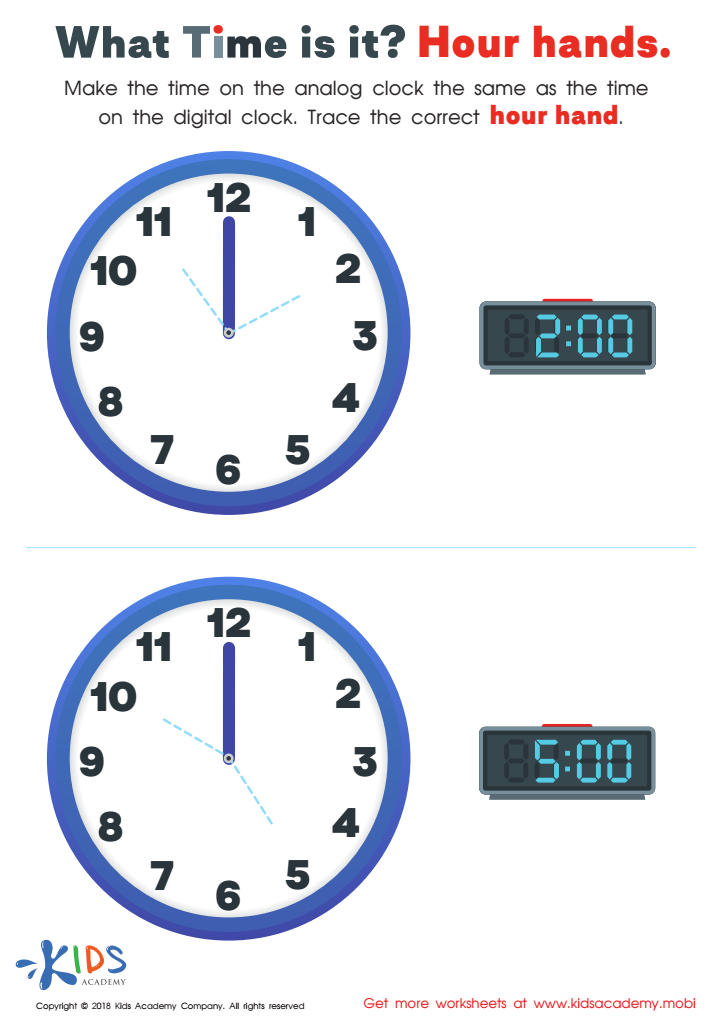
What Time Is it? Hour Hands Worksheet
 Assign to My Students





Teaching young children how to tell time is an essential skill that goes beyond just reading numbers on a clock. For ages 3-8, fostering an understanding of time helps in various developmental areas. Firstly, it enhances math skills as children begin to grasp the concepts of numbers, counting, and relationships between them. Through learning to tell time, children also improve their problem-solving abilities, learning to calculate durations and intervals, which are foundational math concepts.
Additionally, understanding time is crucial for daily routines and improving self-regulation. It helps children learn the importance of schedules. Knowing when it’s time for activities like meals, play, or sleeping encourages independence and responsibility, vital traits for their growth.
Moreover, teaching time cultivates social skills. Children begin to converse about plans and use time in their interactions, enhancing communication and cooperation with peers and adults. Finally, it builds an appreciation for the passage of time, helping them understand life events, transitions, and even holidays.
By investing time and effort in teaching children to tell time early on, parents and teachers are providing critical skills that shape a child’s mathematical reasoning, organizational habits, and social interactions for years to come.








