Understanding adjectives Math Worksheets for Ages 3-8
6 filtered results
-
From - To
Explore our engaging "Understanding Adjectives" math worksheets designed for children ages 3-8. These resources are crafted to help young learners identify and comprehend adjectives through fun and interactive activities that blend math and language skills. Our worksheets feature colorful illustrations and easy-to-follow instructions, making learning enjoyable and effective. As children progress through various exercises, they will enhance their vocabulary, improve their descriptive skills, and apply their understanding in everyday contexts. Perfect for both classroom and at-home learning, these worksheets support early literacy and math development, setting a strong foundation for future academic success. Start your child's learning adventure today!
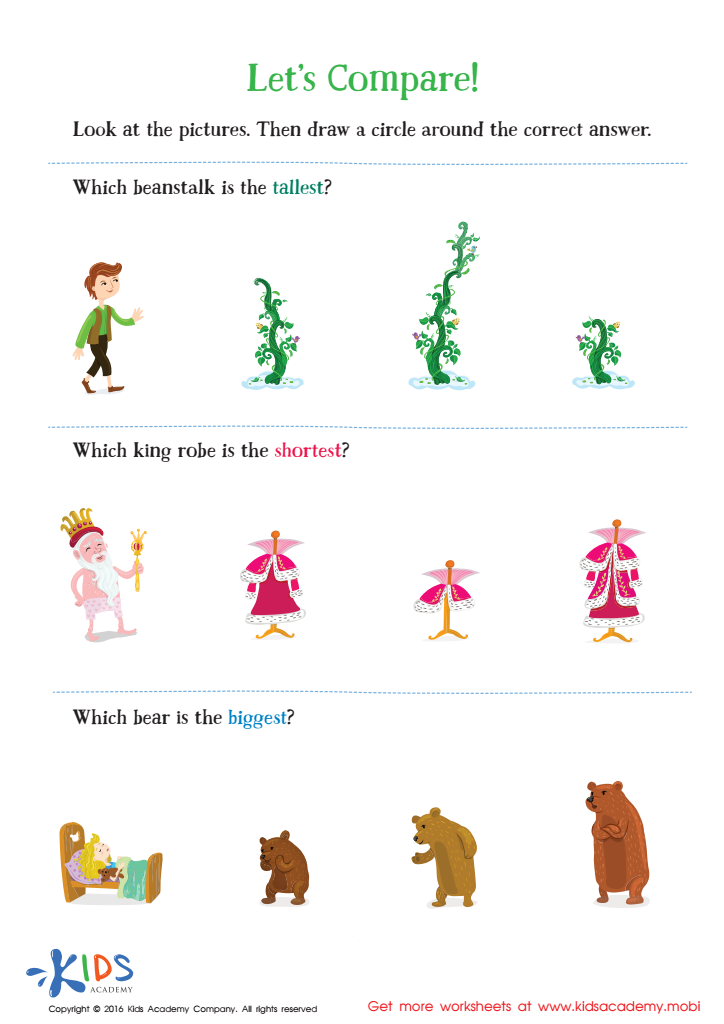
Fairy Tale Worksheet: Let's Compare
 Assign to My Students








Understanding adjectives in math can significantly enhance early learners' educational experiences for several reasons. First, adjectives help describe quantities, sizes, shapes, and more, enriching children's vocabulary and aiding comprehension. For instance, when teaching concepts like "more" or "less," adjectives such as "big," "small," "tall," and "short" provide relatable contexts that make numbers more tangible and meaningful.
Moreover, integrating adjectives into math helps bridge connections between language and mathematical thinking. Children from ages 3 to 8 are developing cognitive skills, and introducing descriptors can foster critical thinking. Describing two groups of objects with adjectives helps learners engage in comparisons and classifications, skills crucial for understanding math concepts like measurement and addition.
Additionally, using adjectives can make learning more engaging and interactive. Teachers and parents can encourage imaginative play around math activities—such as counting colorful blocks while describing their sizes or colors—making the process enjoyable. Incorporating descriptive language into mathematical discussions creates a supportive learning environment, encouraging curiosity and exploration.
Ultimately, understanding adjectives in math not only aids foundational skills but also lays the groundwork for effective communication in mathematical contexts, fostering a love for both language and numbers at an early age.








