Categorization skills World Around Us Worksheets for Ages 3-8
3 filtered results
-
From - To
Enhance your child's understanding of the world with our "Categorization Skills: World Around Us Worksheets" designed for ages 3-8. These engaging worksheets help young learners develop critical thinking and organization skills by classifying items into meaningful groups. Covering various themes related to their immediate environment, these activities foster curiosity and encourage exploration. From sorting animals to grouping everyday objects, your child will enjoy hands-on experiences that promote cognitive development. With colorful designs and age-appropriate tasks, these worksheets make learning fun and interactive. Equip your child with essential categorization skills needed to navigate their world confidently! Ideal for parents and educators alike.
 Assign to My Students
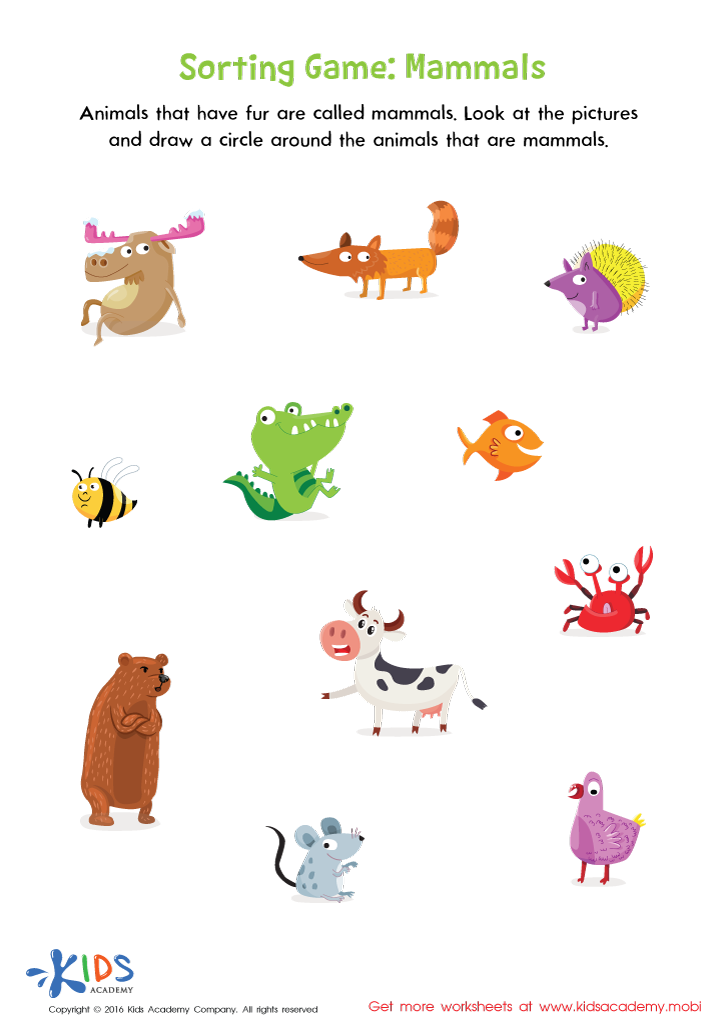
Mammals Sorting Worksheet

Identifying Living or Non–living Worksheet








Categorization skills are vital for children aged 3-8 as they form the foundation for critical thinking and problem-solving abilities. Developing these skills enables young learners to sort and classify objects, ideas, and experiences, fostering cognitive growth essential for understanding the world around them.
When children categorize, they learn to identify similarities and differences, which enhances their observational skills and encourages logical reasoning. For instance, when sorting animals by habitat, children engage with concepts of biology and ecology while building vocabulary and comprehension. This process of categorization also supports creativity, as children explore various ways to group items, sparking imaginative thinking.
Additionally, categorization promotes social development through collaboration. Activities such as group sorting allow children to share thoughts and experiences, encouraging communication and teamwork. Moreover, in a structured environment, skills acquired through categorization lead to improved academic performance in math and science, where sorting and classifying concepts are commonly used.
For parents and teachers, nurturing categorization skills means helping children develop a strong cognitive framework, preparing them for more abstract concepts later in their education. Therefore, investing time in enhancing these skills promotes holistic child development every step of the way.