
Number comparison skills Worksheets for Ages 3-9
3 filtered results
Difficulty Level
Grade
Age
-
From - To
Subject
Activity
Standards
Enhance your child's number comparison skills with our engaging worksheets designed for ages 3-9! These expertly crafted materials provide a fun and interactive way to help young learners understand concepts such as greater than, less than, and equal to. Our worksheets include colorful visuals and relatable examples, making it easy for children to grasp these essential math skills. Perfect for homeschooling or classroom use, these resources promote critical thinking and early numeracy. Dive into our collection today and give your child the confidence to excel in math as they explore and master number comparisons! Suitable for varying skill levels.
Favorites
With answer key
Interactive
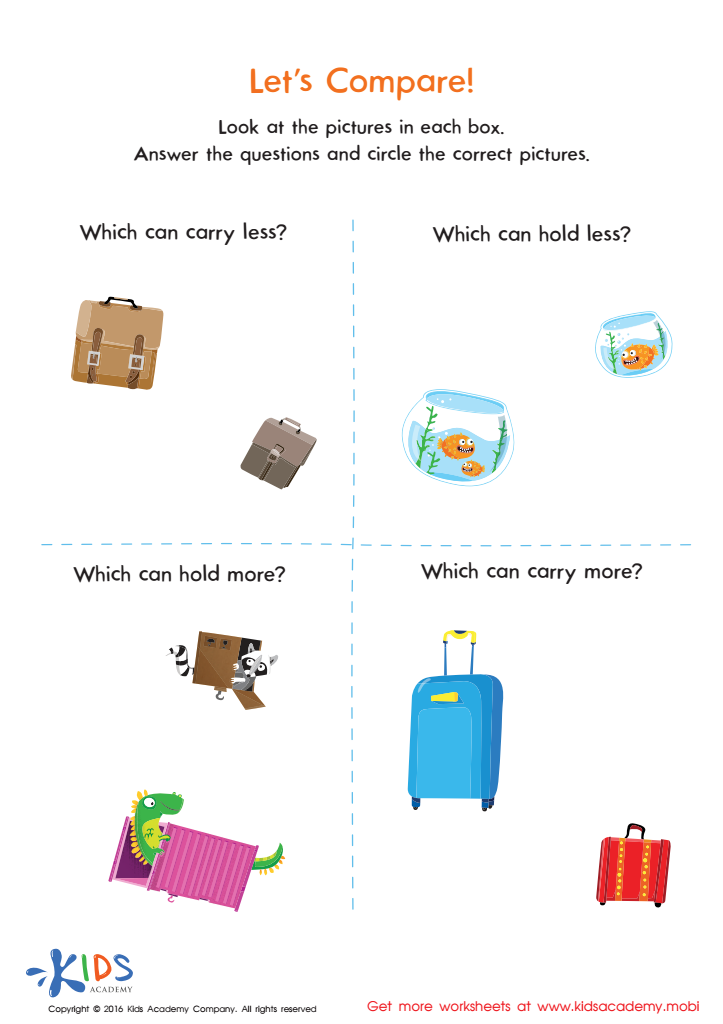
Let's Compare Worksheet: Big or Small
This worksheet will help your child gain an awareness of simple geometry and strengthen cognitive skills. Visualizing objects in 3D and comparing sizes helps to practice solving problems mentally and build analytical skills. Let's Compare worksheet will challenge your child to think hard.
 Assign to My Students
Let's Compare Worksheet: Big or Small
Worksheet
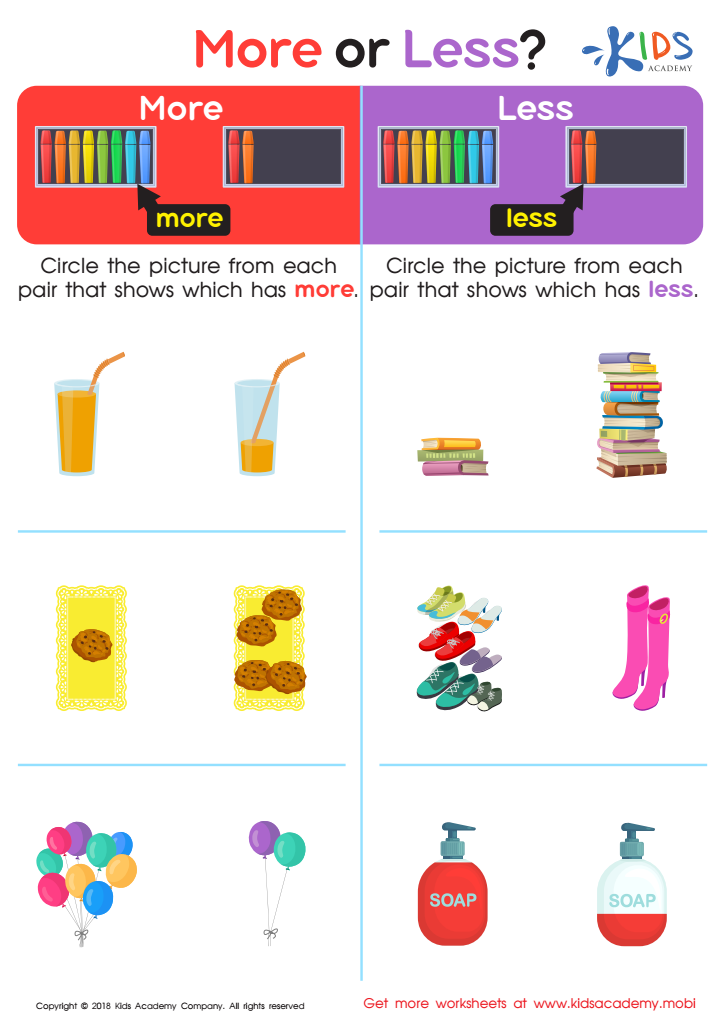
More or Less? Worksheet
Understanding "more or less" can be hard for kids. This PDF uses colorful images to help them learn. By matching the right picture pairs, children can gain a better understanding and strengthen their comparison skills for more complex tasks.
More or Less? Worksheet
Worksheet
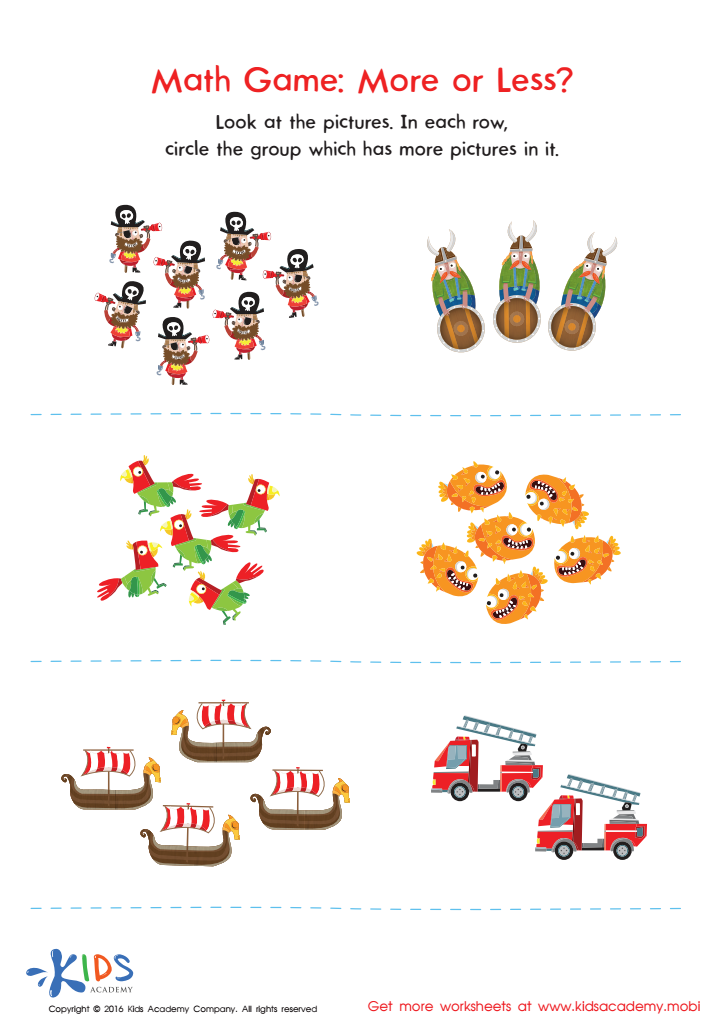
More or Less Worksheet
Counting and understanding quantity are essential skills for kindergarteners. Get your free printable more or less worksheet now!
More or Less Worksheet
Worksheet
Join Kids Academy for Free
Who is primarily going to use this learning content?






Number comparison skills are critical for children aged 3 to 9 as they lay the foundation for mathematical understanding and overall cognitive development. These skills enable young learners to discern differences and similarities between quantities, fostering essential reasoning and problem-solving abilities. By mastering number comparisons, children enhance their ability to understand broader mathematical concepts, such as addition and subtraction.
Additionally, strong number comparison skills promote confidence in academic settings. When children can accurately compare numbers, they feel more competent, leading to greater engagement and a positive attitude towards learning. Early proficiency in these skills can also predict later success in mathematics, as research shows that foundational number sense is crucial for more complex mathematical tasks.
Parents and teachers play a pivotal role in nurturing these abilities. Engaging children in fun activities that promote number comparison, such as using visual aids or interactive games, can make learning enjoyable and effective. Emphasizing number comparison helps children develop not only mathematical skills but also critical thinking skills that are valuable across disciplines and in everyday life. Thus, supporting number comparison development is essential for ensuring children build a solid mathematical foundation and cultivate a lifelong love for learning.








