
Understanding commutative property Worksheets for Ages 3-9
4 filtered results
Difficulty Level
Grade
Age
-
From - To
Subject
Activity
Standards
Explore our engaging "Understanding Commutative Property Worksheets" designed for children ages 3-9! These worksheets provide a fun and interactive way for young learners to grasp the essential concept that the order of numbers in addition and multiplication does not affect the sum or product. With colorful illustrations and practical exercises, kids will discover the commutative property through enjoyable activities, enhancing their mathematical skills and confidence. Perfect for at-home learning or classroom use, these worksheets cater to various learning styles, making math accessible and enjoyable. Start your child’s arithmetic journey today with our resources that empower early learners to thrive!
Favorites
With answer key
Interactive
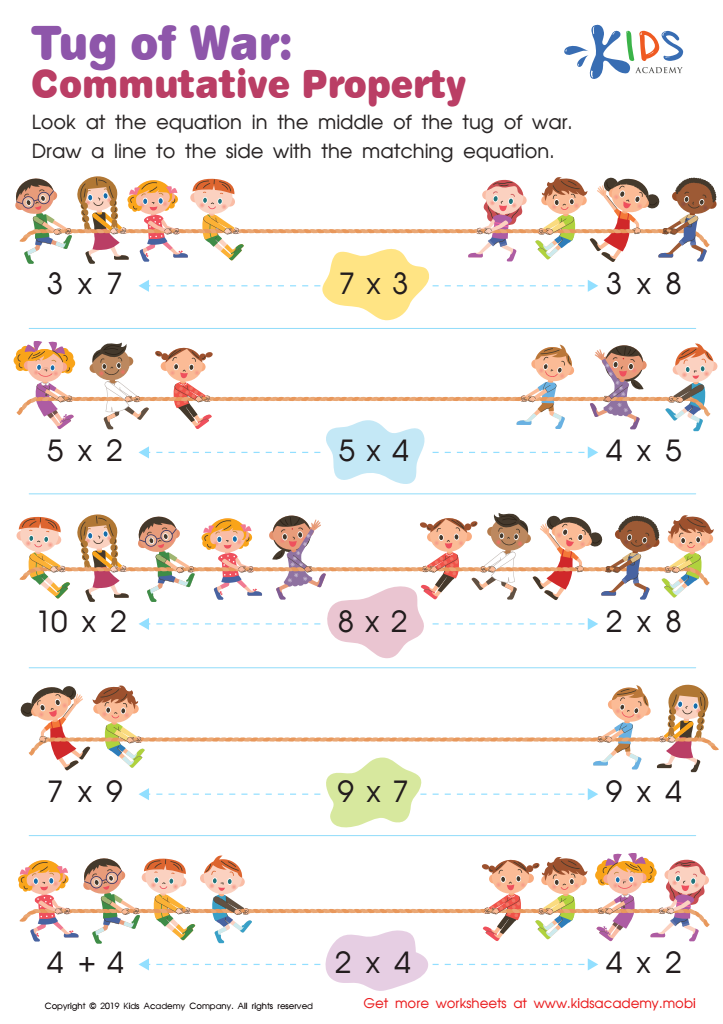
Tug of War: Commutative Property Worksheet
Tug of war is a great game to teach your child simple math. Explain the commutative property--it states that the product remains the same regardless of the order of factors. Use the equations in the middle of the worksheet and have your child draw a line to the corresponding equation. It's a fun and easy way to learn math.
 Assign to My Students
Tug of War: Commutative Property Worksheet
Worksheet
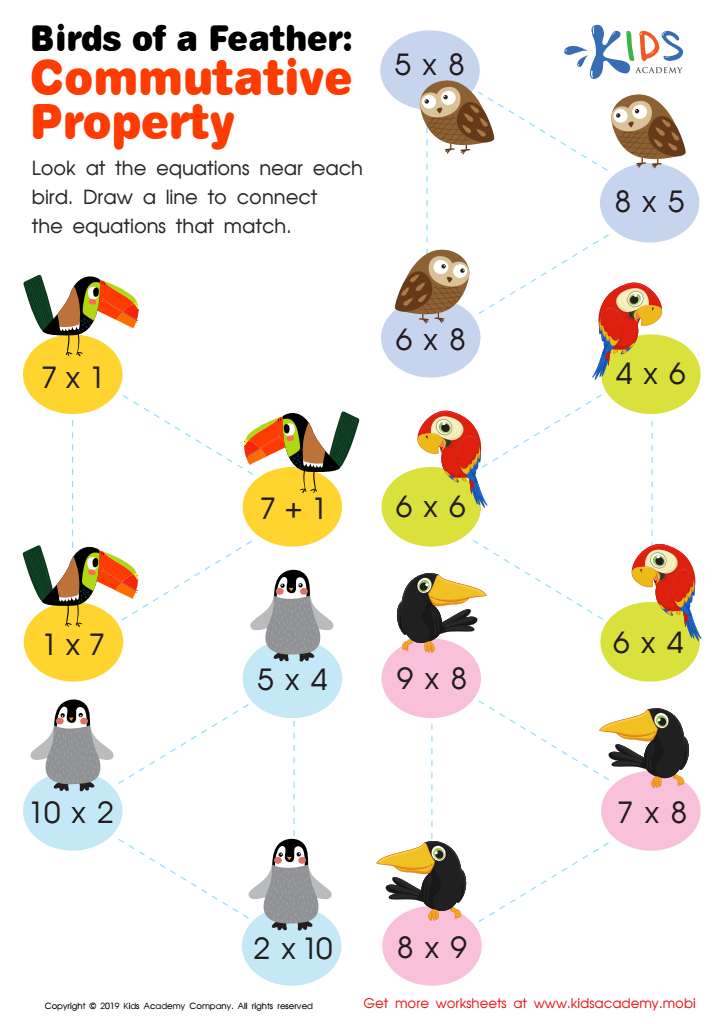
Birds of a Feather: Commutative Property Worksheet
The commutative property states that order of factors doesn't affect the product. Use it to help your kids solve simple problems. If they love birds, they'll love the colorful worksheet to identify exotic ones. Practicing is the best way to understand difficult topics. Look at the equations in this tracing sheet; help them draw a line to connect equations that match.
Birds of a Feather: Commutative Property Worksheet
Worksheet
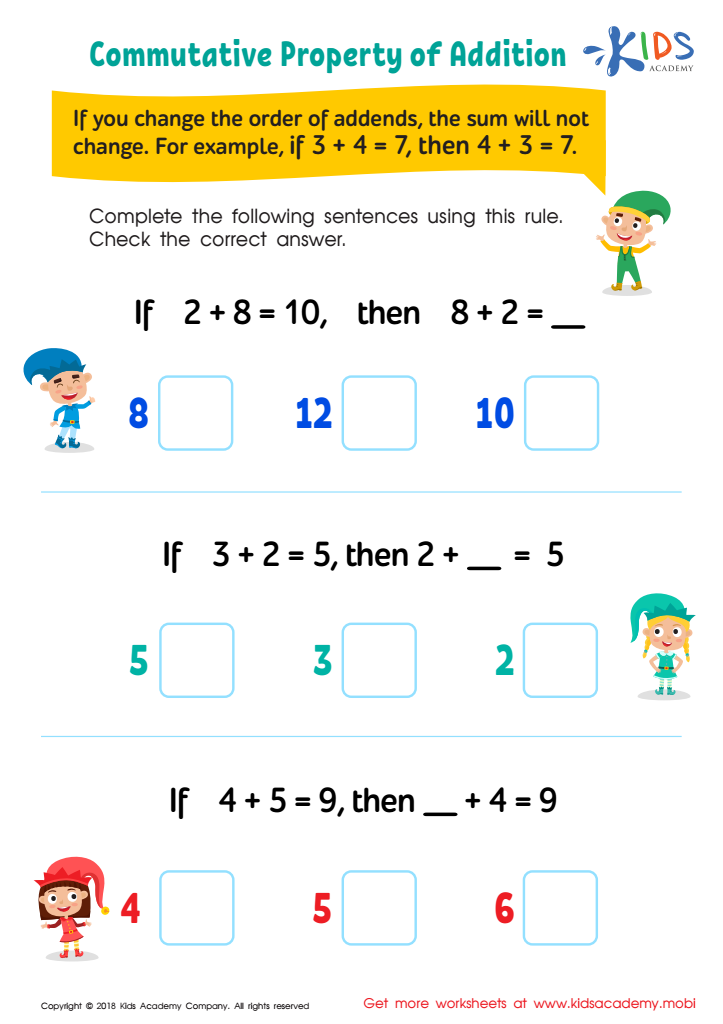
Commutative Property of Addition Worksheet
Master the commutative property of addition with Kids Academy's worksheet! Kids will have fun with silly elves as they complete the rows, switching or adding the addends. Observe that the sum stays the same no matter the order of the numbers!
Commutative Property of Addition Worksheet
Worksheet
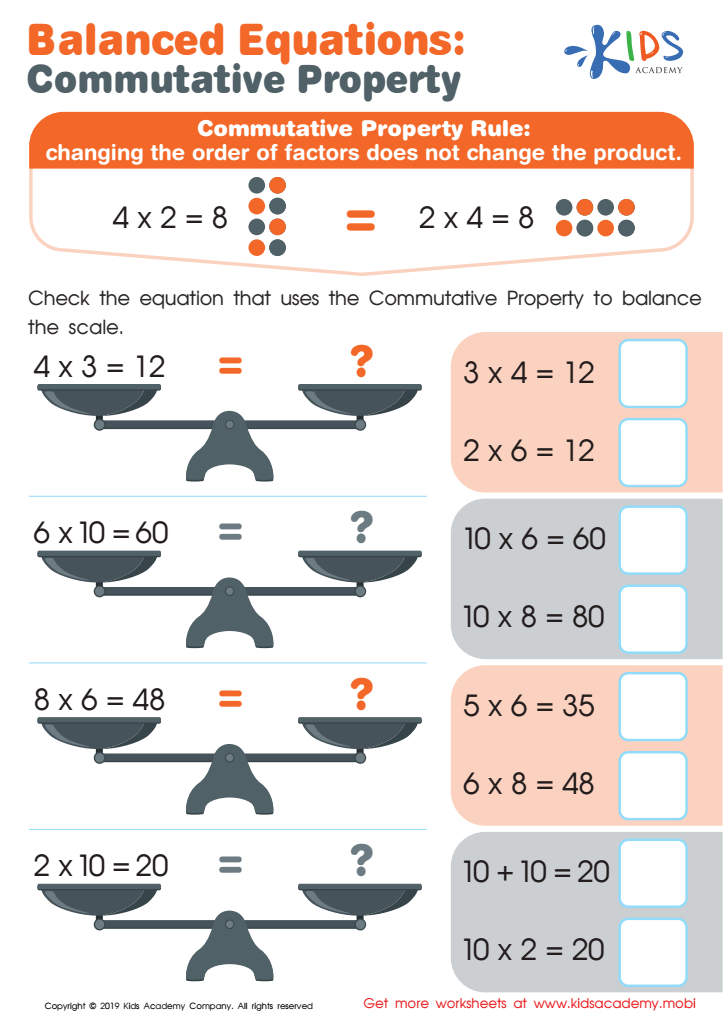
Balanced Equations: Commutative Property Worksheet
Math can be tough, causing a lot of stress. Remind kids that even adults struggle with it - learning never ends. Help kids with math stress or difficulty understanding equations with this worksheet. Explain the commutative property: changing order of factors doesn't change the product. Use the problems on the worksheet to guide them.
Balanced Equations: Commutative Property Worksheet
Worksheet
Join Kids Academy for Free
Who is primarily going to use this learning content?




.jpg)



Understanding the commutative property is crucial for children aged 3-9 as it lays the groundwork for their future mathematical abilities. The commutative property states that the order of adding or multiplying numbers does not affect the outcome, meaning that 3 + 5 is the same as 5 + 3. Recognizing this concept enhances children's number sense and problem-solving skills, making math more accessible and less intimidating.
For young learners, grasping this property promotes flexibility in thinking, as they realize there are multiple ways to approach and solve math problems. This understanding supports the development of addition and multiplication fluency, engaging children in various strategies that foster critical thinking. Parents and teachers can use playful activities to reinforce this concept, showing through games or manipulatives that numbers can be rearranged to achieve the same result.
Moreover, early mastery of such foundational concepts boosts confidence in math, crucial for their overall educational journey. When parents and teachers actively emphasize understanding properties like commutativity, they cultivate not only mathematical competence but also a love for learning, nurturing future problem solvers who see math as a versatile tool rather than a rigid set of rules. This holistic approach enriches children's analytical skills for their lifelong learning.








