Understanding Quantities Worksheets for Ages 3-9 - Page 3
53 filtered results
-
From - To
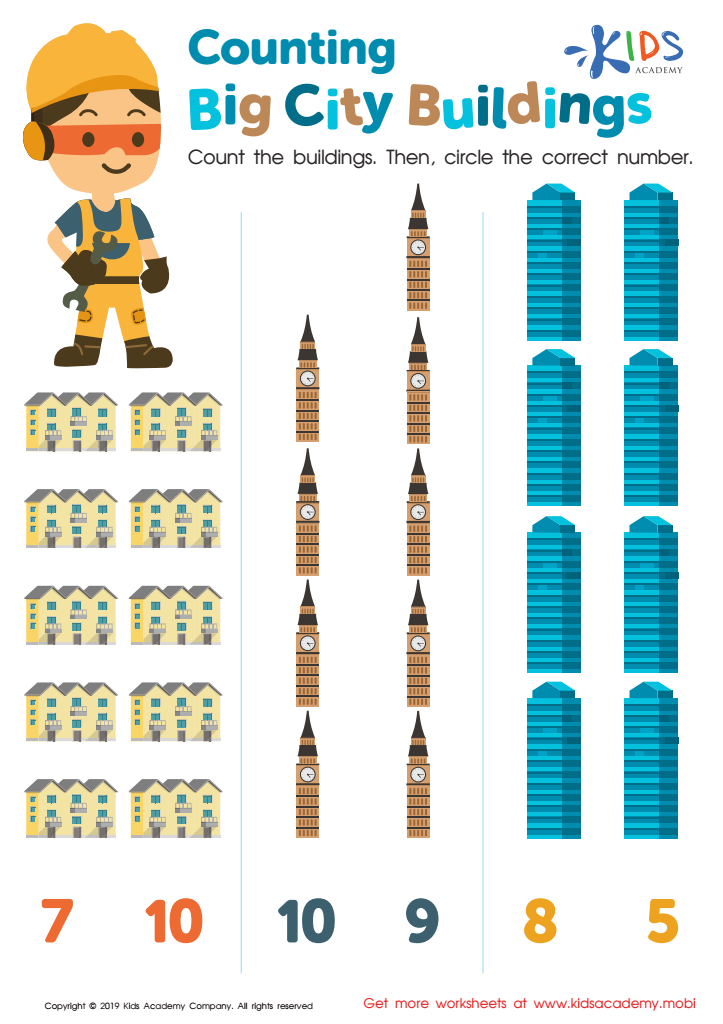
Counting Big City Buildings Worksheet
 Assign to My Students




.jpg)



Understanding quantities is a foundational skill for children aged 3-9, crucial for their overall cognitive development and future academic success. At this young age, the brain is exceptionally malleable, making it an optimal time for grasping fundamental concepts like quantities, which underpin more complex mathematical and analytical skills.
When children begin to understand quantities, they’re not just memorizing numbers; they’re developing a sense of how much different numbers represent. This helps improve their problem-solving capabilities and enhances logical reasoning. For example, recognizing that 5 is more than 3 helps them make sense of the world in more structured ways. These early experiences with quantities form the building blocks for learning arithmetic, measurement, and data interpretation in later years.
Moreover, understanding quantities also impacts everyday life. Children learn to distribute objects fairly, understand time and money, and develop spatial awareness, all of which are crucial life skills. For teachers and parents, supporting this aspect of early learning can lead to stronger academic performance and confidence in later school years. Utilizing hands-on activities like counting blocks or using visual aids can make learning about quantities engaging and effective, setting up the child for long-term success in math and beyond. Thus, caring about understanding quantities at an early age is a proactive step towards nurturing well-rounded, intellectually empowered individuals.








