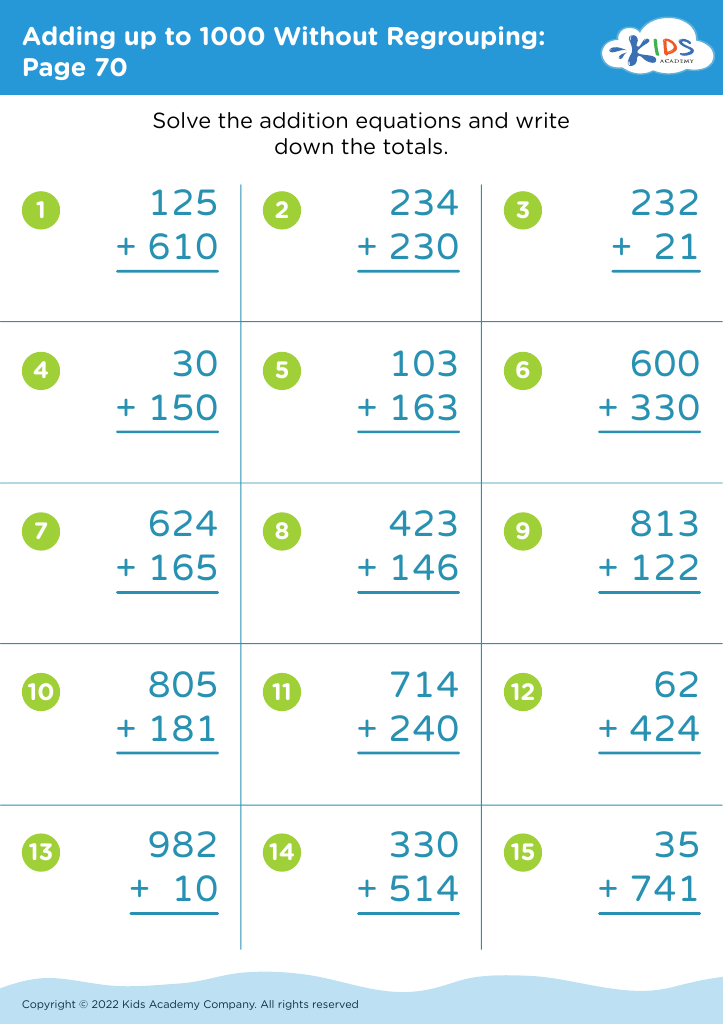








Encouraging critical thinking in addition and subtraction for children aged 3-9 is essential for their overall cognitive development. These foundational math skills go beyond simple computation and help develop logical reasoning, problem-solving abilities, and the capacity to think analytically—skills that are vital in everyday life and future learning scenarios.
Introducing critical thinking in math at an early age fosters a deeper understanding of concepts rather than just memorizing facts. For example, when children engage in activities that require them to think about why 2+3 equals 5, or how 5-2 is solved, they start to grasp the interconnectedness of numbers and operations. This comprehension builds a strong mathematical foundation, indispensable for tackling more complex subjects later on.
Additionally, critical thinking helps children grow their confidence and persistence. Through guided problem-solving exercises, children learn to approach challenges creatively and independently. Parents and teachers who emphasize these skills encourage an educational environment where questions are welcomed, and the "why" and "how" become as important as the "what". These children become more adaptive learners, able to transfer critical thinking and problem-solving skills to other areas, like reading comprehension and scientific inquiry.
Ultimately, investing in critical thinking addition and subtraction allows young learners to build essential life skills early on, setting the stage for a lifetime of educational curiosity and success.








