Decision making skills Addition & Subtraction Worksheets for Ages 3-9
3 filtered results
-
From - To
Enhance your child's decision-making skills with our engaging addition and subtraction worksheets designed for ages 3-9. These worksheets from Kids Academy combine fun activities with essential math practice, helping young learners develop critical thinking and problem-solving abilities. Each worksheet features age-appropriate exercises that encourage children to make thoughtful choices while mastering basic math concepts. Perfect for both classroom and at-home learning, our printable resources make it easy to boost your child’s confidence and academic success. Discover how integrating decision-making with math can create a foundation for lifelong learning!
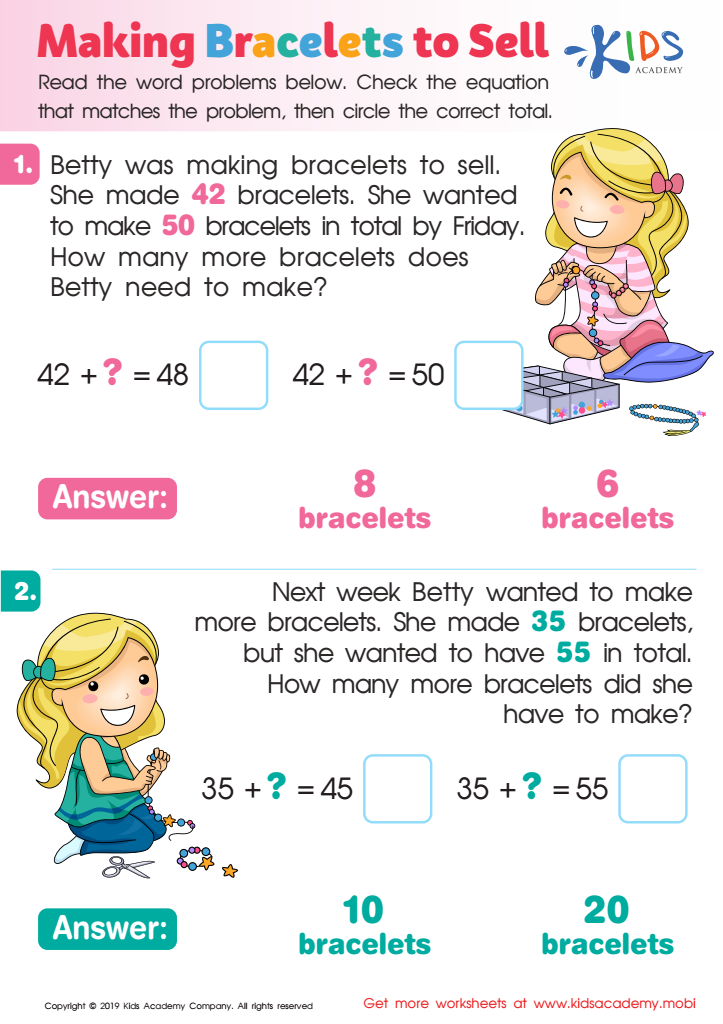
Making Bracelets to Sell Worksheet
 Assign to My Students
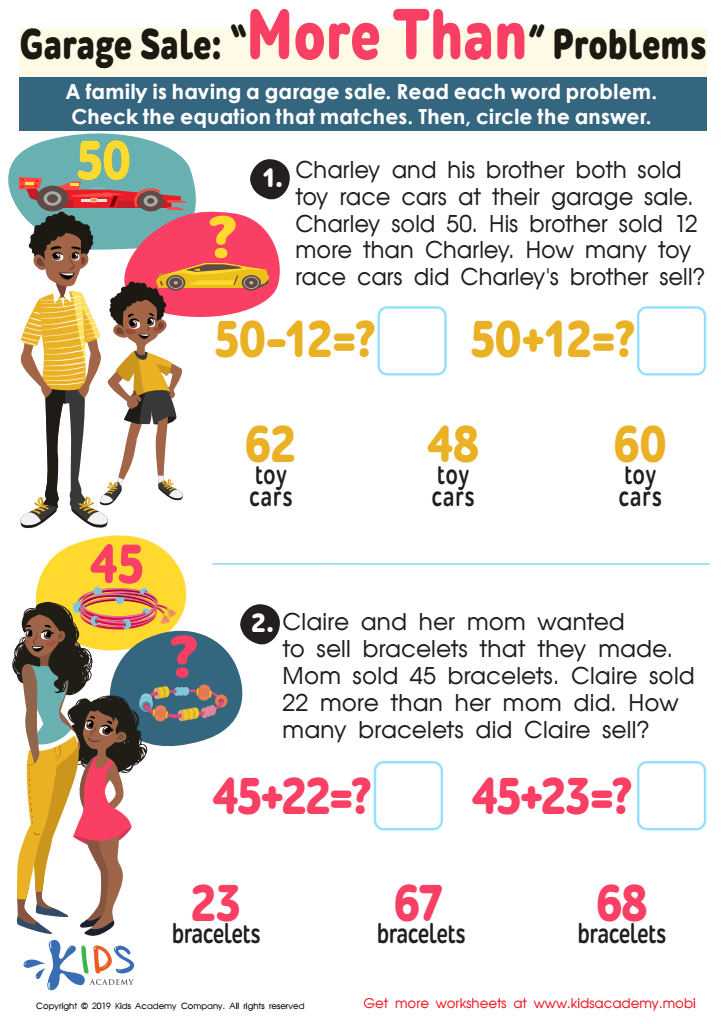
Garage Sale - More yhan Worksheet








Decision-making skills in the context of addition and subtraction for children aged 3-9 are vital for several reasons. Firstly, they lay the foundation for numeracy, which is crucial for academic success in a wide range of subjects, not just mathematics. When children learn to add and subtract, they develop logical thinking and problem-solving abilities. These skills are transferable and can be applied in day-to-day life, such as understanding the concept of money, time, and even in making choices like how many snacks they should have.
Moreover, practicing these mathematical operations stimulates cognitive development, enhancing memory, attention, and processing speed. As children contemplate different ways to solve simple arithmetic problems, they also improve their analytical skills. These mental exercises cultivate patience, perseverance, and a growth mindset, teaching children the value of striving towards a solution even when it is not immediately apparent.
In addition, reinforcing these skills at a young age builds confidence. A child who feels competent in basic arithmetic is more likely to approach more complex tasks assertively. This essential confidence extends beyond academics, helping children to feel capable in various aspects of their lives. Thus, parents and teachers have a compelling reason to prioritize the development of ease and proficiency in these fundamental mathematical skills during these formative years.








