
Observation skills Addition & Subtraction Worksheets for Ages 3-9
3 filtered results
Difficulty Level
Grade
Age
-
From - To
Subject
Activity
Standards
Enhance your child's math journey with our engaging Observation Skills Addition & Subtraction Worksheets, designed specifically for ages 3-9. These interactive worksheets fuse observation techniques with foundational math concepts, helping young learners sharpen their analytical skills while mastering addition and subtraction. Kids will enjoy fun illustrations and relatable scenarios, promoting critical thinking as they identify patterns and solve problems. Tailored for different skill levels, our resources enable parents and educators to support children's growth effectively. Discover how playful learning can make math an enjoyable experience and set the stage for lifelong academic success! Download your worksheets today from Kids Academy.
Favorites
With answer key
Interactive
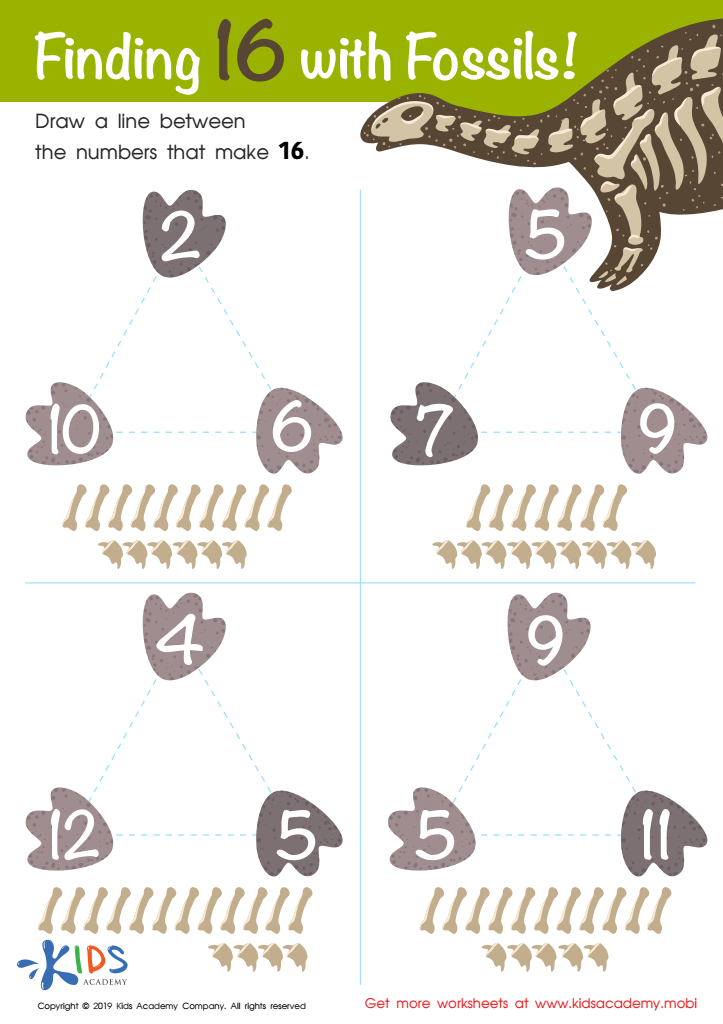
Finding 16 With Fossils Worksheet
Experts hunt for fossils, dig them up, and study them to learn more about past life forms - how they lived, what they looked like, and when they lived. Show kids the picture in this worksheet and point out the fossils. Help them count the bones and draw a line between the numbers that add up to 16 in each triangle.
 Assign to My Students
Finding 16 With Fossils Worksheet
Worksheet
Join Kids Academy for Free
Who is primarily going to use this learning content?








Observation skills are essential for teaching young children addition and subtraction, as they lay the foundation for mathematical understanding and critical thinking. For children aged 3-9, developing these skills allows them to recognize patterns, quantities, and relationships, which are crucial for grasping fundamental mathematical concepts.
For parents and teachers, fostering observation skills in addition and subtraction helps children learn to look for numerical relationships in their everyday environment. This might include counting objects, noticing the increase or decrease of items during play, or even comparing groups. Such interactions enhance their ability to visualize and mentally manipulate numbers, making arithmetic more intuitive.
Additionally, strong observation skills encourage curiosity and exploration. When children learn to observe detail, they also become more engaged with math-related tasks and find opportunities to practice their skills in real-world situations. This engagement is crucial for building confidence and a positive attitude towards mathematics.
Moreover, these fundamental skills are connected to cognitive development. By encouraging young learners to observe and engage, parents and teachers play a vital role in shaping their problem-solving abilities, ultimately preparing them for more complex mathematical concepts in the future. Thus, prioritizing observation in early mathematics education is essential for holistic child development.








