Cognitive skill development Math Worksheets for Ages 3-9
3 filtered results
-
From - To
Discover a collection of cognitive skill development math worksheets designed for children ages 3-9. These engaging and interactive resources help young learners enhance their problem-solving abilities, logical thinking, and analytical skills. Our worksheets cover essential math concepts, enabling kids to grasp numbers, patterns, and relationships in a fun and stimulating way. Perfect for at-home learning or classroom activities, these worksheets are tailored to develop fundamental cognitive skills while sparking a love for math. Support your child's learning journey and watch them grow in confidence with our expertly-crafted worksheets, ideal for encouraging independent thinking and a strong mathematical foundation.
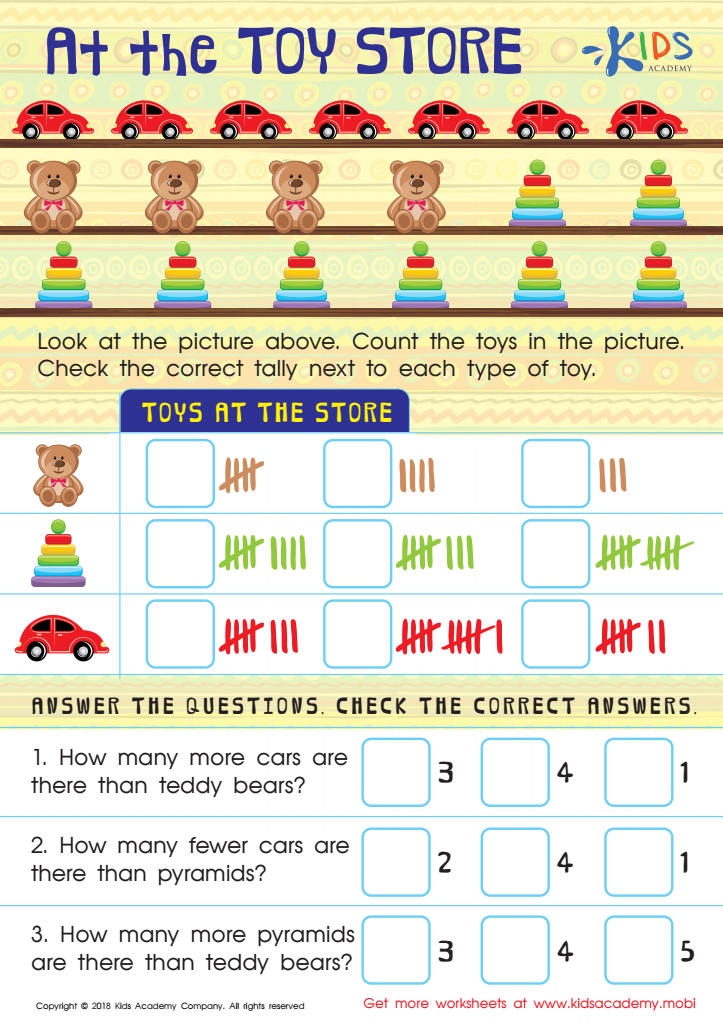
Tally Chart: At the Toy Store Worksheet
 Assign to My Students








Cognitive skill development in math for children aged 3-9 is essential because it lays the foundation for academic success and critical thinking. During these early years, children undergo significant brain development, making this an optimal time for introducing mathematical concepts. Engaging in activities that promote cognitive skills, such as counting, pattern recognition, and problem-solving, enhances a child's ability to process information and develop logical reasoning.
Parents and teachers should care about math skill development because it not only impacts a child’s performance in school but also fosters a positive attitude toward learning. Early exposure to math-related games and challenges encourages curiosity and resilience, equipping children with the confidence to tackle complex problems later in life. Furthermore, cognitive skills developed in early math learning extend beyond academics; they are essential for everyday life situations, from budgeting to making decisions.
Moreover, strong math skills correlate with success in STEM fields, which are increasingly vital in our technology-driven world. By prioritizing cognitive skill development in math, parents and teachers can empower children with the tools and mindset necessary for future learning and success, ultimately shaping well-rounded, capable individuals.








