
Fraction identification Math Worksheets for Ages 3-9
6 filtered results
Difficulty Level
Grade
Age
-
From - To
Subject
Activity
Standards
Discover our engaging Fraction Identification Math Worksheets designed for children aged 3 to 9! These worksheets provide a fun and interactive way for young learners to grasp the concept of fractions through colorful visuals and hands-on activities. Perfect for individual practice or classroom use, our resources include various activities that teach kids how to identify, compare, and manipulate fractions. Tailored to different skill levels, these worksheets support early math development in an enjoyable manner. Help your child build a solid foundation in mathematics while fostering a love for learning with our thoughtfully crafted fraction identification worksheets!
Favorites
With answer key
Interactive
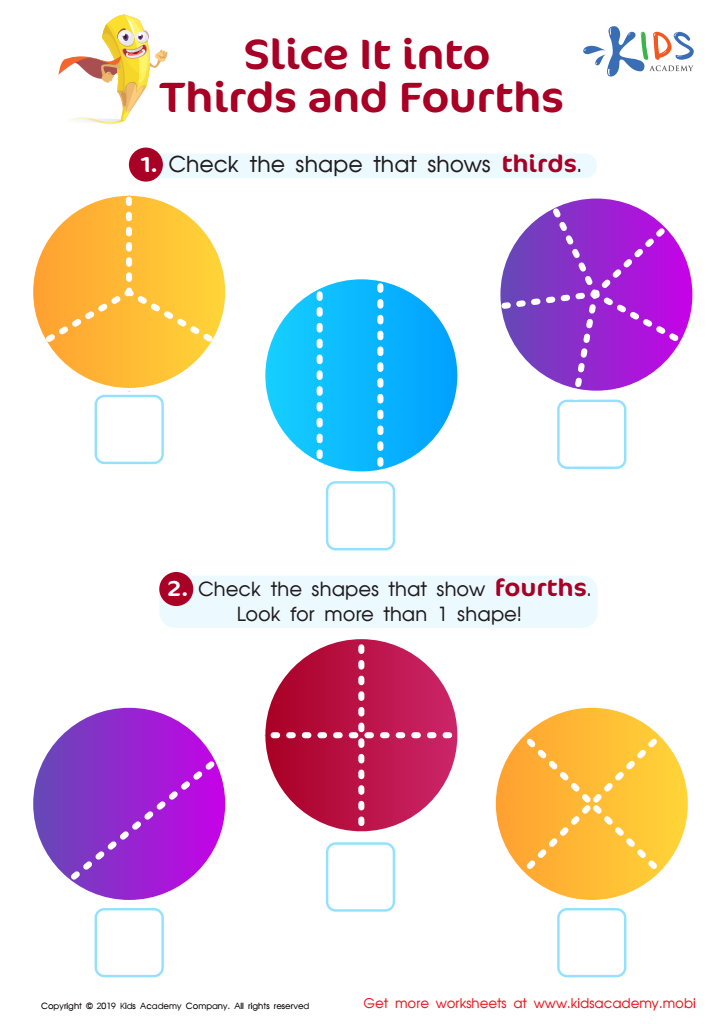
Slice in Thirds Fourths Worksheet
This worksheet helps kids learn fractions visually by dividing circles into thirds and fourths. They will learn that fractions must be equal parts, not just sets, by choosing the right colorful circles. It's an easy way to master fractions and have fun doing it!
 Assign to My Students
Slice in Thirds Fourths Worksheet
Worksheet
Join Kids Academy for Free
Who is primarily going to use this learning content?








Fraction identification is a crucial skill for young learners, particularly for children aged 3-9. Early integration of fraction concepts enhances children's mathematical foundation, fostering critical thinking and problem-solving abilities. As children engage with fractions, they begin to understand the idea of parts and wholes, which is essential for numeracy.
For parents and teachers, nurturing fraction identification can ease the transition into more complex math topics in later years. It helps children develop a solid understanding of division, ratios, and percentages, which are ubiquitous in daily life and advanced math. Furthermore, introducing fractions in playful and engaging ways—like through cooking, cutting drawings, or using visual aids—can make math enjoyable and relatable, aiding in retention.
Additionally, recognizing fractions builds confidence in young learners. Mastering early math skills can enhance their overall academic performance, leading to improved educational outcomes. Importantly, these skills also lay the groundwork for enhanced cognitive development and a love for learning, as children metaphorically 'see' math everywhere around them when they understand concepts of division and sharing.
In conclusion, fostering fraction identification skills is an investment in children's future academic success and their ability to navigate the world quantitatively.








