
Time calculation skills Math Worksheets for Ages 3-9
3 filtered results
Difficulty Level
Grade
Age
-
From - To
Subject
Activity
Standards
Introduce your child to the fascinating world of time with our engaging Time Calculation Skills Math Worksheets tailored for ages 3-9. From identifying hours and minutes to mastering the art of reading clocks, our worksheets are specifically designed to build foundational time-telling skills. With vibrant illustrations and age-appropriate exercises, children will learn to calculate, compare, and manage time confidently. Perfect for both classroom and at-home learning, these worksheets provide a fun and interactive way to enhance your child's mathematical abilities. Visit Kids Academy today to unlock a world of educational fun and pave the way to time mastery!
Favorites
With answer key
Interactive
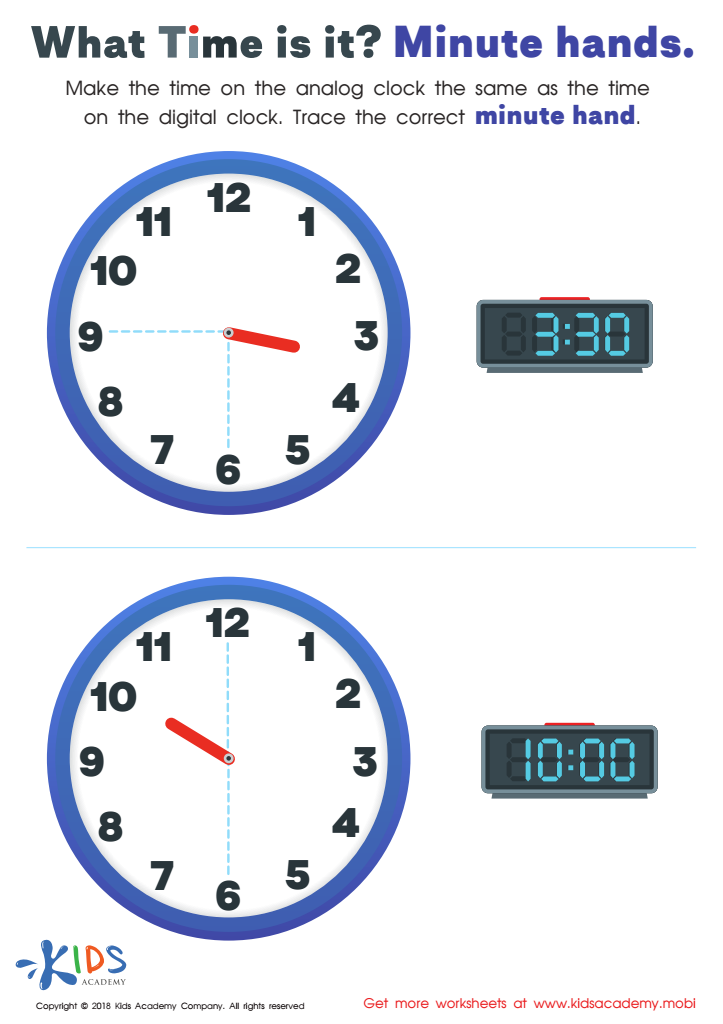
What Time Is it? Minute Hands Worksheet
Help your kids telling time with the minute hand correctly with this tracing sheet. Trace the correct minute hand to make the time on the analog clock the same as the time on the digital clock. Give them a pictured demonstration of how to do it and you'll be all set!
 Assign to My Students
What Time Is it? Minute Hands Worksheet
Worksheet
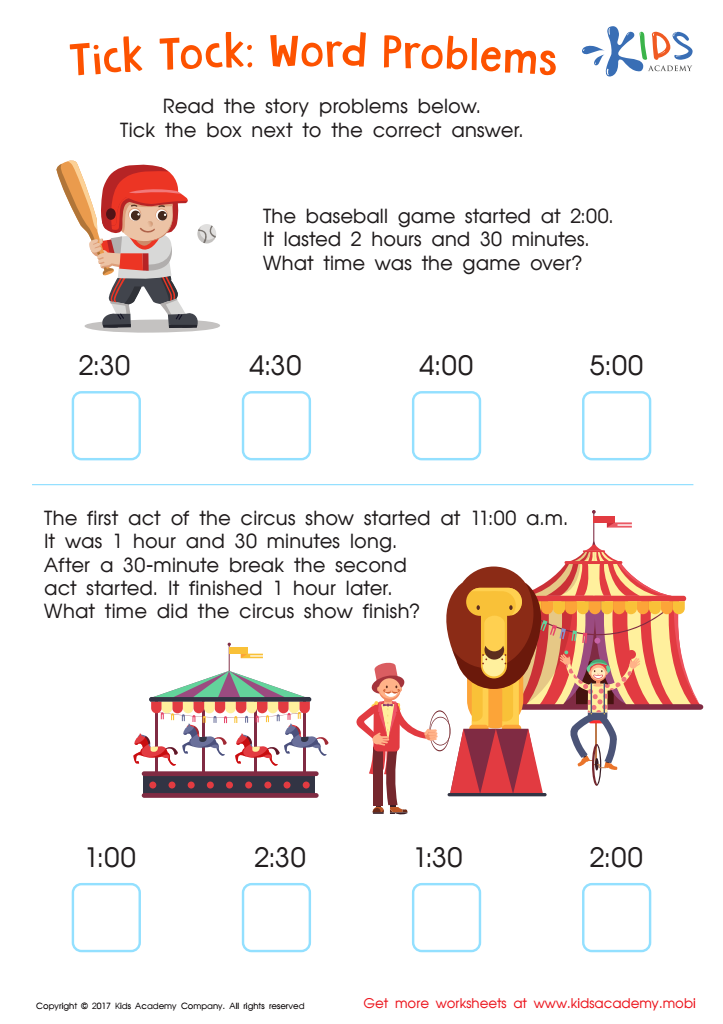
Tick Tock Word Problems Time Worksheet
Mix math and fun with this telling time word problems worksheet! Your child will love solving the events' finishing times using the vivid colors and joyful illustrations. Tick Tock!
Tick Tock Word Problems Time Worksheet
Worksheet
Join Kids Academy for Free
Who is primarily going to use this learning content?








Time calculation skills are vital for young children as they serve as a foundational element that supports overall development and future academic success. For ages 3-9, learning to tell and calculate time nurtures a variety of important skills. Firstly, it introduces basic mathematical concepts such as numbers, sequencing, and comparison, all of which are fundamental to more complex math problems.
Furthermore, understanding time helps children develop a strong sense of routine and time management. It instills the concept of structure by correlating daily activities with specific times, fostering responsibility and predictability. This can enhance their ability to follow directions, complete tasks within a given timeframe, and understand the passage of time, which is crucial for developing organizational skills.
Parents and teachers should also recognize that proficiency in time calculation empowers children with the confidence to navigate daily life. It enables them to manage simple activities independently, such as getting ready in the morning or knowing when it's time for bed.
In essence, learning to calculate time is not just about reading clocks; it's a stepping stone that enhances cognitive abilities, promotes independence, and prepares children for a disciplined and well-structured academic journey. The multifaceted skills gained through time calculation will serve them well into adulthood, making it an essential aspect of early education.








