Understanding measurement units Math Worksheets for Ages 3-9
3 filtered results
-
From - To
Introduce your child to the world of measurement with our fun and educational Math Worksheets for Ages 3-9. These worksheets are designed to help young learners grasp fundamental measurement concepts such as length, height, weight, and volume. Through engaging activities, kids will explore various measurement units and practice comparing, estimating, and measuring objects in their surroundings. Our colorful, interactive worksheets ensure learning is enjoyable and effective, building a solid foundation for future math success. Perfect for both classroom and home use, these resources foster critical thinking and problem-solving skills, aiding in the overall development of your child's mathematical understanding.
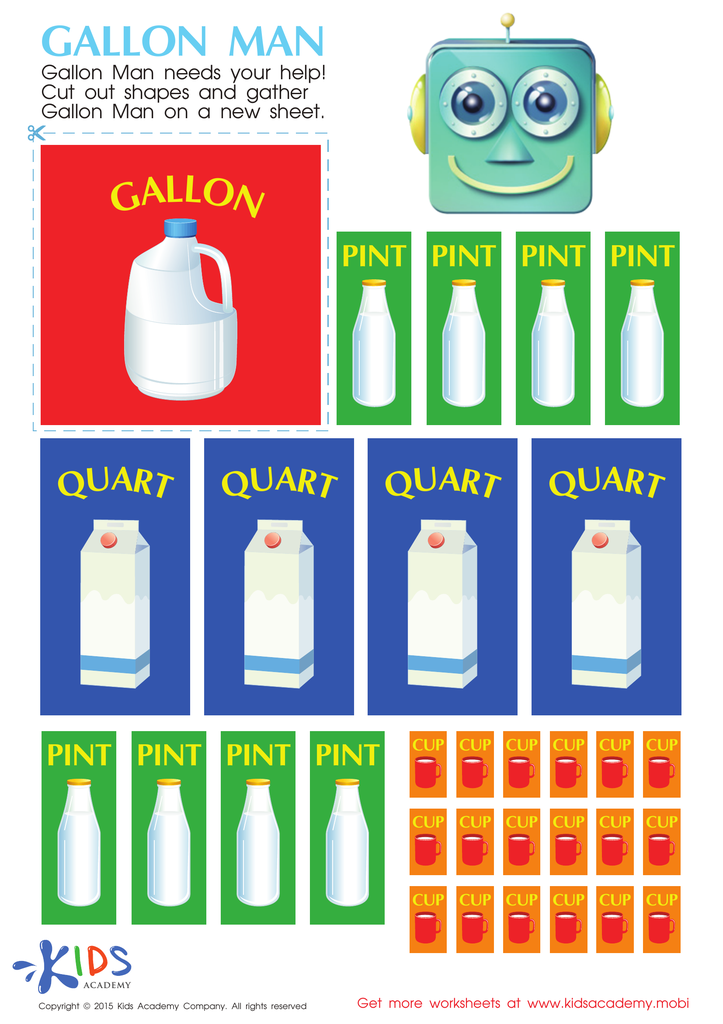
Cups, Pints and Quarts With Gallon Man Worksheet
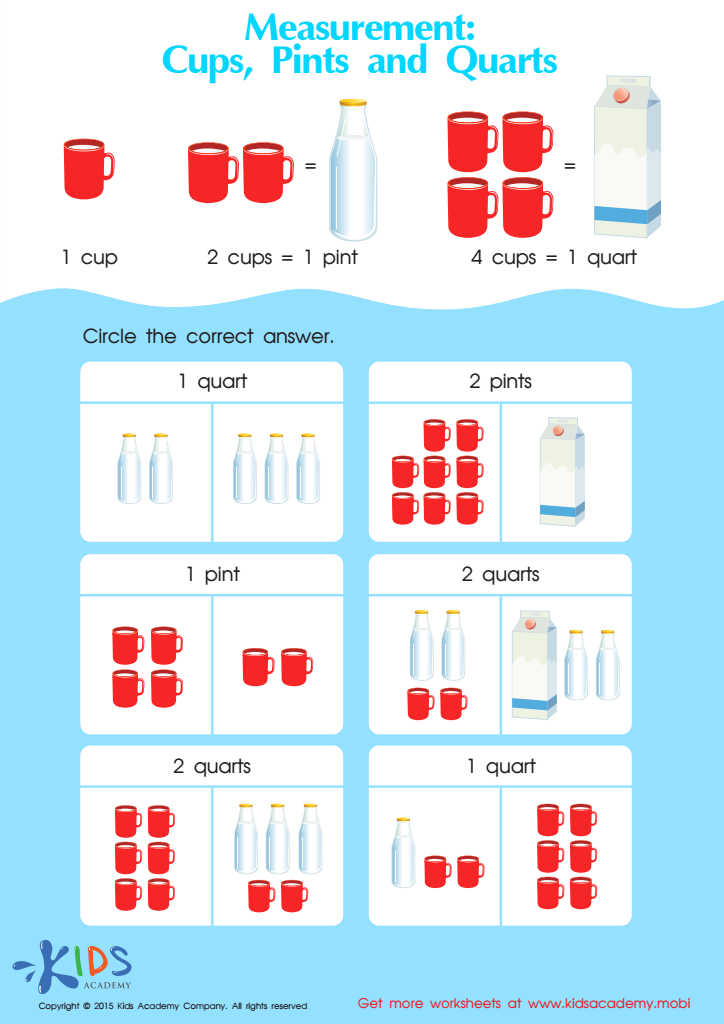
Cups, Pints and Quarts Worksheet
 Assign to My Students
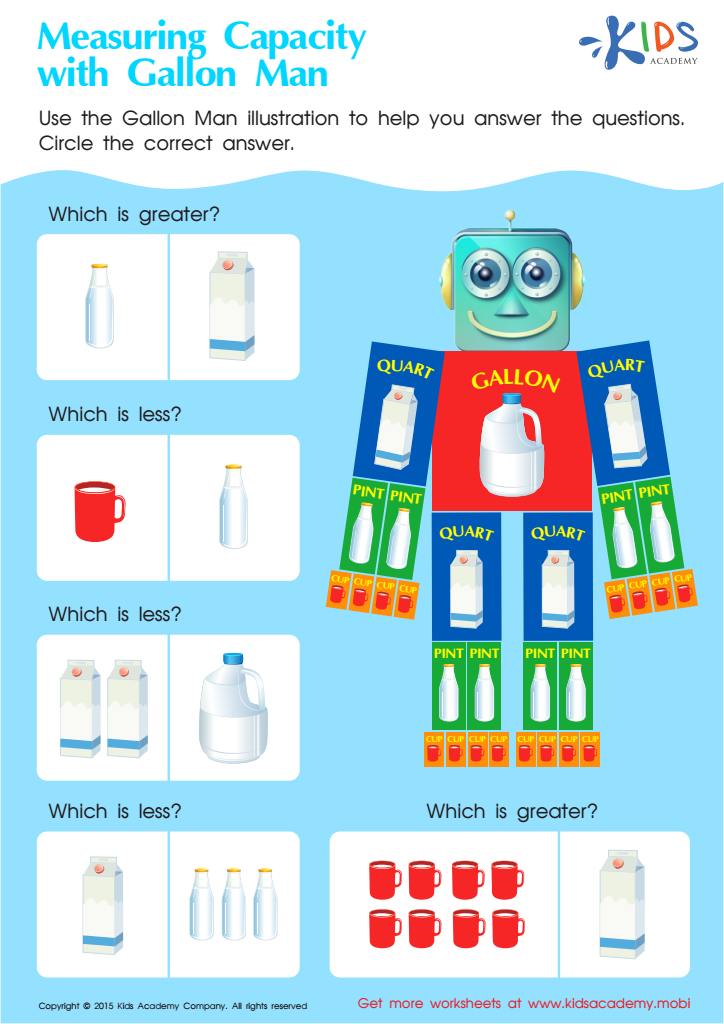
Measurement: Measuring Capacity with Gallon Man Worksheet








Understanding measurement units, such as length, weight, and volume, during the early years (ages 3-9) is a critical part of a child's cognitive development and lays the foundation for future academic success. At this age, children are naturally curious and use their senses to explore the world. Integrating measurement activities helps them make sense of these experiences and builds important life skills.
Firstly, engaging with measurement units enhances mathematical reasoning and problem-solving abilities. Children learn to estimate, compare, and make decisions based on quantitative information, which are essential skills not just in academics but in everyday life.
Secondly, early exposure to these concepts helps improve language skills. Descriptive terms like 'longer,' 'heavier,' or 'fuller' become part of their vocabulary, and discussing measurements encourages communication and understanding.
Additionally, understanding measurement supports other areas of learning, such as science and reading. For example, knowing how to measure ingredients is crucial in science experiments and cooking, linking math skills to real-world applications. In reading, comprehension improves when children understand spatial terms in stories.
Moreover, hands-on activities related to measurement enhance fine motor skills and hand-eye coordination, like using rulers, scales, or measuring cups.
Ultimately, fostering an early understanding of measurement units equips children with a versatile toolset, nurturing their curiosity and laying a robust foundation for lifelong learning. This should be a priority for both parents and teachers.








