Enhancing mathematical skills Worksheets for Ages 4-6
3 filtered results
-
From - To
Boost your child’s mathematical skills with our engaging worksheets designed specifically for ages 4-6. These interactive activities focus on foundational concepts like counting, basic addition, and number recognition. Each worksheet is tailored to spark curiosity and make learning fun while promoting critical thinking and problem-solving abilities. Our colorful designs capture young learners' attention, making practice enjoyable and effective. Perfect for parents and educators, these resources provide a structured way to reinforce classroom learnings at home. Explore our printable worksheets and watch your child develop confidence and competence in math as they embark on this exciting educational journey!
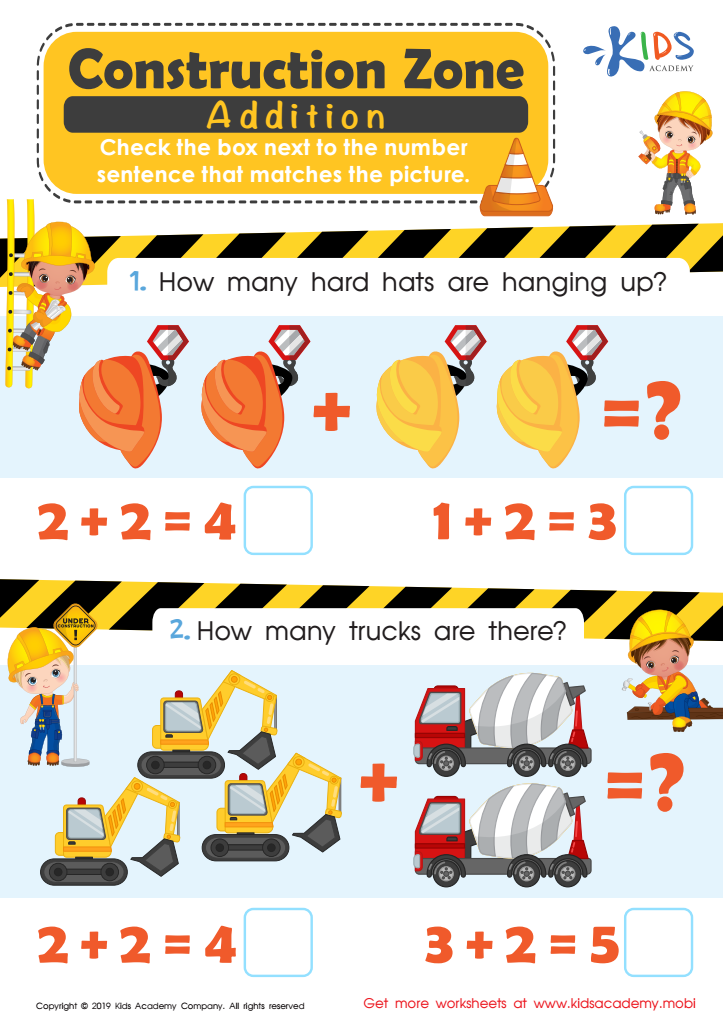
Construction Zone Addition Worksheet
 Assign to My Students
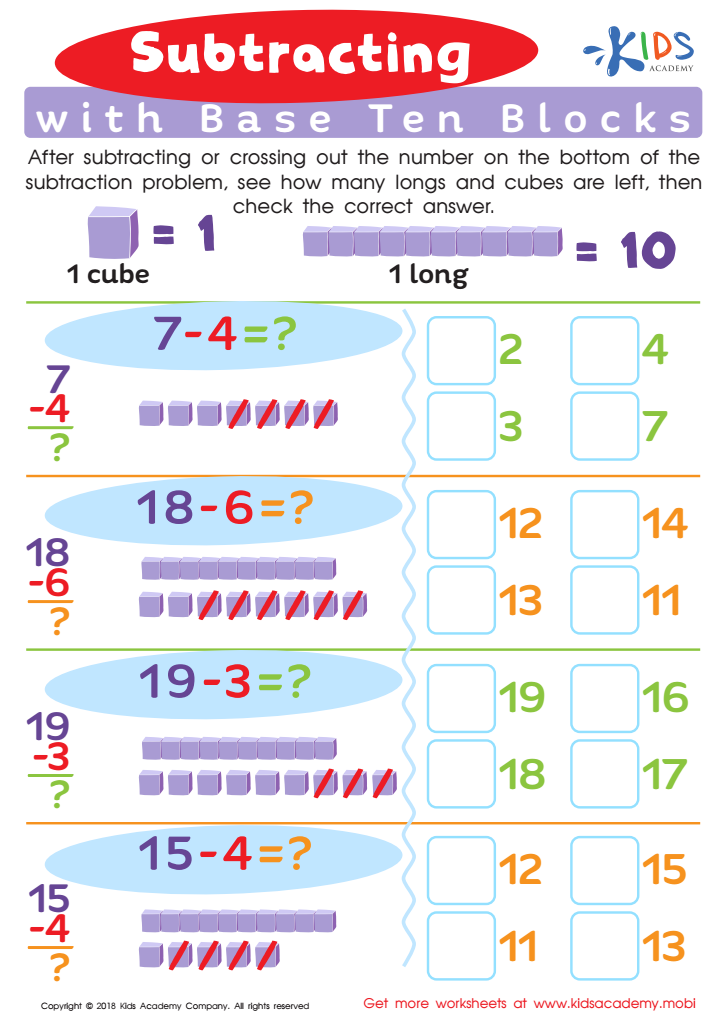
Subtracting With Base 10 Blocks Worksheet








Enhancing mathematical skills in children ages 4-6 is crucial for their overall cognitive and social development, laying the foundation for lifelong learning. During these formative years, early mathematical experiences help children understand concepts such as counting, number recognition, and basic operations, which are essential for later academic success. Children who develop strong mathematical skills tend to have enhanced problem-solving abilities, critical thinking, and reasoning skills, all of which are essential for academic and real-world challenges.
Furthermore, early exposure to math fosters curiosity and a positive attitude towards learning, encouraging children to explore further educational opportunities. Engaging in mathematical activities alongside parents or teachers promotes a rich dialogue about numbers and patterns, nurturing a collaborative learning environment that builds confidence and resilience.
Additionally, strong early math skills have been linked to future achievement in STEM (Science, Technology, Engineering, Mathematics) fields, which are increasingly vital in today’s technology-driven world. Investing time and resources in enhancing mathematical skills in young learners ensures they are well-equipped to navigate a complex world and empowers them to become competent and confident learners. Ultimately, fostering these skills is not just about academics; it prepares children for a successful, engaging, and fulfilling future.








