Understanding equations Worksheets for Ages 4-6
5 filtered results
-
From - To
Our "Understanding Equations Worksheets for Ages 4-6" provide engaging, age-appropriate activities to help young learners develop a strong foundation in basic math concepts. These fun and interactive worksheets facilitate understanding of basic addition and subtraction equations through colorful illustrations and simple exercises. Designed specifically for early learners, our worksheets enhance problem-solving skills, critical thinking, and math confidence, making math enjoyable and accessible. Perfect for parents and teachers, these resources aim to build essential early learning skills for a successful start in math. Explore and support your child's mathematical journey today with our comprehensive, printable worksheets.
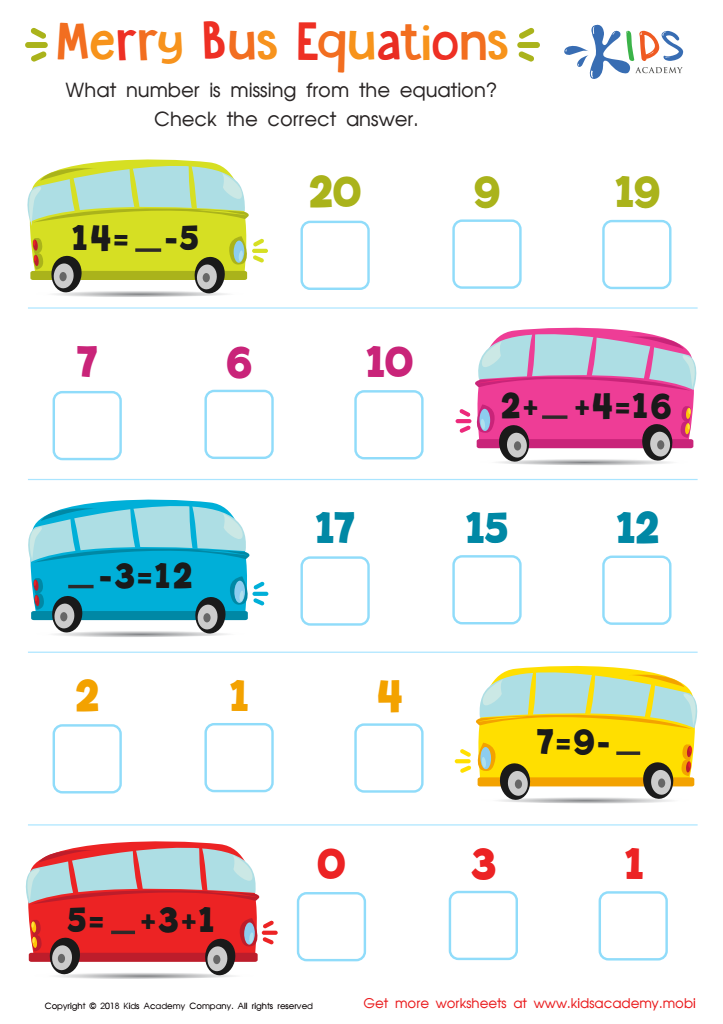
Merry Bus Equations Worksheet
 Assign to My Students
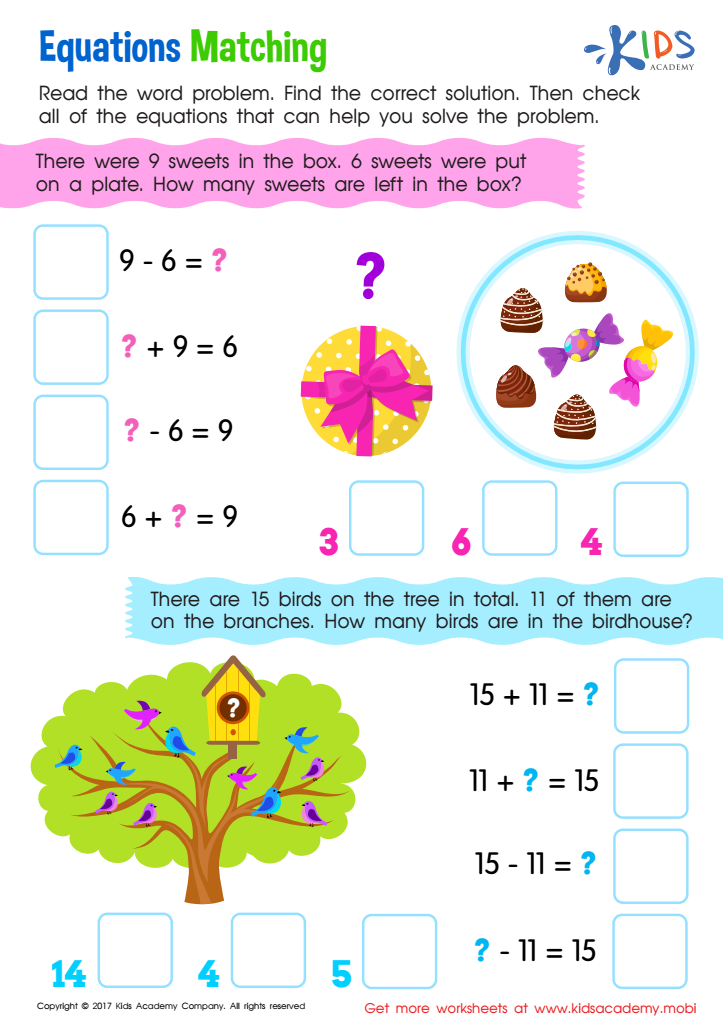
Equations Matching Word Problems Worksheet
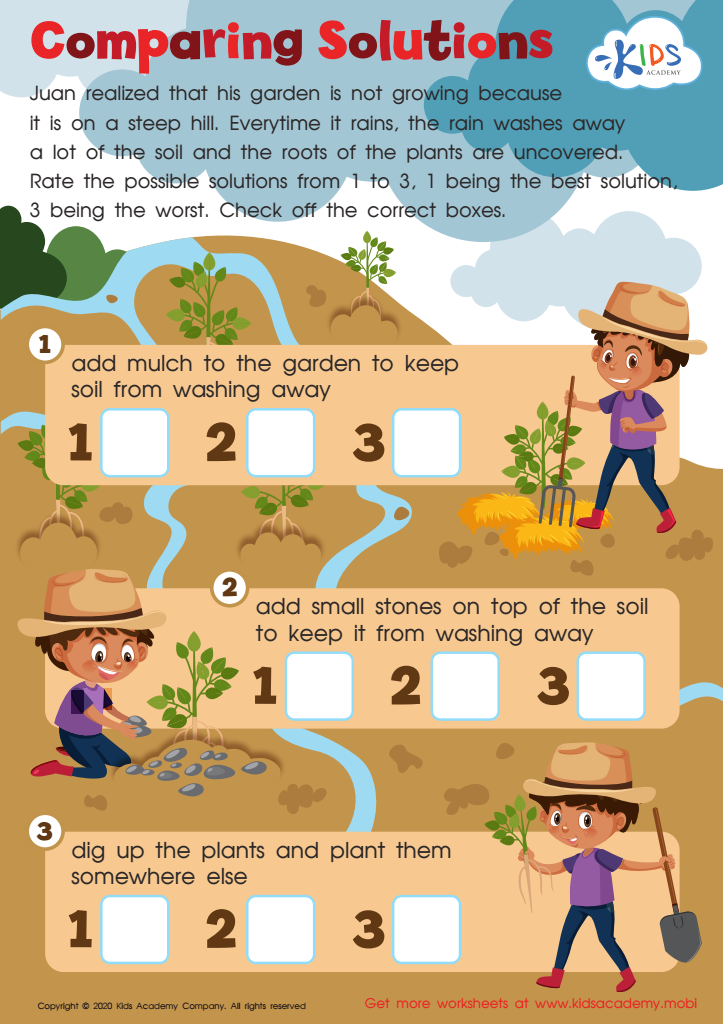
Comparing Solutions Worksheet
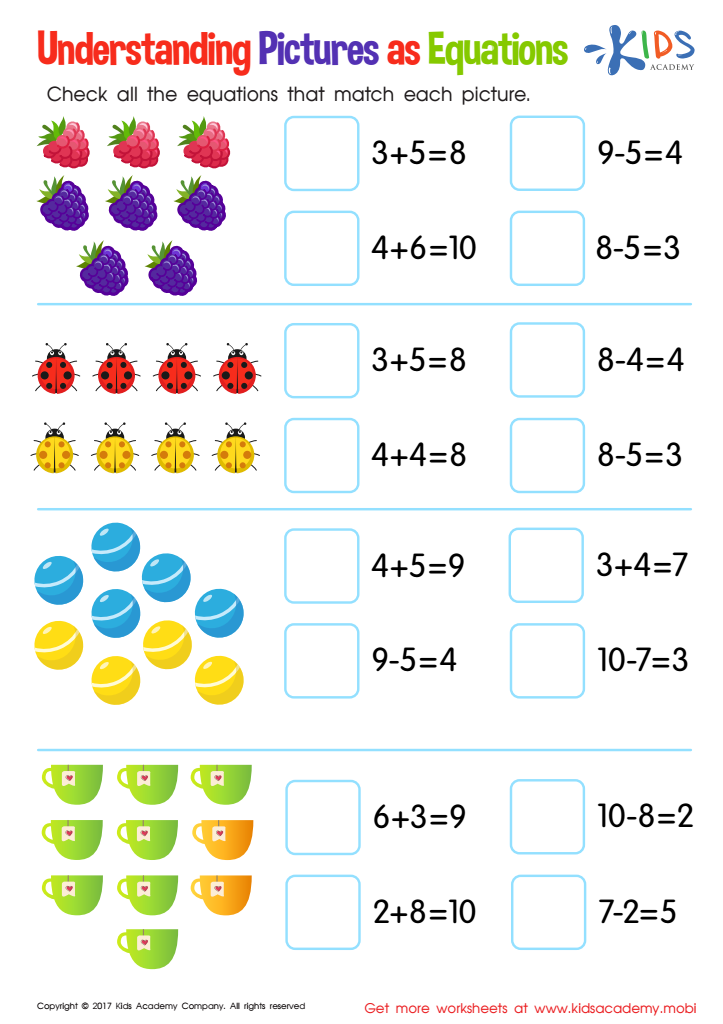
Understanding Pictures as Equations Worksheet
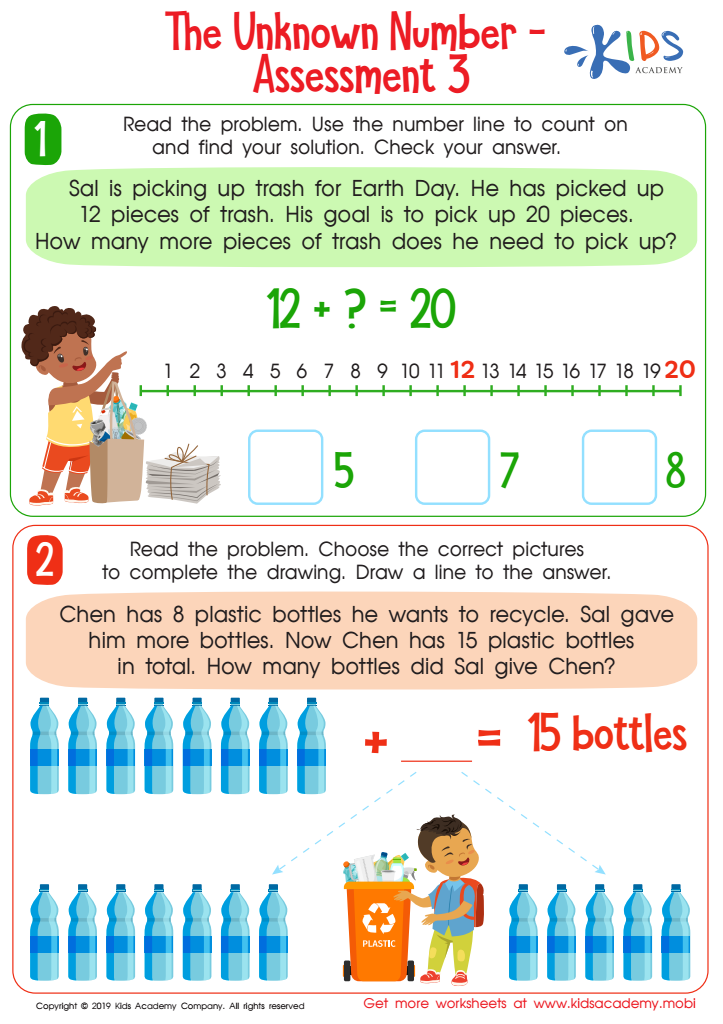
The Unknown Number - Assessment 3 Worksheet








Understanding basic equations at an early age is crucial for the cognitive and academic development of children aged 4-6. Introducing simple equations helps foster critical thinking, problem-solving skills, and a foundation for more advanced mathematical concepts. Equations teach children about balance and equality, fundamental concepts not only in mathematics but in everyday decision-making and logical reasoning.
At this age, children are naturally curious and eager to explore the world around them. Engaging with basic equations—such as understanding that 3 + 2 = 5—turns abstract concepts into concrete learning experiences. These small steps build confidence and excitement about learning, which can translate into a positive attitude towards school and academics in general.
Moreover, early exposure to equations supports the development of number sense, an intuitive understanding of numbers and their relationships. This foundational knowledge is essential as it influences future success in math subjects, including arithmetic, algebra, and beyond. Teachers and parents who prioritize early equation learning contribute to a child’s overall intellectual development, ensuring they are better prepared for the educational challenges ahead.
In essence, understanding equations at an early age cultivates a strong educational foundation, shaping better learners and thinkers. As such, parents and teachers play a pivotal role in nurturing these skills from the start.








