
Understanding forces Worksheets for Ages 4-6
3 filtered results
Difficulty Level
Grade
Age
-
From - To
Subject
Activity
Standards
Explore our "Understanding Forces Worksheets" designed specifically for children ages 4-6! These engaging and interactive worksheets introduce young learners to fundamental concepts of forces, including push and pull, gravity, and friction. With vibrant illustrations and age-appropriate activities, kids will enjoy discovering how forces impact their everyday lives. The worksheets promote critical thinking and problem-solving skills while enhancing fine motor abilities through fun exercises. Perfect for classroom use or at-home learning, these worksheets are an excellent resource for early educators and parents looking to foster curiosity and a love for science in young children. Start your journey into the world of forces today!
Favorites
With answer key
Interactive
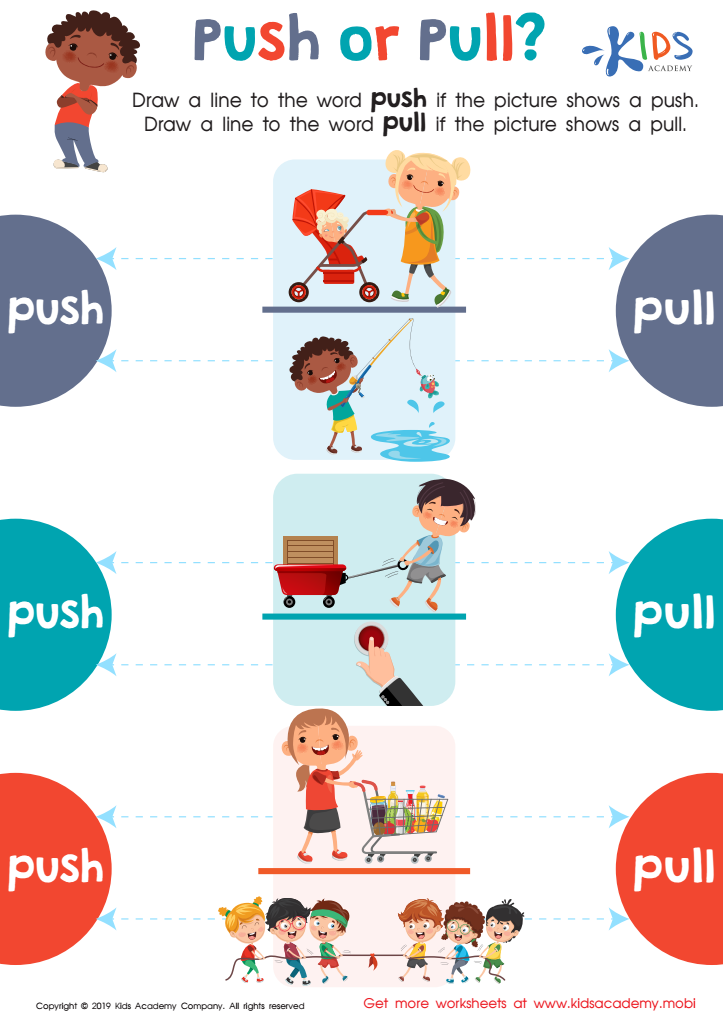
Push or Pull? Worksheet
Young kids may struggle to differentiate push and pull. When they start writing, they may use them interchangeably and wrongly. This worksheet clarifies the concepts: pushing means moving something away, pulling means bringing something closer. It provides pictures and traceable lines for kids to connect each image to the correct word. This helps them understand and remember the difference for future writing and reading.
 Assign to My Students
Push or Pull? Worksheet
Worksheet
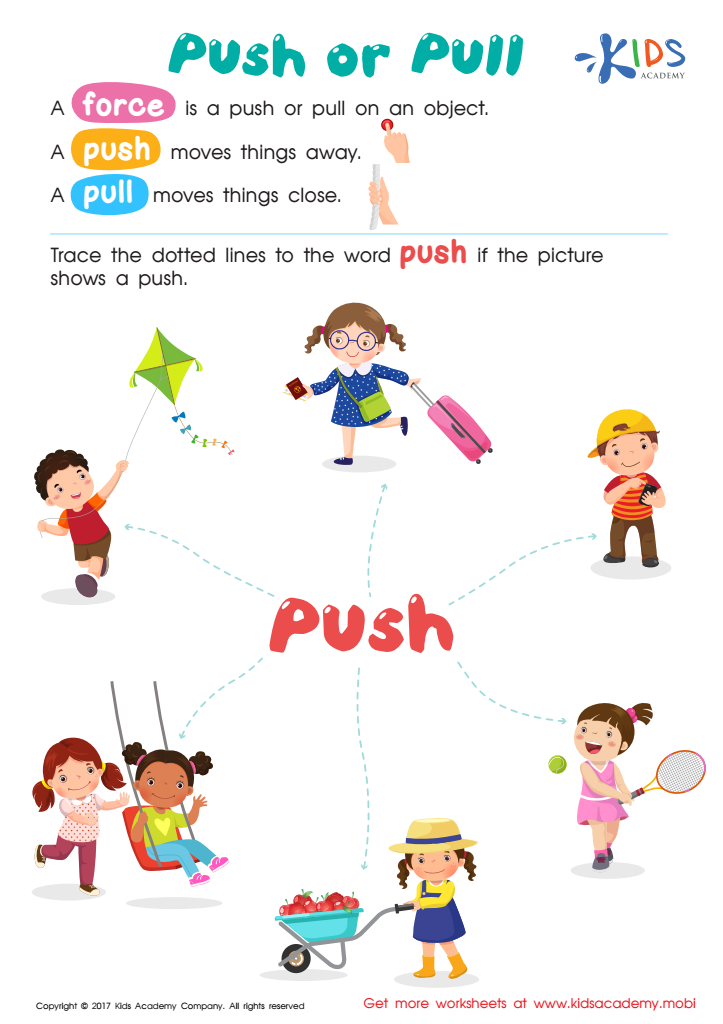
Push or Pull Worksheet
and which involve pulling! With this fun worksheet, your child will learn about force and its simple application in everyday activities. Get them started with Push or Pull! (80 words)
Push or Pull Worksheet
Worksheet
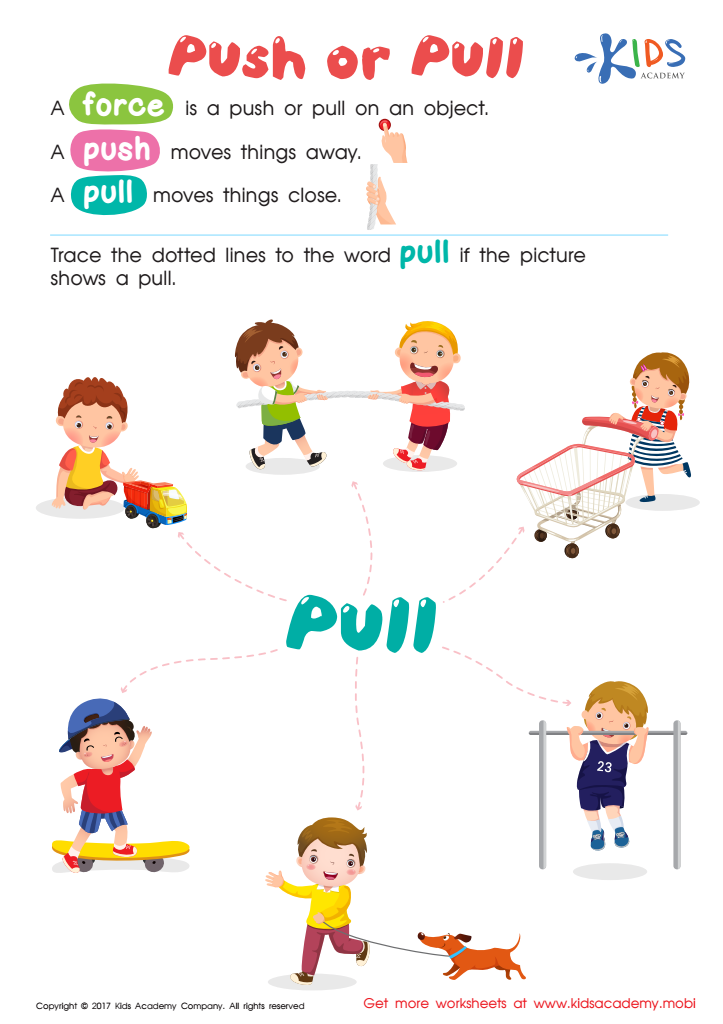
Pull or Push Worksheet
With this fun worksheet, they'll explore physics by sorting objects into categories according to their mode of motion. It's a great way to get them interested in science.
Pull or Push Worksheet
Worksheet
Join Kids Academy for Free
Who is primarily going to use this learning content?







Understanding forces is essential for children aged 4-6 as it lays the groundwork for their scientific literacy and curiosity about the world. At this young age, children are naturally inquisitive and are constantly exploring their surroundings. By introducing them to the concept of forces—such as push, pull, gravity, and friction—adults can enhance their observational skills and critical thinking.
Forces act as the driving mechanism behind many everyday phenomena, from playing with toys to interacting with nature. When children engage in activities like rolling a ball, building with blocks, or swinging on a playground, they intuitively experience forces, even if they do not yet have the vocabulary to describe them. Teaching about forces helps kids articulate their experiences, promoting effective communication and vocabulary development.
Moreover, understanding forces fosters social skills, as children often work collaboratively in play scenarios that involve problem-solving and teamwork. Early engagement with fundamental concepts builds a solid foundation for future scientific education, nurturing a love for learning and exploration. In turn, this helps develop logical reasoning and an inquisitive mindset that are crucial for lifelong learning. Ultimately, parents and teachers play a vital role in cultivating an environment where understanding forces becomes a fun and integral part of a child's growth.








