
Practice problem-solving Worksheets for Ages 4-7
5 filtered results
Difficulty Level
Grade
Age
-
From - To
Subject
Activity
Standards
Discover our engaging practice problem-solving worksheets designed specifically for children ages 4 to 7. These worksheets provide a fun and interactive way for young learners to enhance their critical thinking skills while enjoying engaging activities. From puzzles and reasoning exercises to simple word problems, our resources are tailored to nurture creativity and logic. The colorful designs and age-appropriate challenges make learning enjoyable, helping kids develop essential life skills early on. Perfect for classroom use or at-home study, these worksheets promote independent learning and boost confidence in problem-solving abilities. Explore our collection and watch your child's skills flourish!
Favorites
With answer key
Interactive
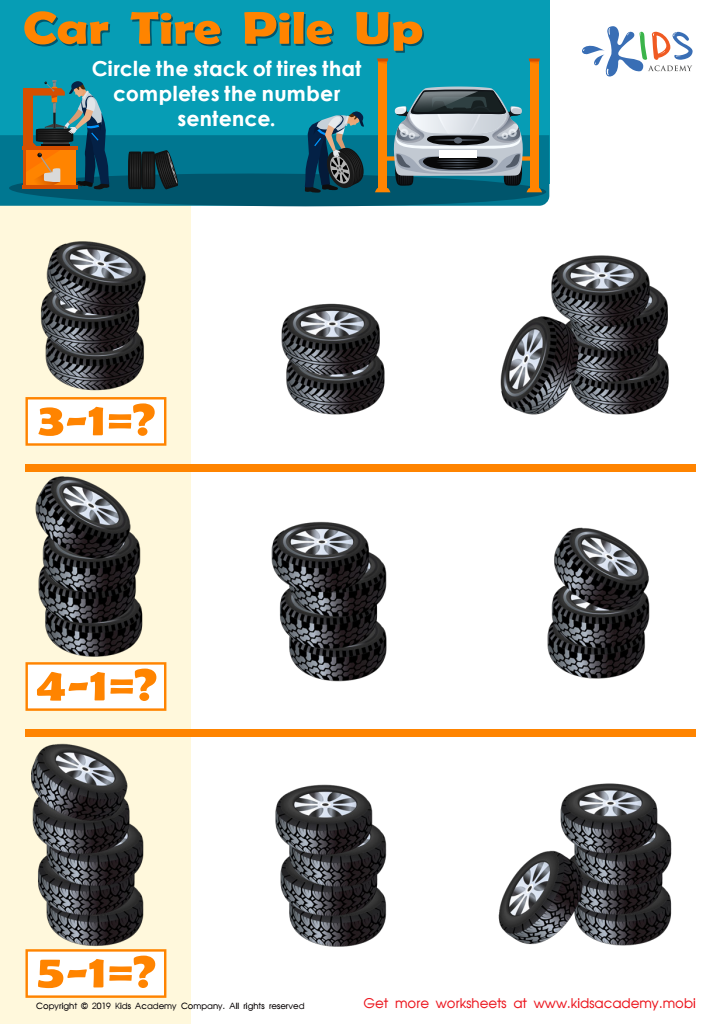
Car Tire Pile Up Worksheet
Examine the pic with your kids. Can they recognize the items piled up? The tires are organized in different quantities. Equations are on the left. Have your children work out the equations, counting the tire stacks to identify the correct answer.
 Assign to My Students
Car Tire Pile Up Worksheet
Worksheet
Join Kids Academy for Free
Who is primarily going to use this learning content?






%20(1).jpg)

Practice problem-solving for children aged 4-7 is crucial as it lays the foundation for critical thinking skills essential in everyday life. During these formative years, children are naturally curious and eager to explore their environment. By engaging in problem-solving activities, they learn to identify challenges, generate potential solutions, and evaluate outcomes. This process helps them develop cognitive flexibility, which allows them to adapt to new situations and changes.
Moreover, problem-solving fosters essential social-emotional skills. Children learn to collaborate with peers, communicate their thoughts effectively, and handle frustration when solutions aren’t immediately apparent. These skills not only enhance their academic performance but also prepare them for collaborative environments in the future.
Furthermore, practicing problem-solving strengthens persistence and resilience. When children face difficulties and learn to navigate them, it instills a growth mindset, encouraging them to see challenges as opportunities for growth rather than obstacles.
For parents and teachers, supporting problem-solving is a way to nurture a child’s independence and confidence. As they develop these skills early on, they are better equipped to handle the complexities of later academic challenges and real-world situations, making problem-solving a vital focus in early education.








