Understanding division Worksheets for Ages 4-7
8 filtered results
-
From - To
Discover our "Understanding Division Worksheets for Ages 4-7," designed to introduce young learners to the basics of division in a fun and engaging way. These worksheets use simple language, colorful illustrations, and interactive activities to help your child grasp the concept of sharing and grouping. Perfect for early learners, each worksheet is crafted to build foundational math skills while encouraging curiosity and confidence in numbers. Ensuring a solid start in mathematics, our resources are aligned with educational standards and are ideal for both classroom and at-home learning. Prepare your child for a bright mathematical future with our worksheets!
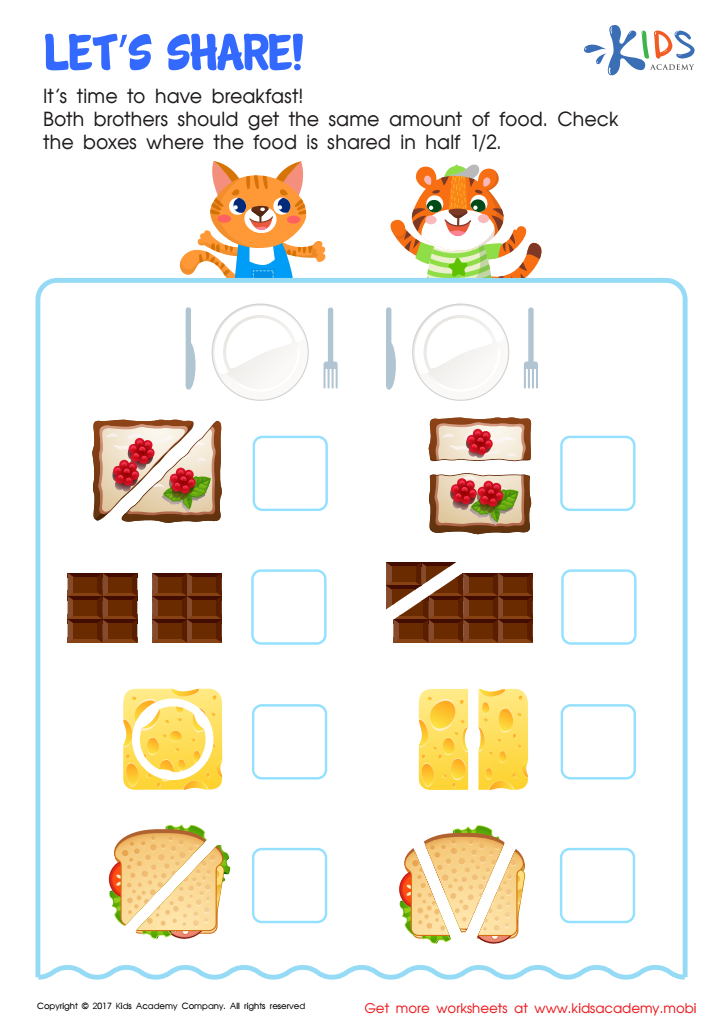
Let's Share Worksheet
 Assign to My Students
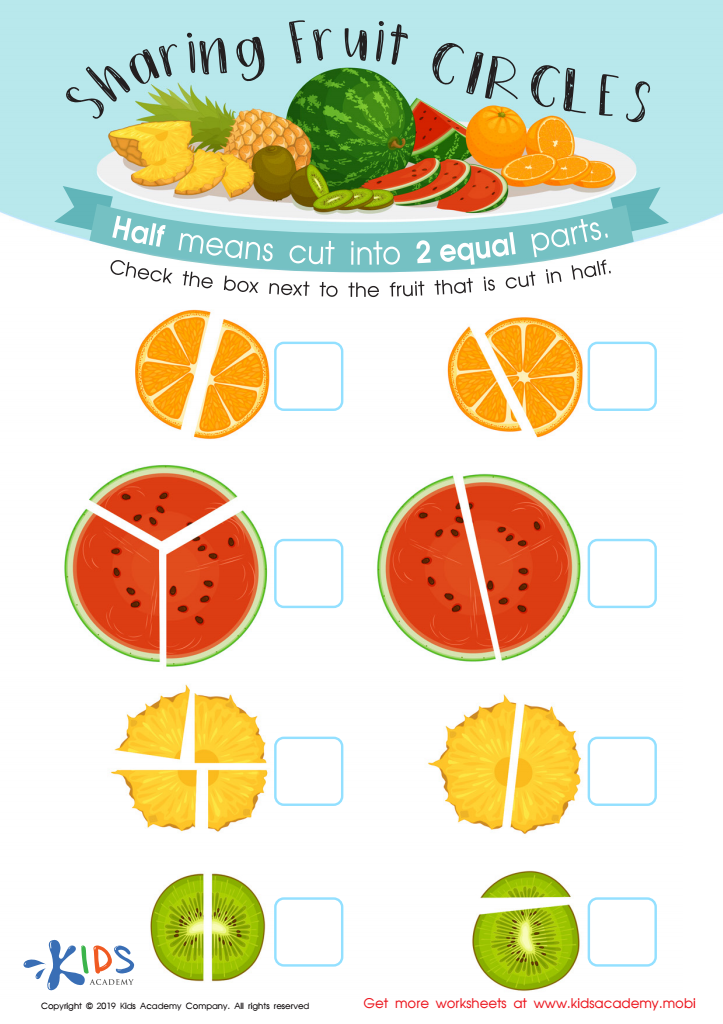
Sharing Fruit Circles Worksheet








Understanding division at a young age is crucial for children's cognitive and academic development. At ages 4-7, children are in a critical period of learning fundamental concepts that form the foundation for more advanced mathematical skills. Introducing division early helps to build their number sense and problem-solving abilities, fostering an intuitive grasp of how numbers work together.
This early exposure also enhances children's logical thinking and spatial reasoning. When children comprehend how to divide objects or numbers into equal parts, they begin to understand the principles of fairness and sharing, which are essential social skills. Moreover, division is a proficiency that supports other areas of math and everyday life activities, such as telling time and understanding portions during meals or play.
Parents and teachers should care because fostering this early competence in division promotes self-confidence in young learners. It helps alleviate anxiety around math, turning it into a fun, manageable subject. Engaging educational activities, such as using toys or visual aids, can make learning division more relatable and enjoyable. By prioritizing these fundamental math skills, parents and teachers are investing in their children's future academic success and enabling them to handle more complex mathematical concepts with ease as they grow.








