
Understanding number relationships Worksheets for Ages 4-7
9 filtered results
Difficulty Level
Grade
Age
-
From - To
Subject
Activity
Standards
Understanding Number Relationships Worksheets for Ages 4-7
Unlock your child’s numerical potential with our Understanding Number Relationships Worksheets designed for ages 4-7! These interactive printables engage young learners through fun activities that build core math skills. Children explore concepts like counting, comparing numbers, addition, subtraction, and number bonds. Through colorful and age-appropriate exercises, kids develop a solid foundation in number sense and mathematical reasoning. Ideal for classroom or home learning, these worksheets foster early math confidence and prepare children for future success. Start your child's mathematical journey today with Kids Academy’s expertly crafted resources!
Favorites
With answer key
Interactive
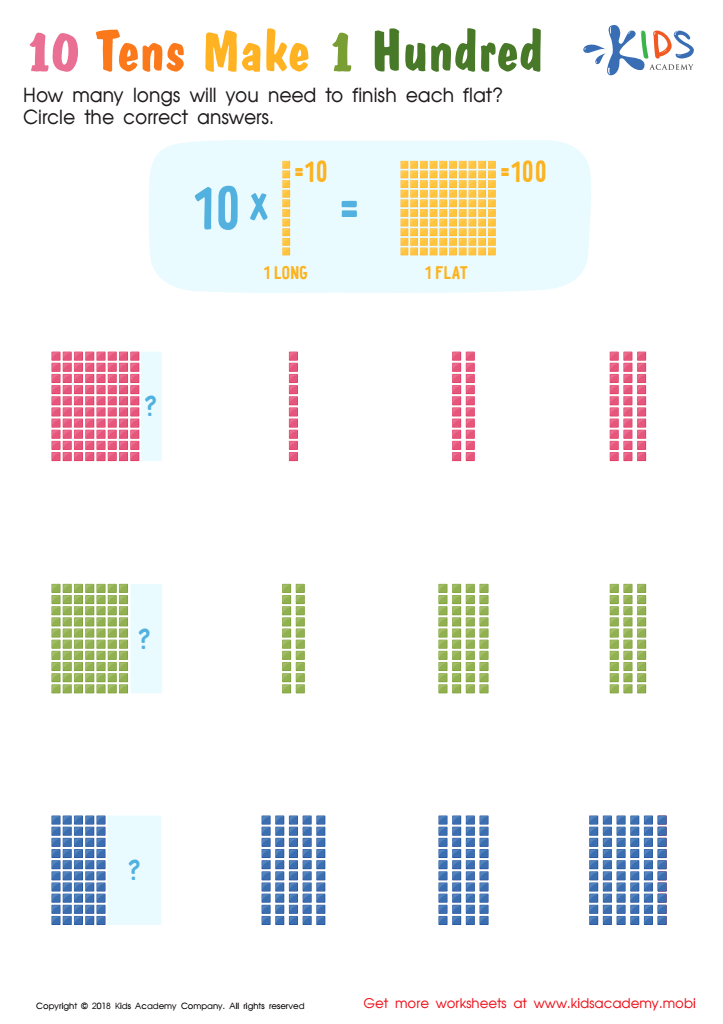
10 Tens Make 1 Hundred Worksheet
Help your child understand multiplication with this worksheet. Ask them how many 'longs' will be needed to complete each flat, then have them circle the correct answer from the options. With this exercise, your child will learn that 10 'tens' make 1 'hundred'!
 Assign to My Students
10 Tens Make 1 Hundred Worksheet
Worksheet
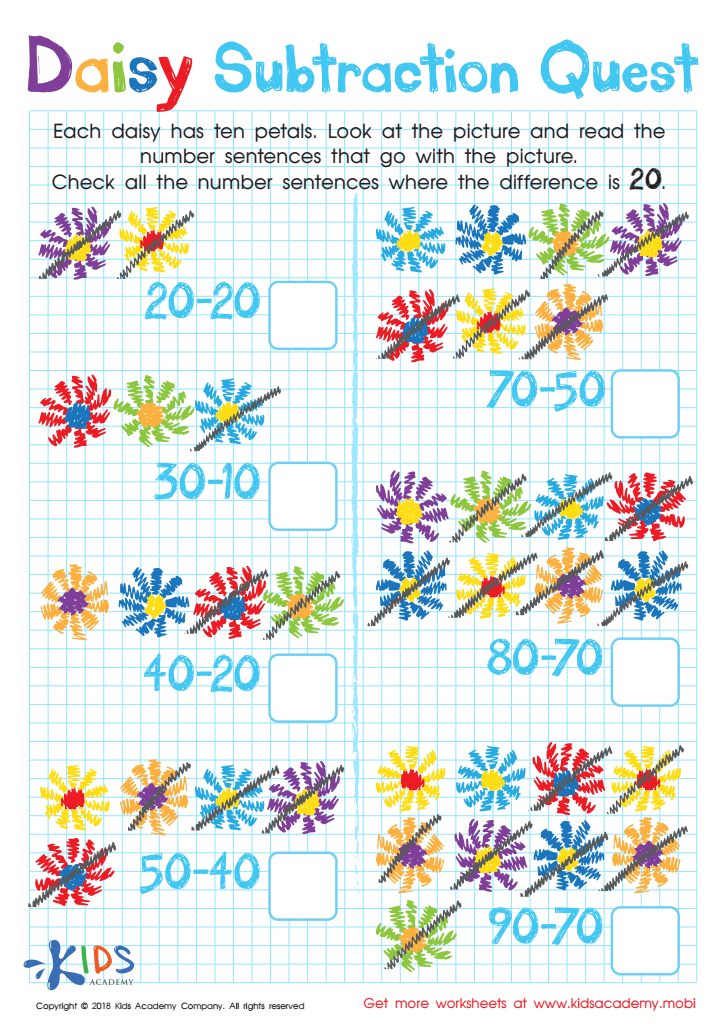
Daisy Subtraction Quest Worksheet
Ohh-la-la! These daisies are something special! With ten petals each, they're perfect for helping little math learners use tens to find number sentences that differ by 20. Our free worksheet is full of bright colors to engage and easy questions to strengthen math automaticity and confidence.
Daisy Subtraction Quest Worksheet
Worksheet
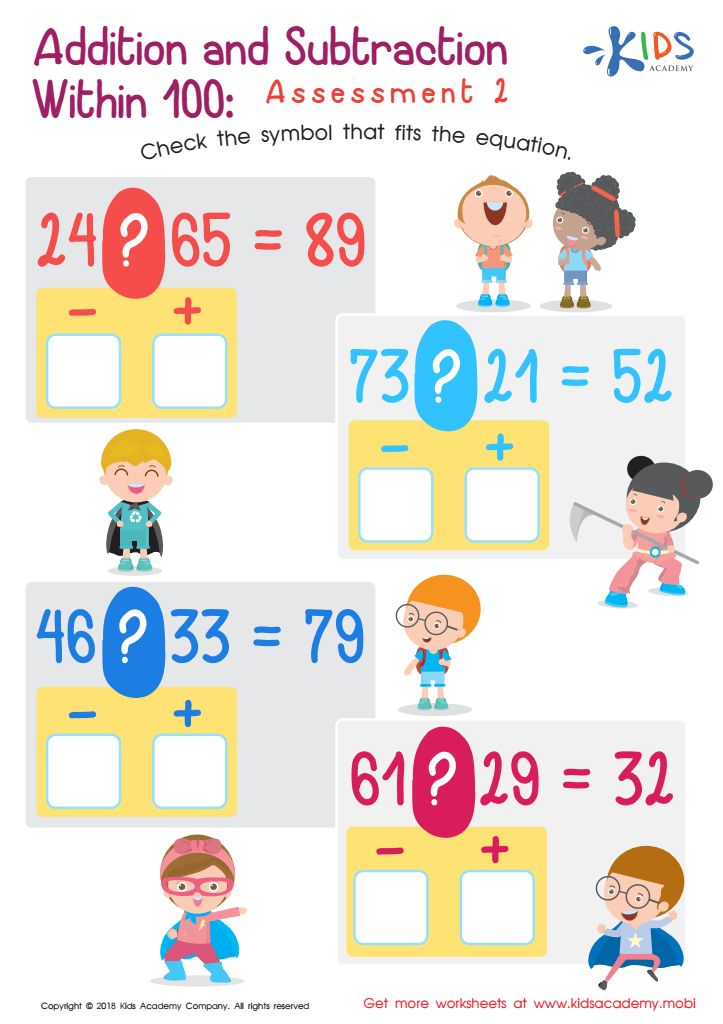
Addition and Subtraction Within 1: Assessment 2 Worksheet
This worksheet is a great tool to help your students learn addition and subtraction. It contains four equations in a printable pdf. Ask your students to review the equation and determine if the symbol between them is a '+' or '-'. Guide them in selecting the correct symbols for each equation.
Addition and Subtraction Within 1: Assessment 2 Worksheet
Worksheet
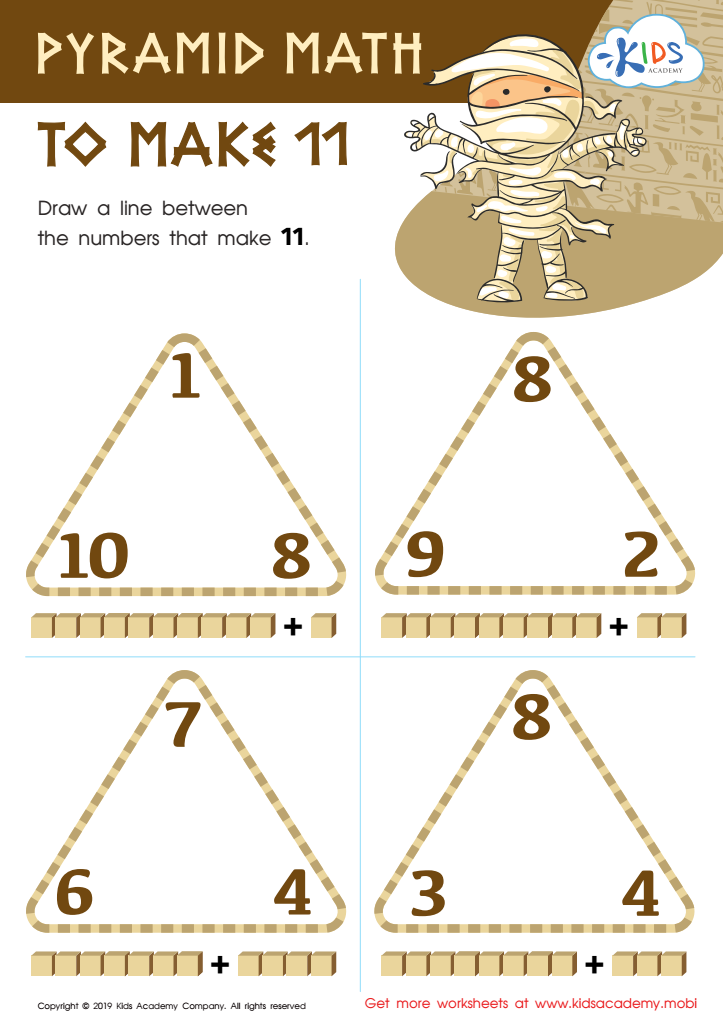
Pyramid Math to Make 11 Worksheet
Have your kids look at the picture of the Egyptian pyramids and tell you what they see. Then, help them do simple math by adding up the numbers in the pyramids and connecting those that make 11. This worksheet is perfect for teaching your kids about history, mathematics, and problem-solving.
Pyramid Math to Make 11 Worksheet
Worksheet
Join Kids Academy for Free
Who is primarily going to use this learning content?


.jpg)





Understanding number relationships for children aged 4-7 is foundational for their mathematical development and overall cognitive progress. At this early age, kids are naturally curious and absorb new information like sponges. Teaching them number relationships sets the groundwork for more complex mathematical concepts they will encounter later.
Number relationships refer to comprehension of how numbers interact, including grasping concepts of quantity, order, addition, subtraction, and patterns. When children understand that numbers relate to each other in predictable ways, they build a deeper, more flexible understanding of math. This flexibility allows them to tackle challenges creatively, improves their problem-solving skills, and lays a robust groundwork for future learning in mathematics, science, and engineering.
Moreover, mastering number relationships enhances a child's confidence and interest in math. Positive early experiences with numbers can dispel intimidation around the subject and foster a long-lasting positive attitude towards learning. Strong early math skills are also correlated with higher academic achievement in later years.
Therefore, parents and teachers should prioritize helping children at ages 4-7 comprehend number relationships. Doing so equips children with essential skills, encourages a love for learning, and sets them on a path towards academic success and mastery of critical life skills.








