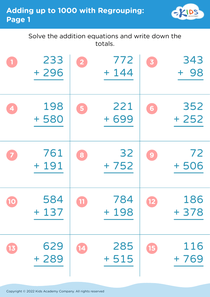
Counting practice Adding up to 1000 Without Regrouping Worksheets for Ages 4-7
4 filtered results
-
From - To
Welcome to our "Counting Practice: Adding Up to 1000 Without Regrouping Worksheets" designed for children ages 4-7. These engaging worksheets offer a fun and interactive way for young learners to practice their addition skills without the challenge of regrouping. Each activity helps strengthen their number sense and counting abilities as they work through easy-to-follow exercises that build confidence and foundation in math. With vibrant visuals and age-appropriate problems, your child will enjoy hours of educational practice while mastering addition up to 1000. Perfect for home or classroom use, these worksheets make learning math an enjoyable experience!
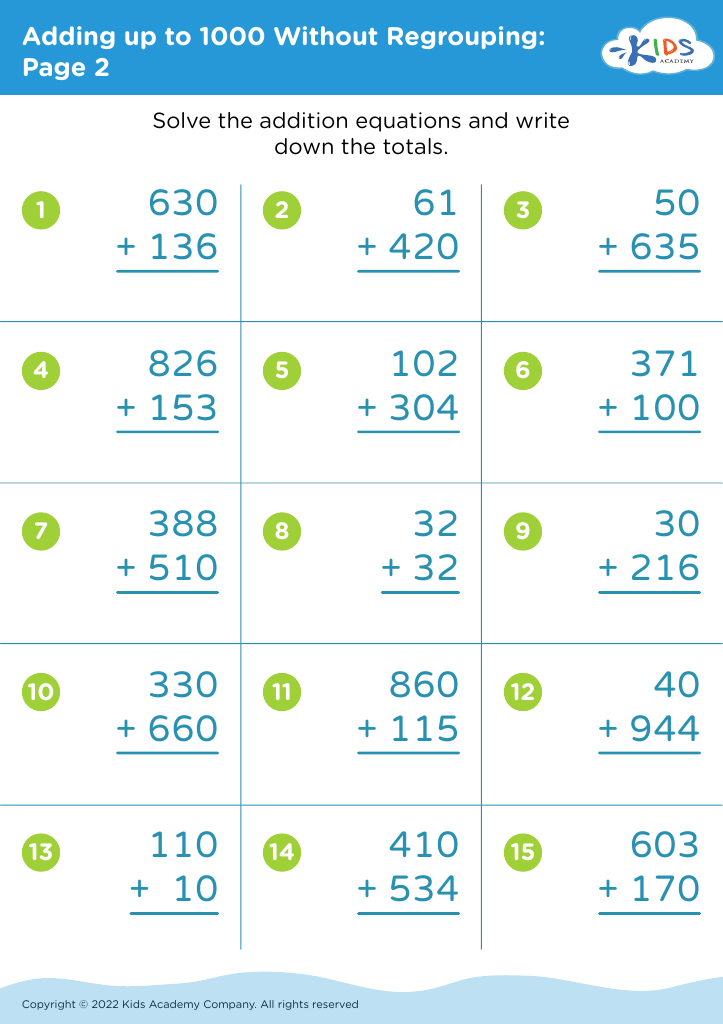
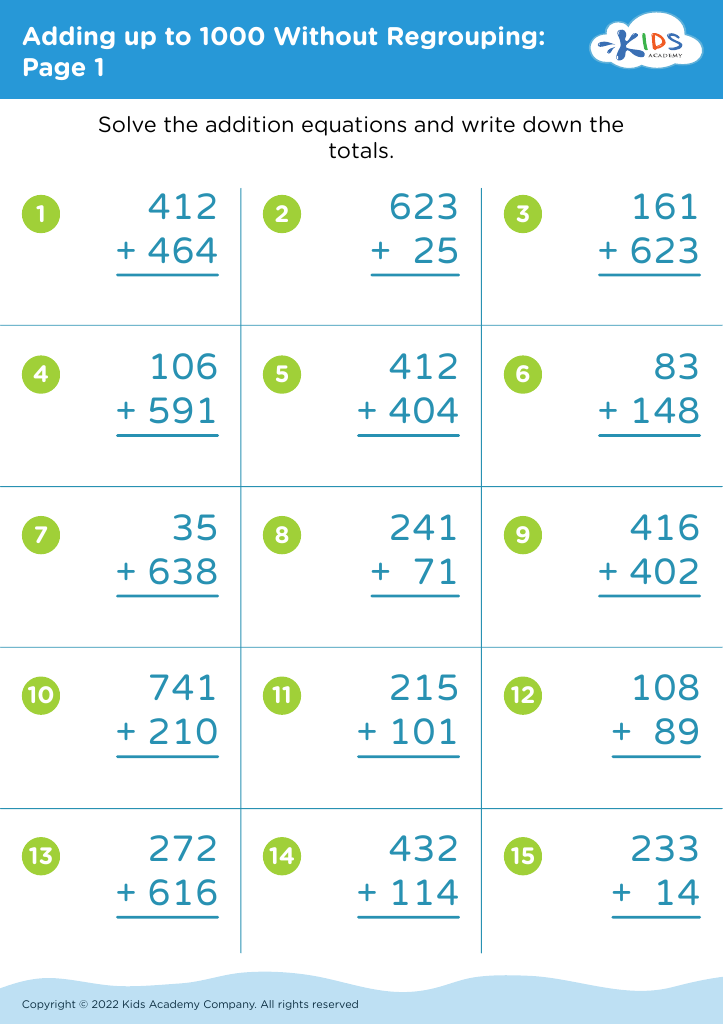
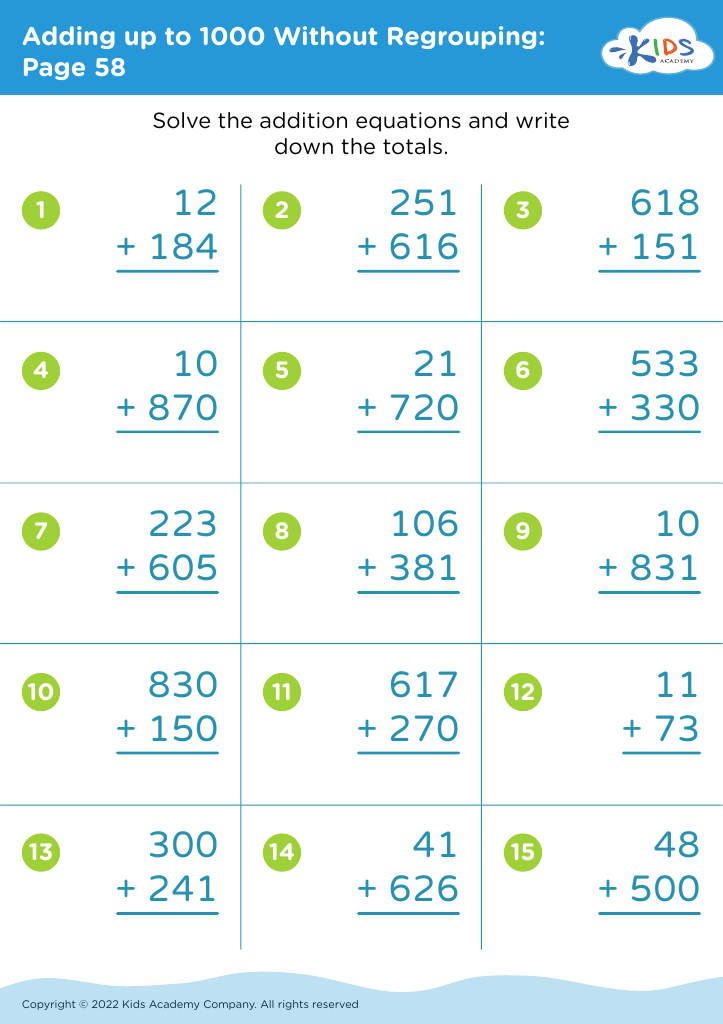
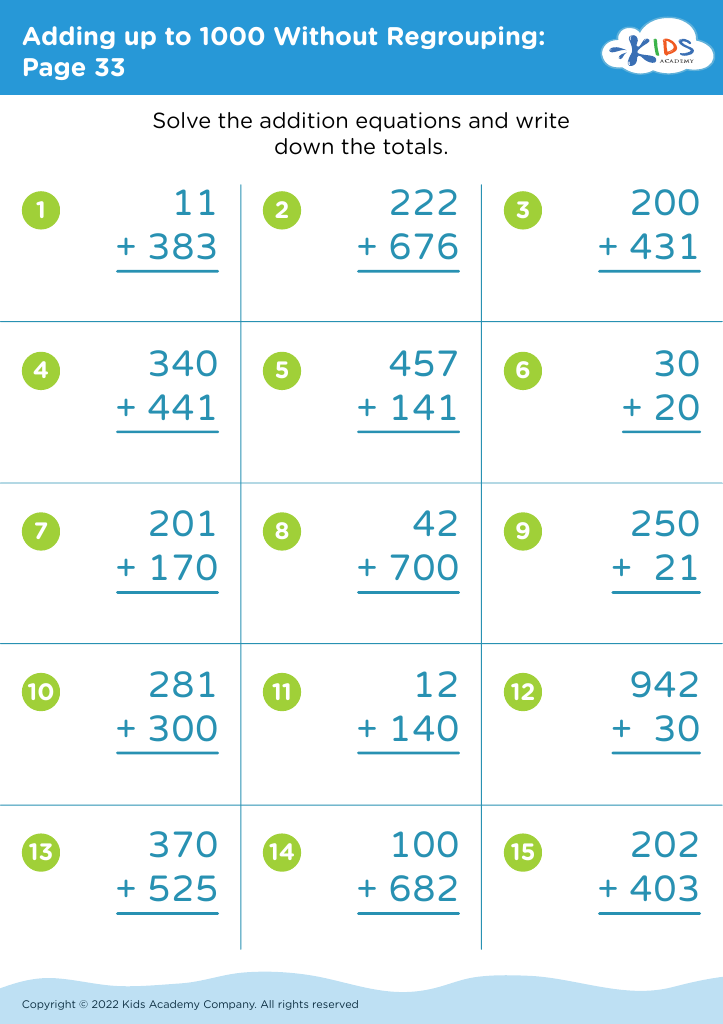


Counting practice, particularly adding up to 1000 without regrouping, is crucial for children aged 4-7 as it lays the foundation for their mathematical development. At this early stage, children are naturally curious and eager to explore numbers. Engaging them in counting helps solidify their numerical recognition and understanding, enhancing their confidence in math.
For both parents and teachers, focusing on instances like adding up to 1000 promotes essential cognitive skills. This practice encourages logical thinking and problem-solving abilities, which are vital in everyday life beyond academics. Additionally, mastering basic addition without regrouping cultivates mental math skills, allowing children to visualize and internalize concepts rather than rely solely on written methods.
Moreover, this age group is impressionable, and positive experiences with numbers can foster a lifelong interest in mathematics. As children interact with numbers, they develop cooperation with peers through group activities, reinforcing social skills. Parents and teachers, therefore, play a vital role in providing supportive environments for these practices to flourish, enabling kids to develop a strong mathematical foundation, paving the way for more complex concepts as they progress in their education. Engaging children early in math cultivates not just skill, but a mindset of curiosity and problem-solving.