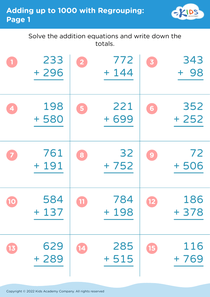
Develop counting skills Adding up to 1000 Without Regrouping Worksheets for Ages 4-7
3 filtered results
-
From - To
Enhance your child's counting skills with our engaging "Adding Up to 1000 Without Regrouping Worksheets" designed for ages 4-7. These worksheets provide a fun and interactive way for young learners to practice addition and build confidence in their math abilities. Featuring colorful illustrations and age-appropriate exercises, children will work on adding numbers effortlessly without the need for regrouping. Perfect for home or classroom use, our resources encourage independent learning and reinforce crucial foundational math skills. Encourage your child's journey towards numerical fluency and watch them thrive in their mathematical understanding while having fun with our thoughtfully crafted worksheets!
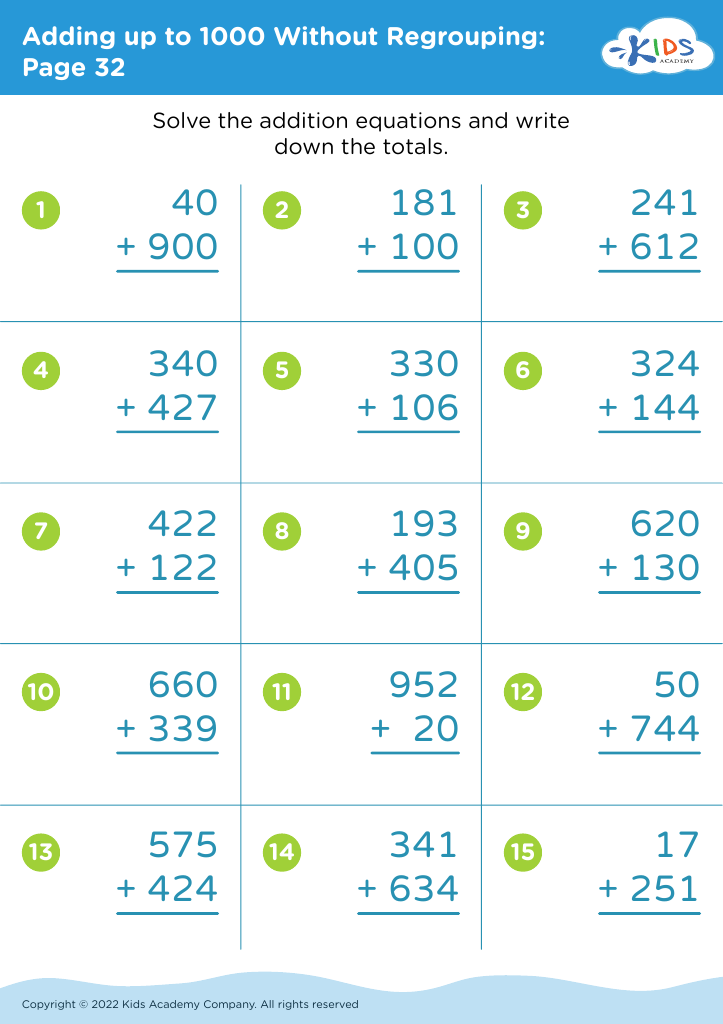
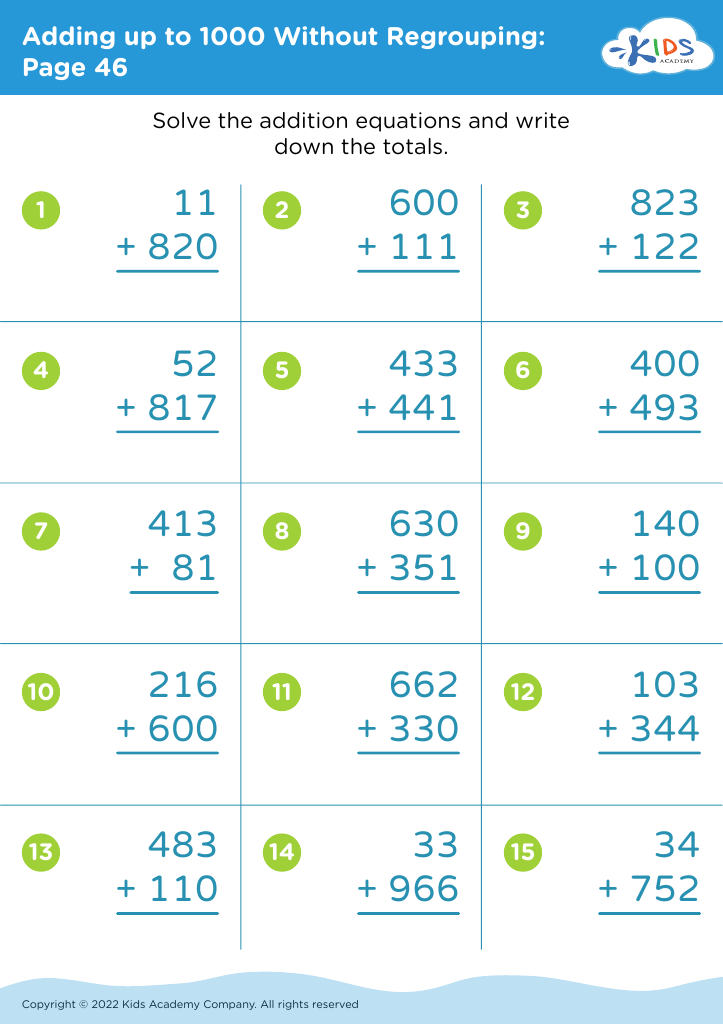
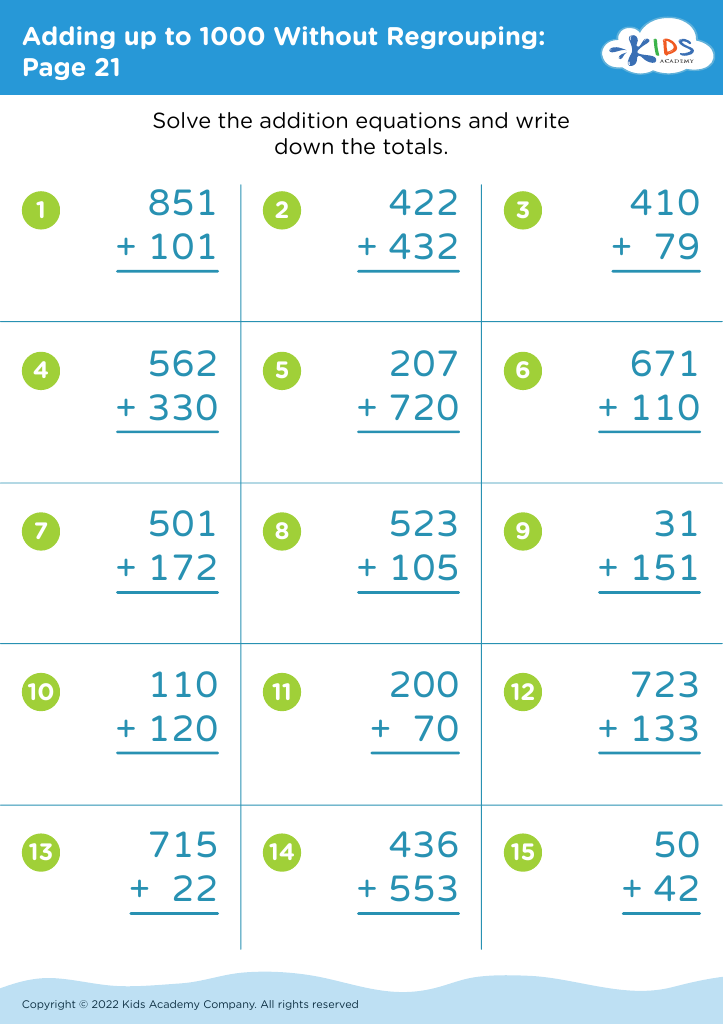


Developing counting skills in children ages 4-7, particularly focusing on adding up to 1000 without regrouping, is crucial for several reasons. Firstly, foundational math skills form the basis for future mathematical understanding and problem-solving abilities. Early learners who can count confidently and perform simple addition without regrouping develop a strong number sense that is essential for tackling more complex concepts later on.
Additionally, mastering counting skills enhances cognitive development. It strengthens focusing and memory retention, as children need to keep track of numbers as they add. Moreover, engaging with numbers helps children make meaningful connections between math and the real world, as they learn to quantify objects and recognize patterns.
For parents and teachers, fostering these skills can also build a child's self-confidence. When young learners successfully achieve these milestones, they feel a sense of accomplishment that can motivate them to embrace further challenges. Ultimately, investing time and effort in developing counting skills help children not only in math-related subjects but also in critical thinking and reasoning, laying the groundwork for academic success in various fields. In collaboration, parents and teachers can create a supportive environment that encourages practice and cultivates a positive attitude toward learning math.