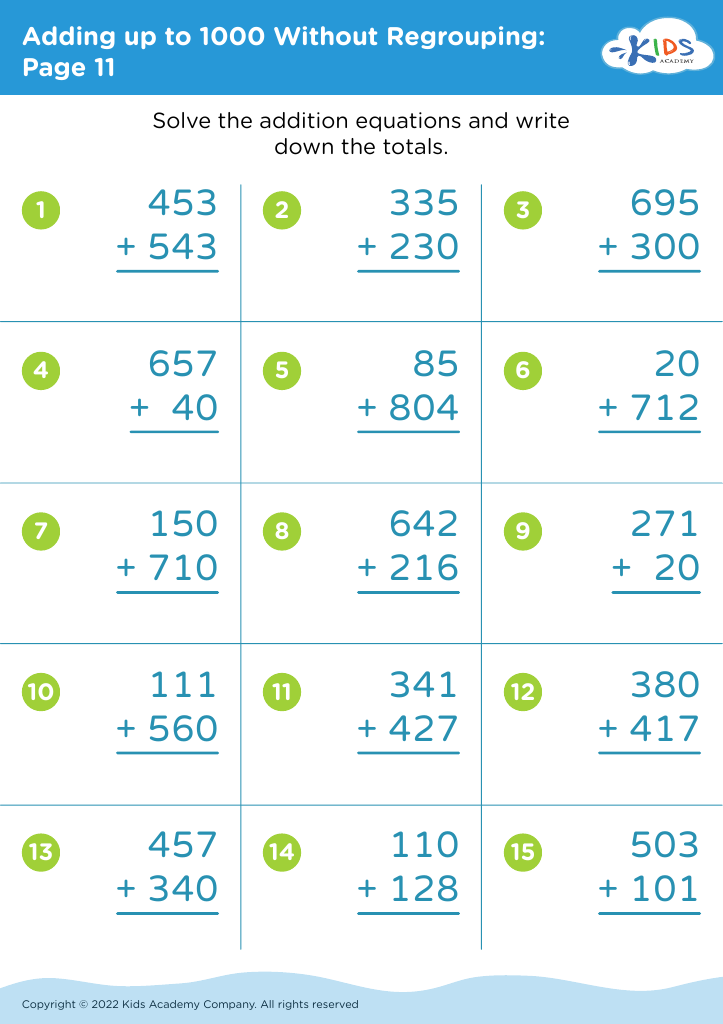
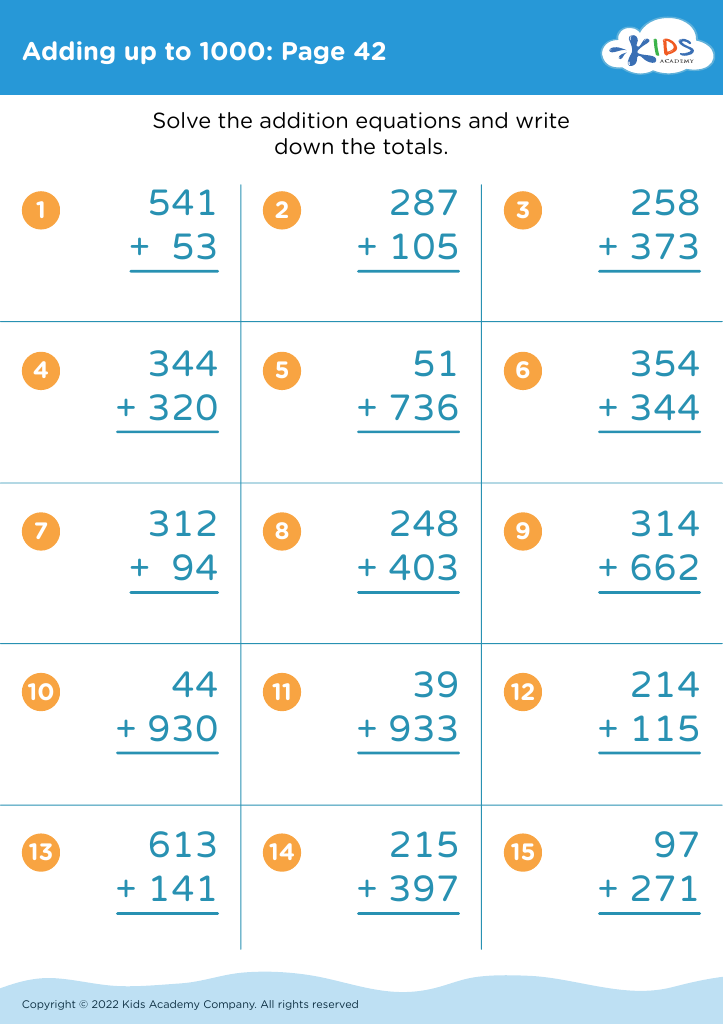




Parents and teachers should care about developing counting skills and the ability to add up to 1000 for children aged 4-7 because these foundational math skills are critical for future academic success and daily problem-solving. Mastery in early mathematics shapes a child's cognitive abilities, fosters numerical literacy, and boosts confidence in handling more complex mathematical concepts later. By emphasizing counting and addition, children learn to understand numbers as symbols that represent real-world quantities, which helps in practical activities like telling time, handling money, and measuring.
Early counting skills enhance memory, logical thinking, and the ability to follow systematic processes — all of which are transferrable skills essential in other subjects and everyday life. Moreover, proficiency in basic arithmetic at a young age is a predictor of higher achievement in mathematics and other academic areas during later schooling. Peer-reviewed studies show that children who build robust foundational math skills are likely to develop better problem-solving abilities and critical thinking skills.
Encouraging kids to count and add up to 1000 between ages 4-7 provides a comprehensive understanding of number magnitude and improves their ability to perform more intricate arithmetic operations, positioning them for a successful academic journey and fostering a lifelong independent learning attitude.








