Problem-solving practice Adding up to 1000 Worksheets for Ages 4-7
3 filtered results
-
From - To
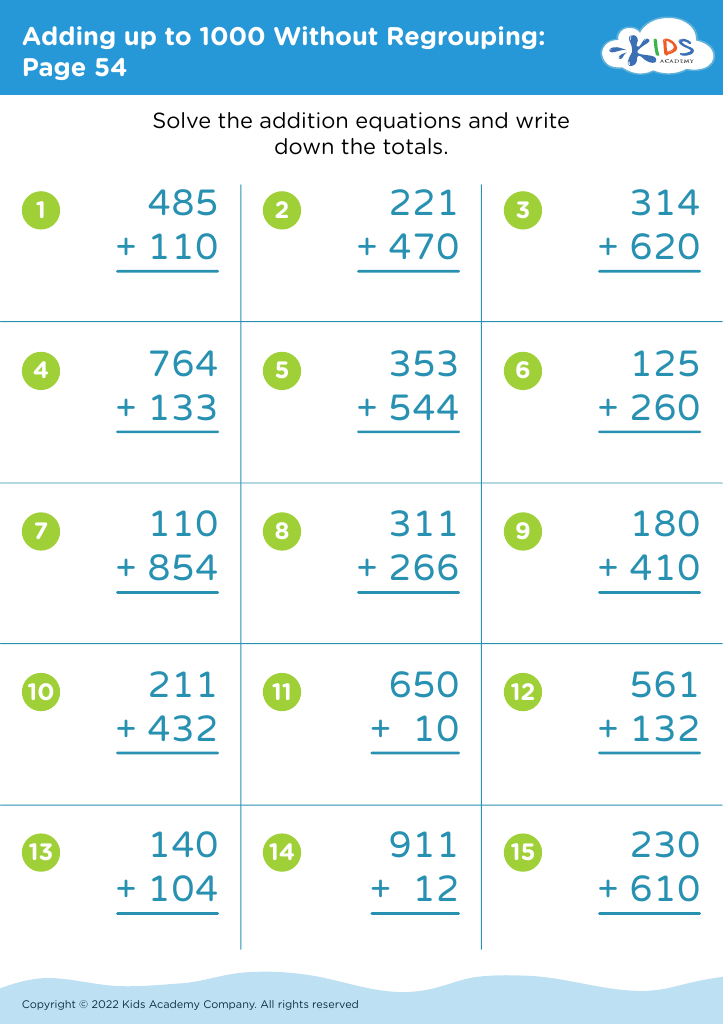
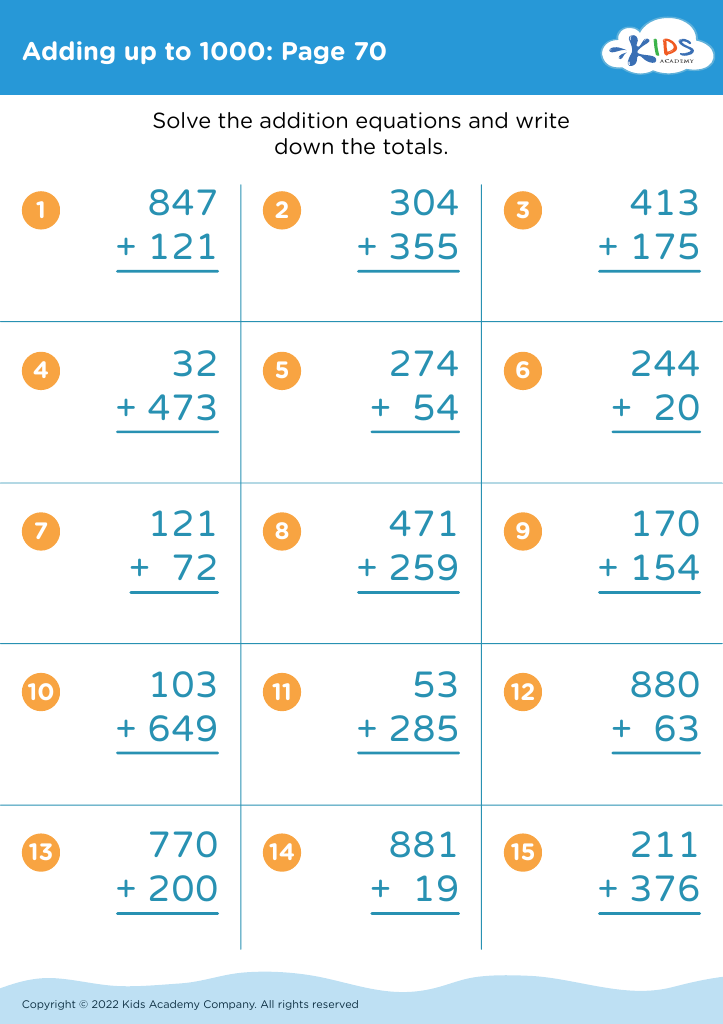
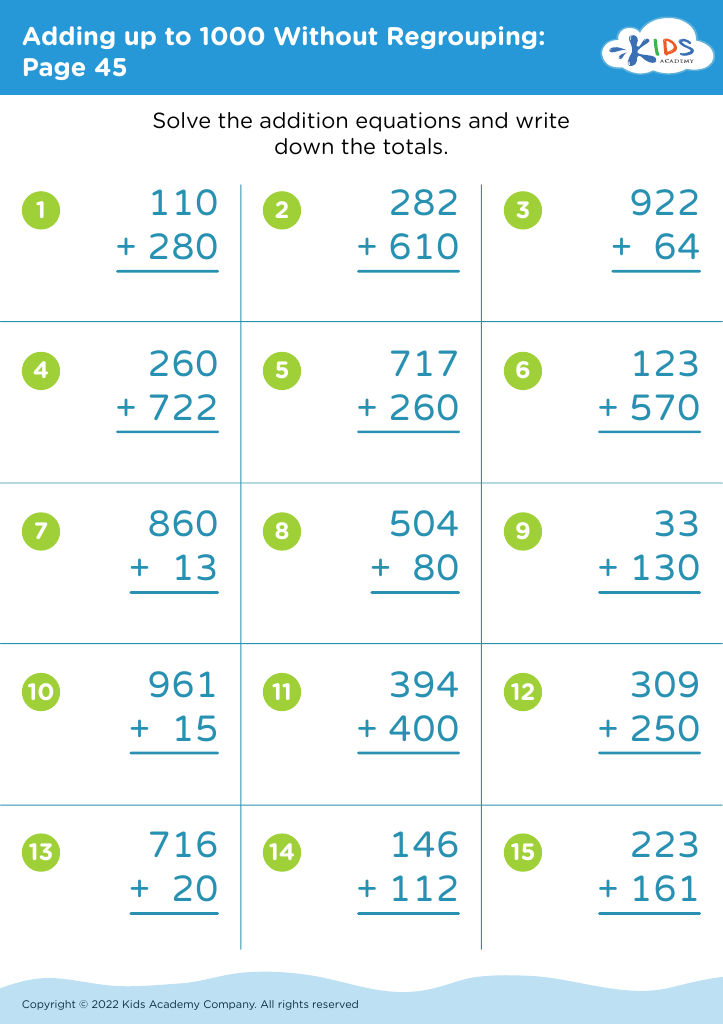
Unlock the potential of young minds with our "Problem-solving practice Adding up to 1000 Worksheets for Ages 4-7". Designed to enhance critical thinking and mathematical skills, these engaging worksheets help children practice adding up to 1000 in a fun and interactive way. Our activities support both individual learning and classroom settings, catering to the developmental needs of young learners. With colorful illustrations and strategic exercises, these worksheets keep kids motivated and excited about math. Perfect for parents and educators who want to cultivate a strong foundation in math and problem-solving, set the stage for a successful educational journey!



Parents and teachers should prioritize problem-solving practice that includes adding up to 1000 for children aged 4-7 because it cultivates foundational mathematical skills critical for future academic success. At this developmental stage, children are naturally curious and rapidly building cognitive abilities. Introducing them to higher-range addition molds their numerical understanding, enhances their computational skills, and fosters early confidence in handling more complex math concepts.
Practicing addition problems up to 1000 helps children recognize number patterns, develop logical thinking, and improve mental calculation abilities. These skills are crucial not only for mathematics but for various real-world situations requiring problem-solving and critical thinking. It also builds perseverance as children learn to approach and solve incrementally challenging problems, fostering a growth mindset.
Additionally, early exposure to advanced math tasks sets a strong foundation for later education. It bridges the gap between basic arithmetic and more complex math they will encounter in higher grades, ensuring they are prepared and less likely to struggle. Teachers and parents who actively engage children in these practices demonstrate the importance of mathematics, making learning enjoyable and integrative, cementing a positive attitude towards math in their formative years.








