Understand patterns Adding up to 1000 Worksheets for Ages 4-7
3 filtered results
-
From - To
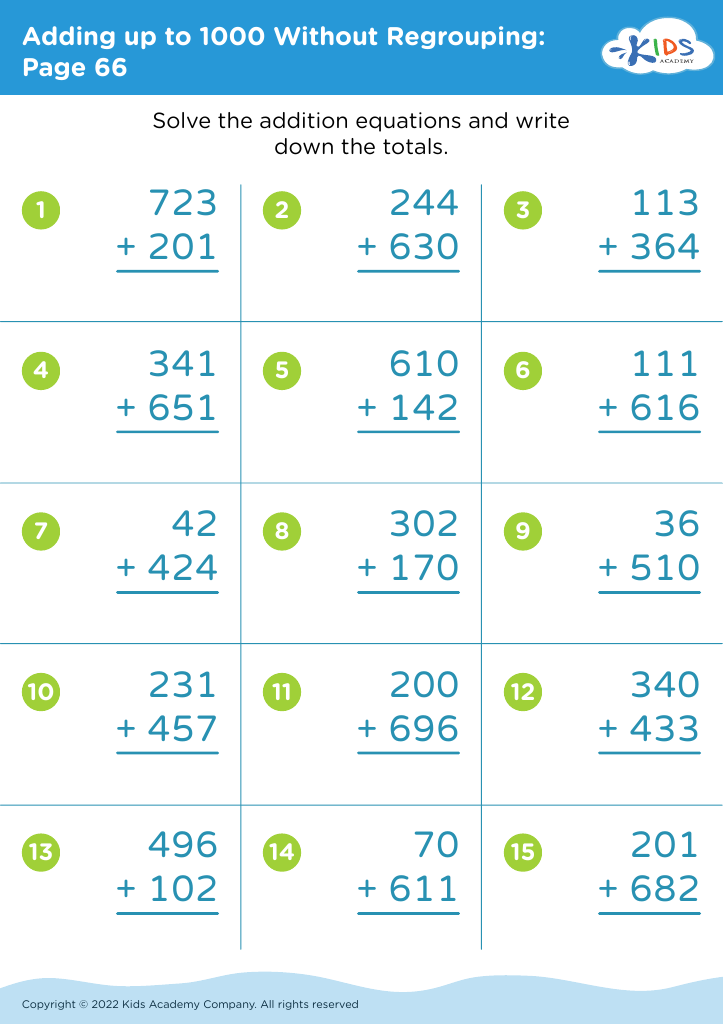
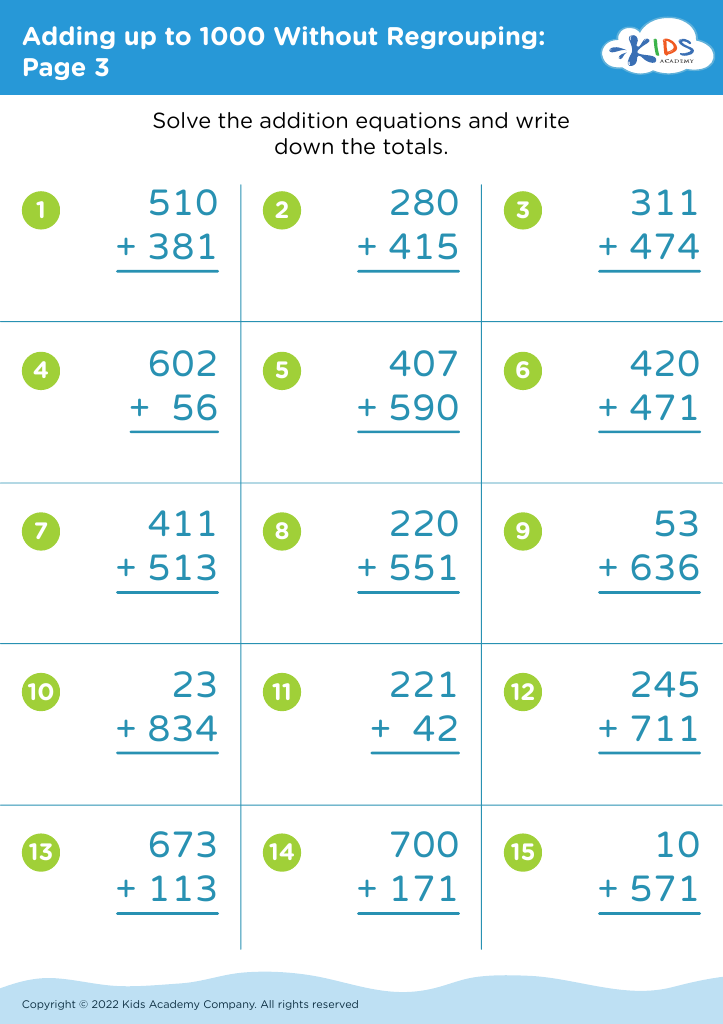
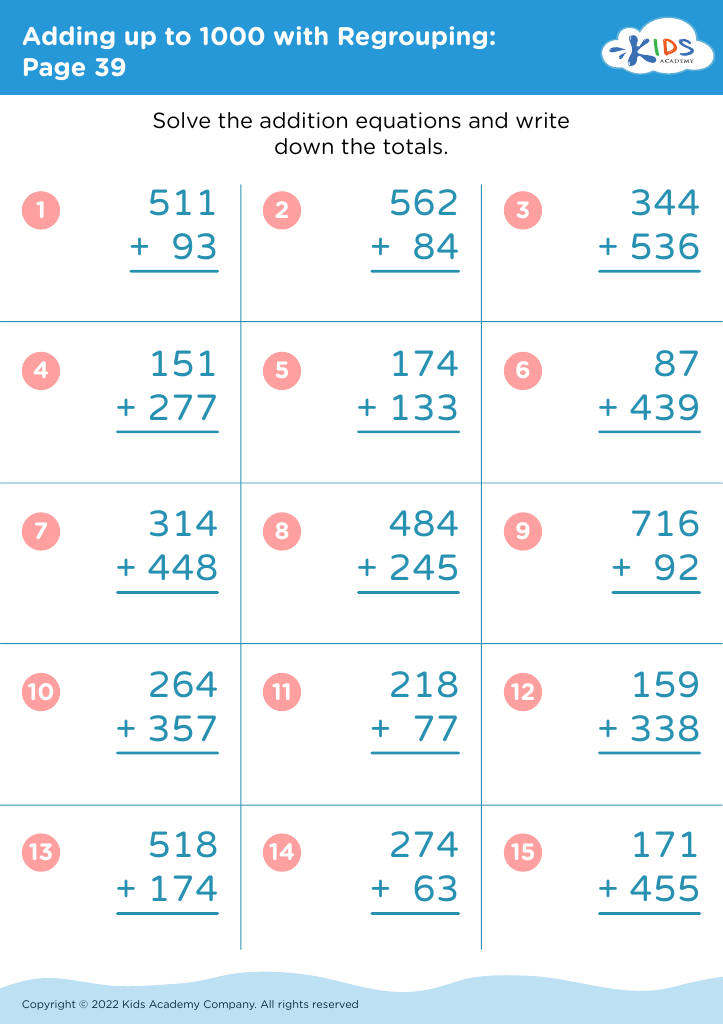
Explore our "Understand Patterns Adding Up to 1000 Worksheets" designed for children aged 4-7! These engaging worksheets help young learners recognize and understand numerical patterns, a foundational skill in math. Through fun exercises, children will practice adding up to 1000 while developing crucial problem-solving abilities and improving their number sense. Our thoughtfully crafted activities motivate kids to identify relationships between numbers, enhancing their overall mathematical understanding. Perfect for home or classroom use, these worksheets are an excellent resource for reinforcing pattern recognition and addition skills. Dive into an enjoyable learning experience that sets the stage for future success in math!



Understanding patterns and the concept of adding up to 1000 is essential for children aged 4-7 as it lays the foundation for critical mathematical skills. At this age, children are naturally curious and eager to explore numbers in various ways. By engaging them with patterns, such as recognizing sequences and relationships between numbers, we help develop their analytical thinking abilities. Patterns occur in many real-life situations, such as counting items, recognizing shapes, or telling time, making these concepts relatable and applicable to their everyday experiences.
Additionally, adding up to 1000 introduces children to larger numbers, enhancing their numerical literacy. Mastery of these foundational skills not only boosts their confidence in mathematics but also fosters a positive attitude toward learning. When children are comfortable with these concepts, they are more likely to engage in complex problem-solving and critical thinking in the future.
For parents and teachers, encouraging comprehension of patterns and addition helps in creating a well-rounded educational experience. It promotes cognitive development, supports future learning across subjects, and equips children with the tools needed for success in academics and everyday life. In essence, nurturing a strong understanding of these concepts prepares young learners for more advanced mathematical challenges ahead.








