Drawing skills Math Worksheets for Ages 4-7
7 filtered results
-
From - To
Enhance your child’s mathematical abilities and creative talents with our engaging Drawing Skills Math Worksheets for ages 4-7. Designed to seamlessly integrate math concepts with fun drawing activities, these worksheets help young learners strengthen their fine motor skills while mastering fundamental math skills, such as counting, shapes, and patterns. Ideal for preschool and early elementary students, these printable worksheets turn learning into an enjoyable experience. Parents and teachers will find these resources perfect for supporting classroom instruction and home practice, ensuring a solid foundation for future academic success. Download now and watch your child's confidence soar!
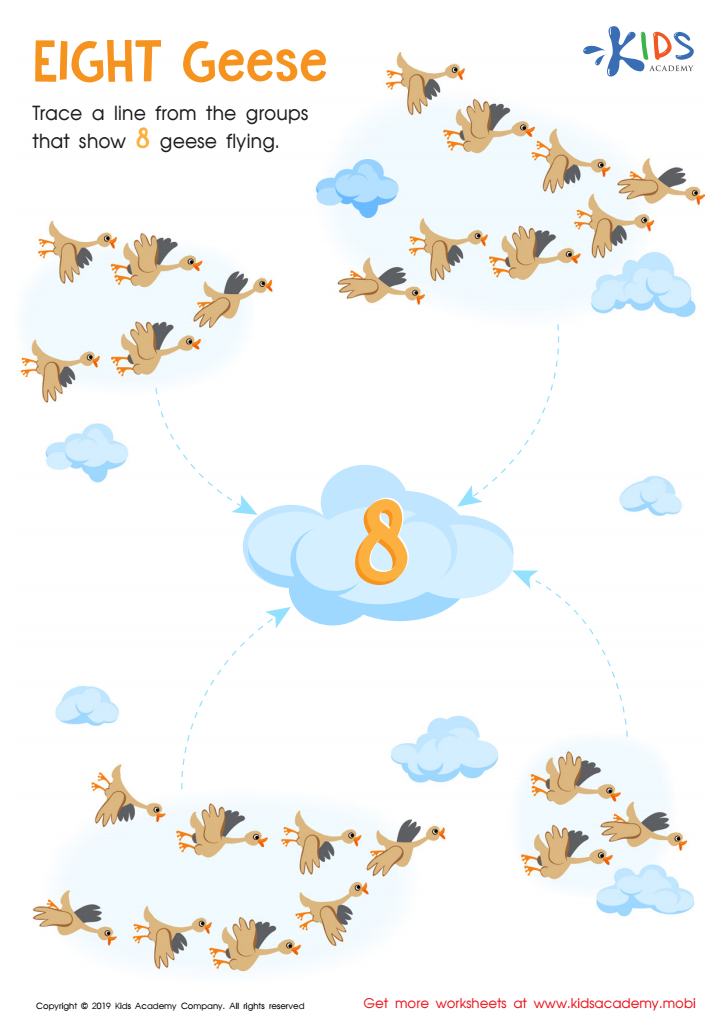
Eight Geese Worksheet
 Assign to My Students




.jpg)



Drawing skills in early childhood (ages 4-7) play a significant role in the development of mathematical abilities, and caring about this connection can greatly benefit children's overall cognitive growth. Firstly, drawing encourages children to develop fine motor skills, hand-eye coordination, and spatial reasoning – all foundational skills for mathematics. When children draw shapes, patterns, or scenes, they learn to recognize and manipulate geometric figures, fostering an intuitive understanding of spatial relationships.
Moreover, drawing activities often involve counting, sorting, and pattern recognition. For example, creating a picture with a certain number of objects, or repeating patterns, directly reinforces concepts like sequencing and one-to-one correspondence. These are crucial components of early math education. Encouraging drawing helps children visualize abstract math concepts, making them more concrete and understandable.
Parents and teachers should care about drawing skills because they support creative and critical thinking. Children who are interested in and enjoy drawing are more likely to see math as a fun and engaging subject. This positive attitude towards learning mathematics can lead to better engagement and success in later grades.
Ultimately, integrating drawing with math instruction helps create a holistic learning environment where children can thrive, blending creativity with analytical thinking and making early math experiences both enjoyable and educationally meaningful.








