
Understanding punctuation Worksheets for 4-Year-Olds
3 filtered results
Difficulty Level
Grade
Age
-
From - To
Subject
Activity
Standards
Explore our engaging Understanding Punctuation Worksheets for 4-Year-Olds, designed to introduce young learners to essential punctuation marks in a fun and interactive way. These worksheets feature colorful illustrations and simple activities that help children recognize and understand the purpose of commas, periods, question marks, and exclamation points. Ideal for preschool or kindergarten classrooms, our resources support early literacy skills while keeping little ones engaged. By incorporating playful exercises, your child will gain confidence in reading and writing, laying a solid foundation for future language development. Start your child's punctuation journey today with our imaginative and educational worksheets!
Favorites
With answer key
Interactive
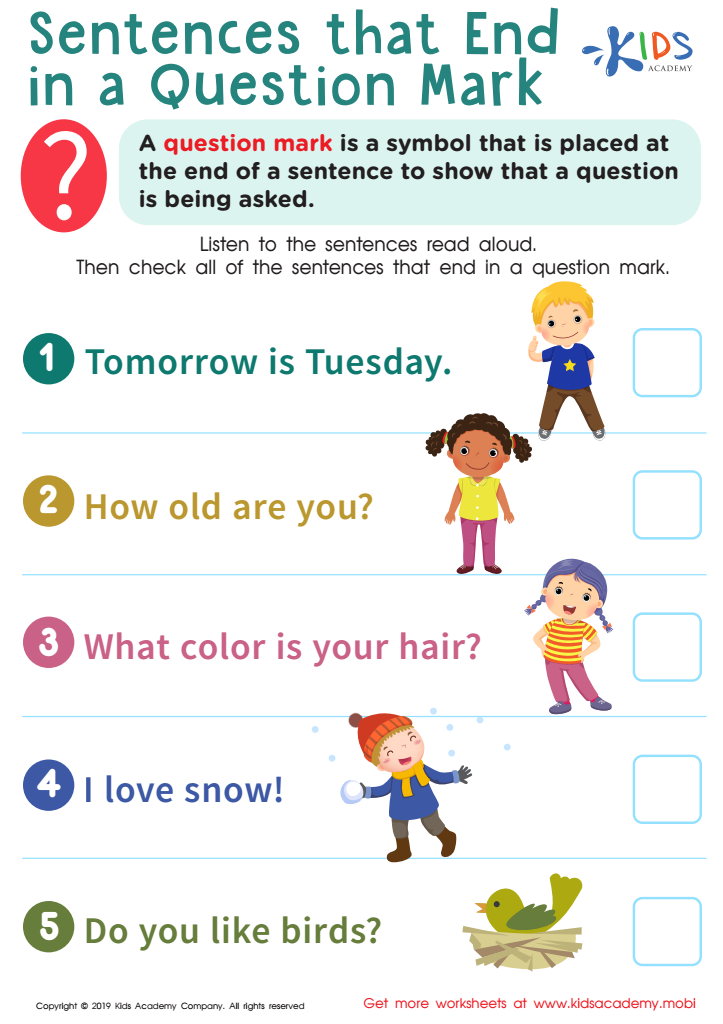
Sentences That End in an Question Mark Worksheet
Teach your students about the four most common punctuation marks - period, comma, question mark, and exclamation mark - with this worksheet. Show them how to use the question mark to indicate a sentence is a question. Then, have them check all sentences that end in a question mark.
 Assign to My Students
Sentences That End in an Question Mark Worksheet
Worksheet
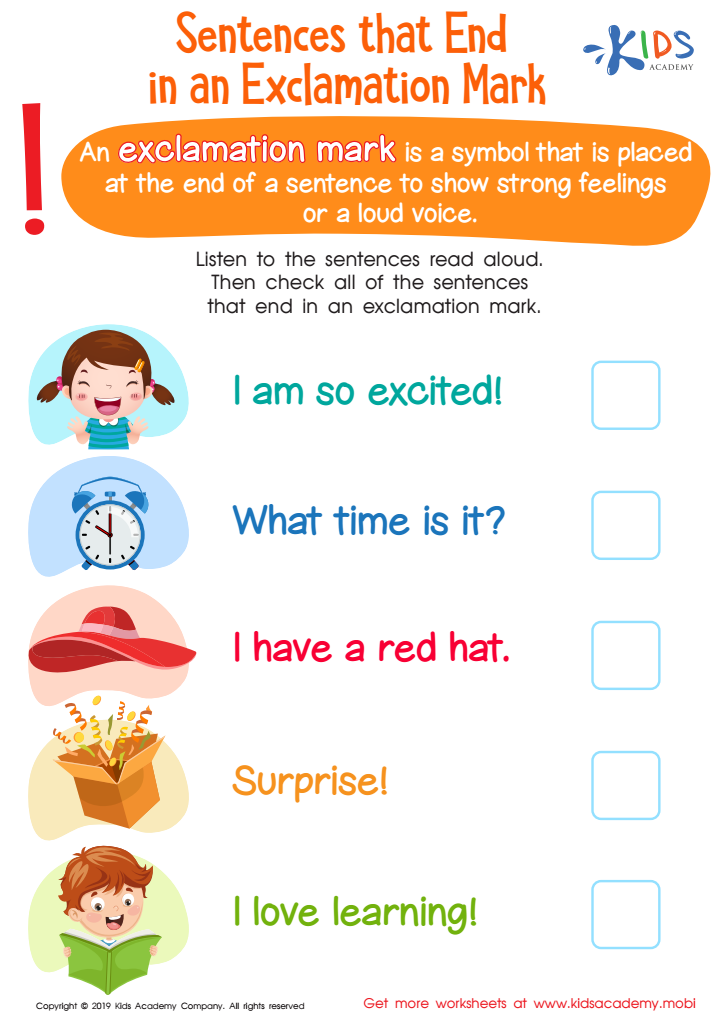
Sentences That End in an Exclamation Mark Worksheet
This worksheet is a great way to brush up kids' punctuation skills. Period, comma, question mark and exclamation mark are the first four punctuation marks they should learn. Exclamation marks show strong emotion or a noise. Use this printout to teach and test kids' understanding of exclamation marks.
Sentences That End in an Exclamation Mark Worksheet
Worksheet
Join Kids Academy for Free
Who is primarily going to use this learning content?







Understanding punctuation may seem advanced for 4-year-olds, but introducing its basic concepts can significantly benefit early language development. Firstly, punctuation marks serve as visual cues that help children comprehend the structure and flow of a sentence. By familiarizing young learners with periods, question marks, and exclamation points, teachers and parents can lay a foundation for effective communication.
When children recognize punctuation marks in texts, they learn to identify different types of sentences, enhancing their reading comprehension. This understanding encourages them to pay attention to tone, emphasis, and meaning, essential skills for later literacy. Additionally, knowing punctuation aids in building full sentences during their own writing, fostering creativity and self-expression.
Socially and emotionally, engaging with punctuation allows children to participate in storytelling and conversations more dynamically. They learn that feeling, questioning, or stating facts can be expressed through punctuation, thereby enriching their communication skills.
Moreover, early mastery of such concepts supports later academic success, as fluency in punctuation will be crucial as they navigate more complex texts in school. Thus, fostering an appreciation for punctuation from an early age is a valuable investment in a child’s educational journey.








