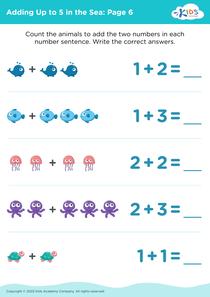
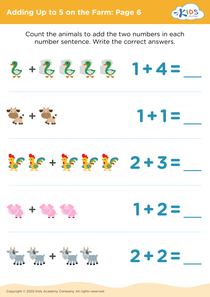
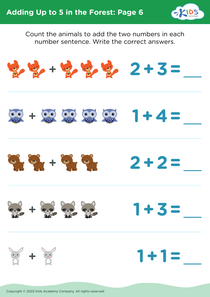
Hand-eye Coordination Adding at the Zoo Worksheets for 4-Year-Olds
3 filtered results
-
From - To
Our "Hand-Eye Coordination Adding at the Zoo Worksheets for 4-Year-Olds" offer a fun and interactive way to boost your child's math skills. Each worksheet is designed with vibrant zoo-themed illustrations that engage young learners, enhancing their ability to match and manipulate objects through counting and adding exercises. These activities not only improve hand-eye coordination but also build a solid foundation in basic arithmetic. Perfect for preschoolers, these worksheets make math learning exciting and effective, capturing their imagination while strengthening essential developmental skills. Download now to provide your child with a playful math adventure at the zoo!
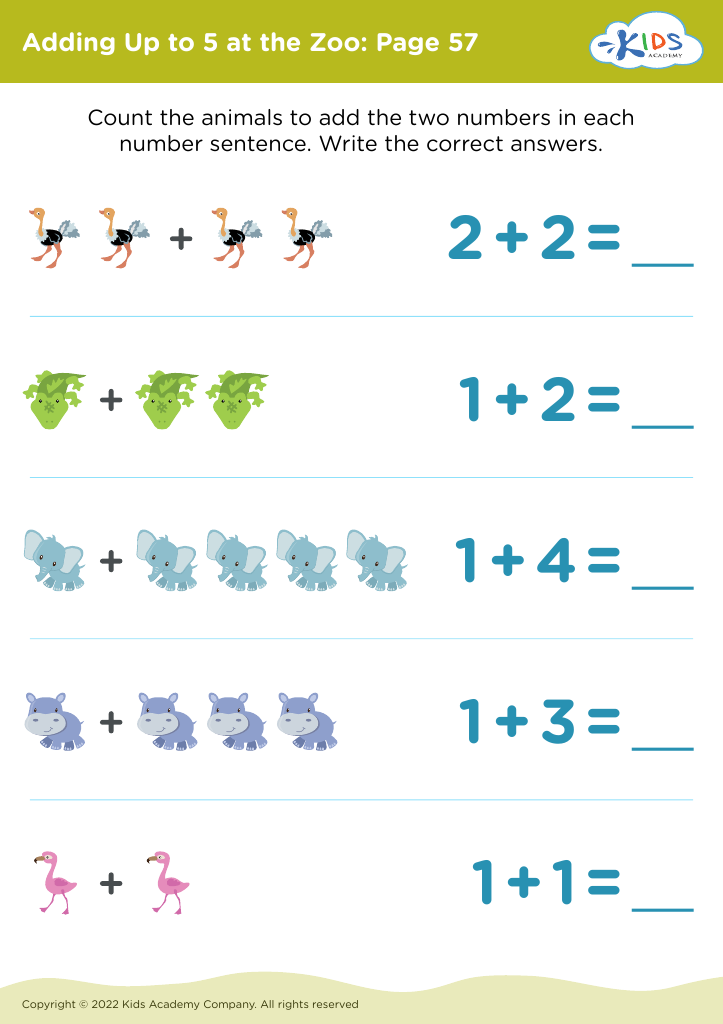
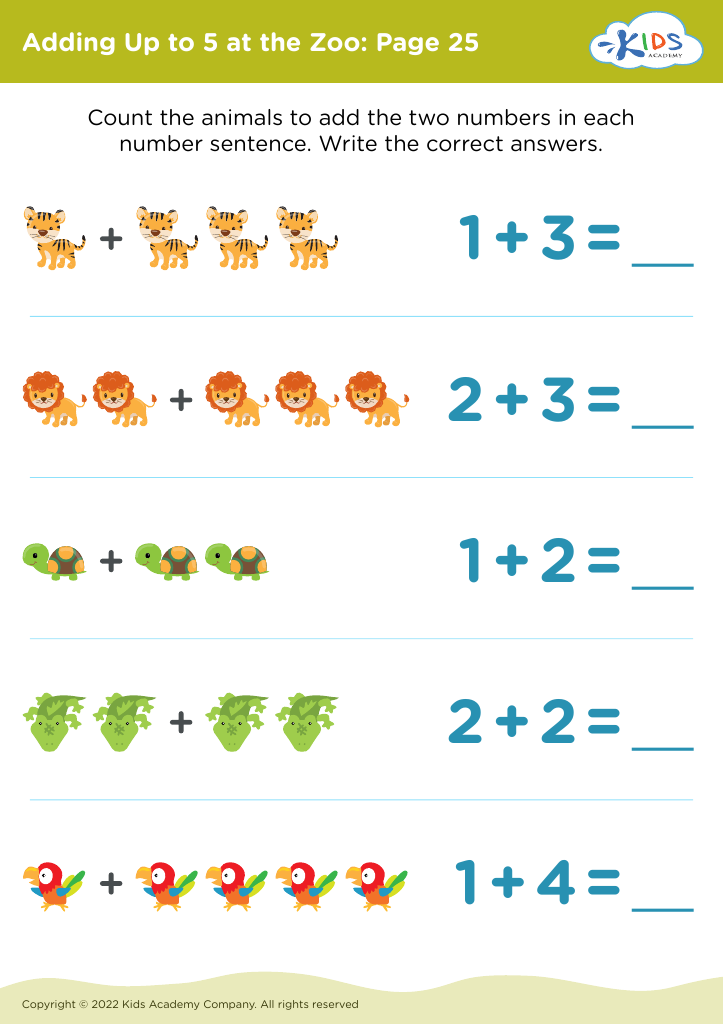
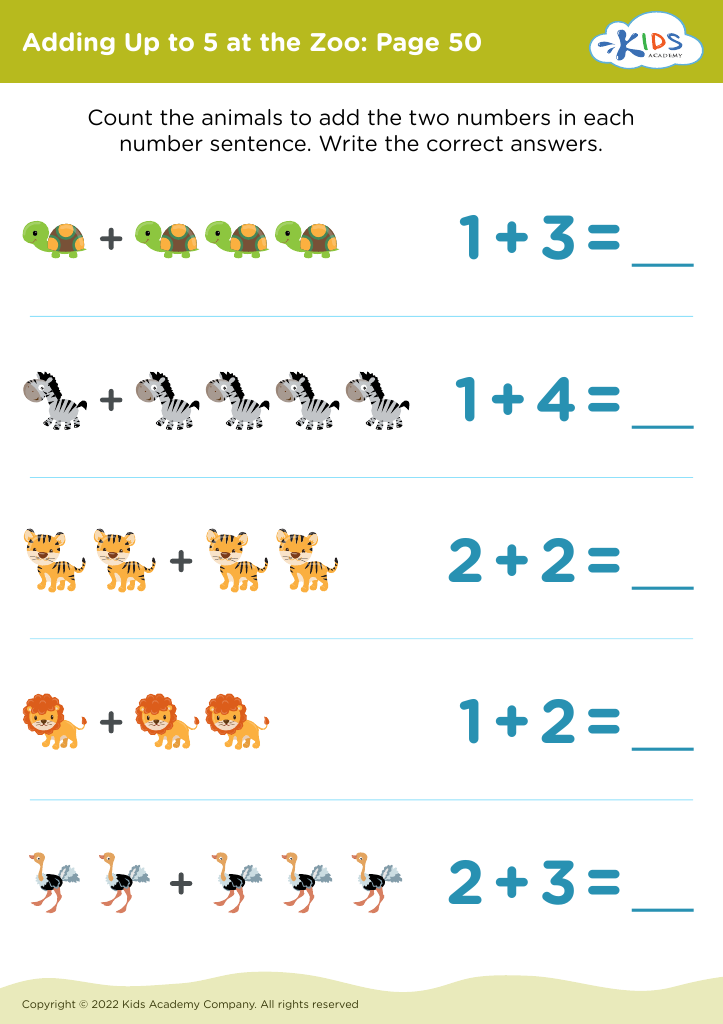



Hand-eye coordination is a critical developmental skill for young children, and incorporating activities that enhance this ability, such as Hand-eye Coordination Adding at the Zoo for 4-year-olds, is essential for both parents and teachers. At this age, children are rapidly developing their fine motor skills, visual-motor integration, and cognitive abilities, all of which are significantly supported by activities that require precise coordination between what they see and how they move their hands.
Engaging in Hand-eye Coordination Adding at the Zoo allows children to combine physical activity with cognitive challenges, reinforcing their ability to perform complex tasks smoothly and efficiently. For instance, counting animals while moving pieces in a zoo-themed game integrates academic learning with motor skills enhancement. This dual focus not only aids in muscle development but also promotes mathematical thinking and problem-solving capabilities, all wrapped in an enjoyable context that fosters a love for learning.
Moreover, strengthening hand-eye coordination is foundational for future academic and life skills. It underpins necessary activities such as writing, drawing, and even sports, laying down a robust framework for school readiness and beyond. Thus, by caring about these kinds of enriching activities, parents and teachers invest in a holistic developmental approach that optimizes the growth and potential of their young learners.