
Mathematical thinking Addition & Subtraction Worksheets for 4-Year-Olds
3 filtered results
Difficulty Level
Grade
Age
-
From - To
Subject
Activity
Standards
Discover our "Mathematical Thinking Addition & Subtraction Worksheets for 4-Year-Olds" designed to build foundational math skills. These engaging, age-appropriate activities introduce young learners to key concepts of addition and subtraction through fun, interactive exercises. Our worksheets aim to foster logical thinking, problem-solving, and numerical fluency, ensuring a solid grounding for future math success. Tailored for preschoolers, these easy-to-follow printable sheets make learning enjoyable while supporting early cognitive development. Boost your child's confidence in math with our expertly crafted resources, perfect for at-home practice or classroom use. Start their mathematical journey today!
Favorites
With answer key
Interactive
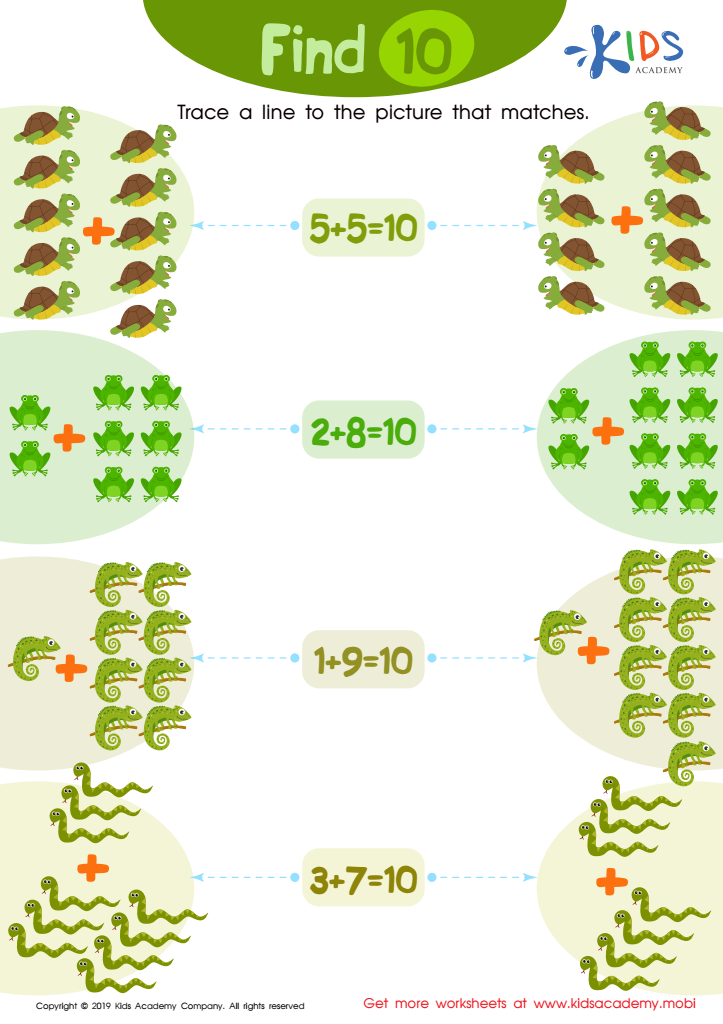
Find 10 Worksheet
Counting can be tricky, but your kids can master it with regular practice. Here's a fun activity to help: count the animals, then trace a line to the pictures that matches. With these tips, math will be an easy walk in the park.
 Assign to My Students
Find 10 Worksheet
Worksheet
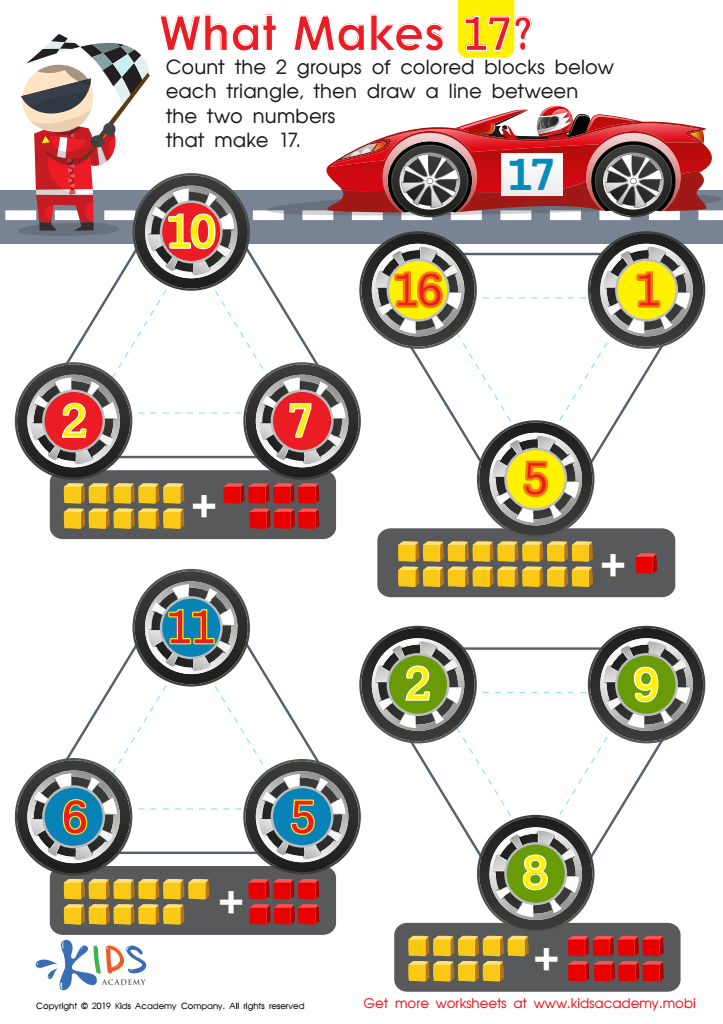
What Makes 17 Worksheet
Practice makes perfect! Let your kindergartners explore addition using this worksheet. Count the blocks in each triangle to reach the same total of 17, and draw a line between the two numbers. Once they get the hang of it, nothing will be too difficult!
What Makes 17 Worksheet
Worksheet
Join Kids Academy for Free
Who is primarily going to use this learning content?








Mathematical thinking, particularly addition and subtraction, for 4-year-olds is essential because it forms the foundation of numeracy skills necessary for future academic success and practical daily life. Early exposure to these concepts fosters cognitive development; children develop critical thinking and problem-solving strategies, which are crucial across various learning stages and subjects.
Teaching young kids addition and subtraction helps them understand the concepts of 'more than' and 'less than,' enhancing their comprehension of number relationships and quantities. This understanding translates to better performance in kindergarten and beyond, easing their integration when formal arithmetic becomes a core part of their education. Furthermore, early mathematical thinking is linked to overall brain development. It stimulates parts of the brain that handle logical reasoning, pattern recognition, and spatial awareness.
For parents and teachers, nurturing these skills is easily integrated into everyday activities, from counting toys during playtime to simple snack-time sharing. Involve kids in real-world applications, like counting apples into a basket or subtracting candies as they're eaten, giving context to abstract concepts. The infusion of basic math into routine tasks makes learning enjoyable, fostering a positive attitude towards math as they age. Ultimately, prioritizing early math skills equips children with foundational tools for academic achievement and life-long learning.








