
Fruit identification Math Worksheets for 4-Year-Olds
3 filtered results
Difficulty Level
Grade
Age
-
From - To
Subject
Activity
Standards
Nurture your child’s math and cognitive skills with our engaging "Fruit Identification Math Worksheets" designed specifically for 4-year-olds. These fun and educational worksheets combine the excitement of fruit identification with foundational math activities, such as counting and grouping. Children will enjoy recognizing various fruits while improving their number sense and problem-solving abilities. Each colorful page is tailor-made to capture young learners' attention, making learning both enjoyable and effective. Perfect for use at home or in early childhood education settings, our worksheets make mastering early math concepts delightful and interactive. Give your child a fruitful start in math today!
Favorites
With answer key
Interactive
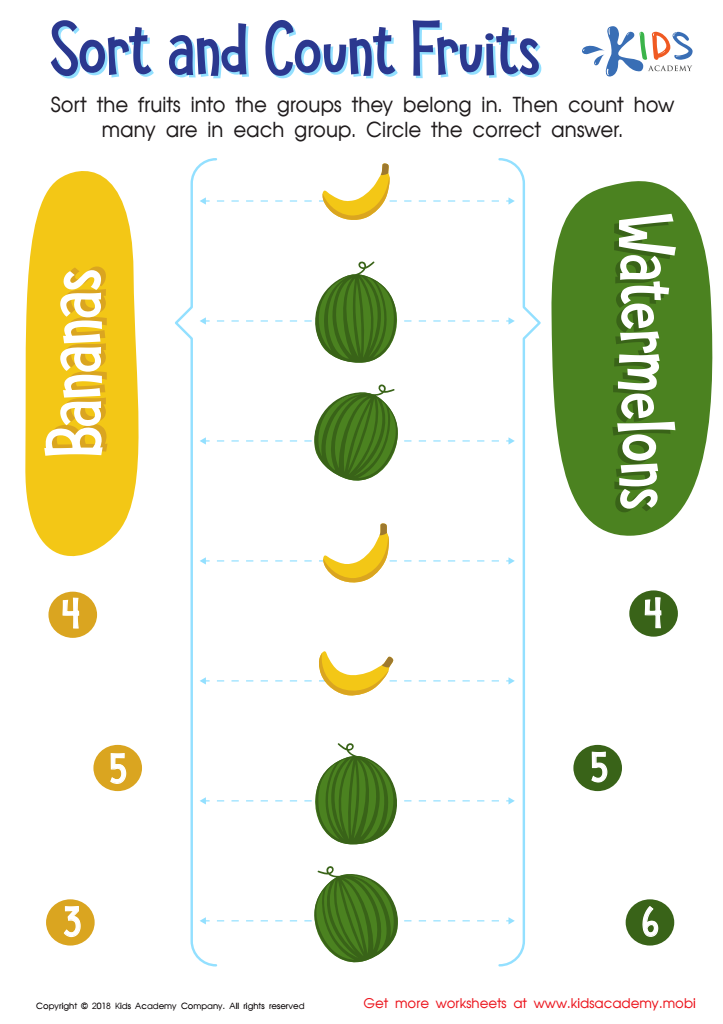
Sort and Count Fruits Worksheet
Allow your children to hone their critical thinking and number reasoning skills with this free worksheet. They'll sort, count, and trace fruits while learning basic number sense. A fun, delicious learning experience with familiar pictures they'll love.
 Assign to My Students
Sort and Count Fruits Worksheet
Worksheet
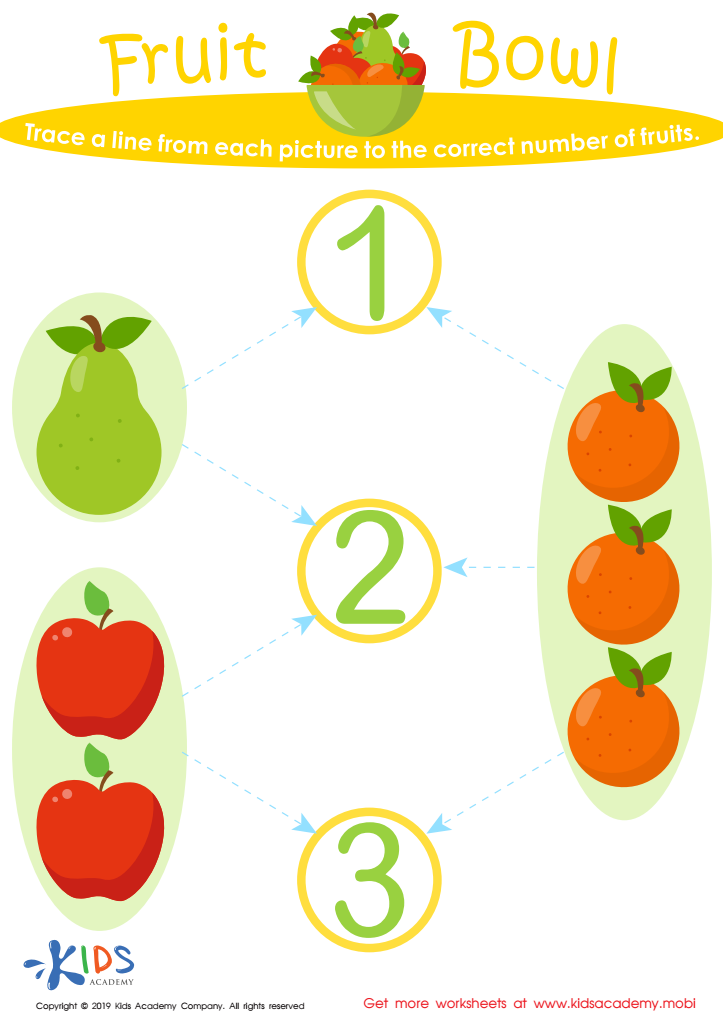
Fruit Bowl Worksheet
Kids love counting fruit! This fun math worksheet lets them count the number of fruit in each group and use the traceable lines to connect the correct number. It's a great way to learn one-to-one number representation, plus it's yummy and delicious!
Fruit Bowl Worksheet
Worksheet
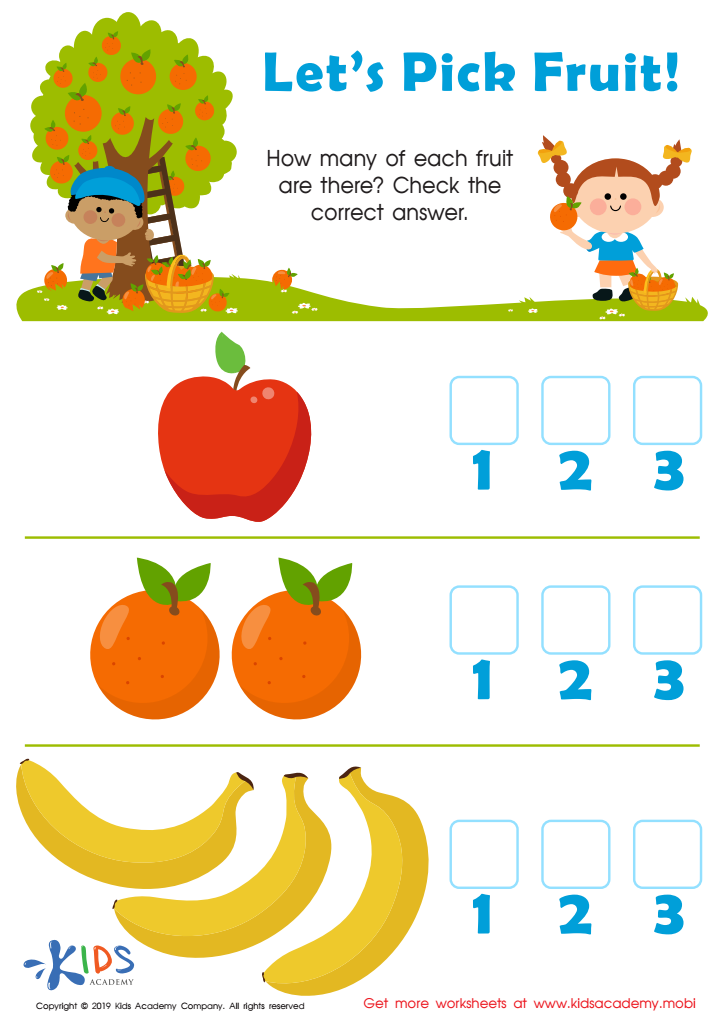
Let's Pick Fruit Worksheet
Picking fruit is fun - and counting it is even better! This free worksheet is perfect for young math learners. They'll use picture representation to count the fruit in each problem and then select the correct answer from the multiple-choice boxes. It's a great way to teach number sense in an easy, fun way!
Let's Pick Fruit Worksheet
Worksheet
Join Kids Academy for Free
Who is primarily going to use this learning content?








Fruit identification math for 4-year-olds is a fundamental activity that intertwines basic mathematics and cognitive development within a fun and engaging context. Parents and teachers should care about this for several important reasons.
Firstly, integrating fruit identification into math helps young children develop their counting and sorting skills. By counting apples, oranges, or berries, children learn basic numerical concepts while enhancing their understanding of quantities and numbers. Sorting different types of fruits by attributes such as color, size, or type facilitates cognitive development in areas such as categorization, pattern recognition, and logical reasoning.
Secondly, fruit identification math introduces children to the concept of variation and comparison. Simple activities, such as determining which fruit is bigger, smaller, more, or less, nurture their comparative skills and understanding of proportions—laying the groundwork for more advanced mathematical concepts in the future.
Additionally, associating learning with tangible objects like fruits makes the educational experience relatable and joyful, thereby fostering a positive attitude towards math from an early age. Fruits are familiar and visually appealing, aiding memory retention and making abstract concepts more concrete.
Finally, involving fruits in math exercises encourages a holistic approach to learning, wherein children simultaneously internalize lessons on nutrition and healthy eating. This dual emphasis on academic and physical well-being underlines the importance of interdisciplinary learning. In summary, fruit identification math is a multifaceted teaching tool that holistically supports early childhood development.








