
Visualization skills Math Worksheets for 4-Year-Olds
3 filtered results
Difficulty Level
Grade
Age
-
From - To
Subject
Activity
Standards
Enhance your 4-year-old's mathematical understanding with our engaging Visualization Skills Math Worksheets! These expertly designed resources help young learners develop critical spatial awareness and problem-solving skills. Each worksheet offers fun, age-appropriate activities that encourage children to visualize and solve puzzles, patterns, and sequences, laying a strong foundation for future math success. Perfect for home or classroom use, our vibrant worksheets captivate young minds and make learning math an enjoyable adventure. Download today to support your child's cognitive development and watch them thrive in math with confidence and excitement!
Favorites
With answer key
Interactive
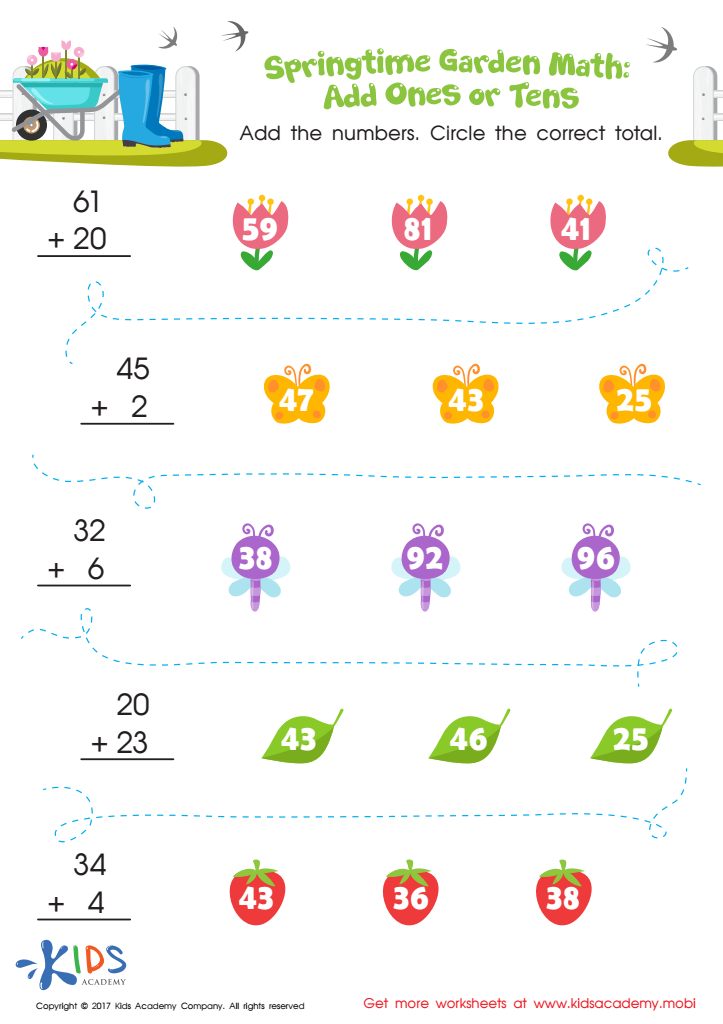
Springtime Garden Math Worksheet
Get your kid ready for math success with this bright garden-themed addition worksheet! They'll practice adding two-digit numbers and check their answers with the choices provided. It's an effective way to help kids build skills, as practice strengthens understanding. Get printing for math mastery!
 Assign to My Students
Springtime Garden Math Worksheet
Worksheet
Join Kids Academy for Free
Who is primarily going to use this learning content?








Visualization skills are critical for early childhood math development and should be a focus for parents and teachers working with 4-year-olds. At this age, children are in a crucial period of cognitive development where they start to grasp basic mathematical concepts. Visualization helps them to comprehend and internalize these concepts more effectively.
For instance, when children are able to visualize numbers, patterns, and shapes, they can better understand counting, sequencing, and spatial relationships. This lays a strong foundation for future mathematical learning. Visualization also aids in problem-solving and critical thinking, as children learn to picture what a problem looks like and map out potential solutions in their heads.
Moreover, involving visualization in math makes learning more engaging and fun. Children are naturally visual learners, and using colorful objects, images, and interactive activities can significantly enhance their interest and retention. Techniques such as drawing, using blocks, and playing educational games enable kids to see abstract concepts in a tangible form, making the learning process enjoyable and effective.
In essence, nurturing visualization skills in young learners helps instill a positive attitude towards math. It opens doors for successful future learning, builds confidence, and equips children with essential tools to tackle increasingly complex mathematical challenges as they grow.








