Phonics Skills Initial and Final Consonant Blends Worksheets for Ages 5-6
3 filtered results
-
From - To
Unlock the world of reading for your young learner with our "Phonics Skills: Initial and Final Consonant Blends Worksheets" specifically designed for ages 5-6. These engaging, printable worksheets from Kids Academy focus on essential phonics skills, helping to build a strong reading foundation. Perfect for little ones, each activity is crafted to make learning fun and interactive, enhancing children's abilities to recognize and blend sounds at the start and end of words. With vivid illustrations and age-appropriate challenges, our worksheets guarantee to boost your child's confidence and phonics skills. Explore now and set your child on a path to reading success!
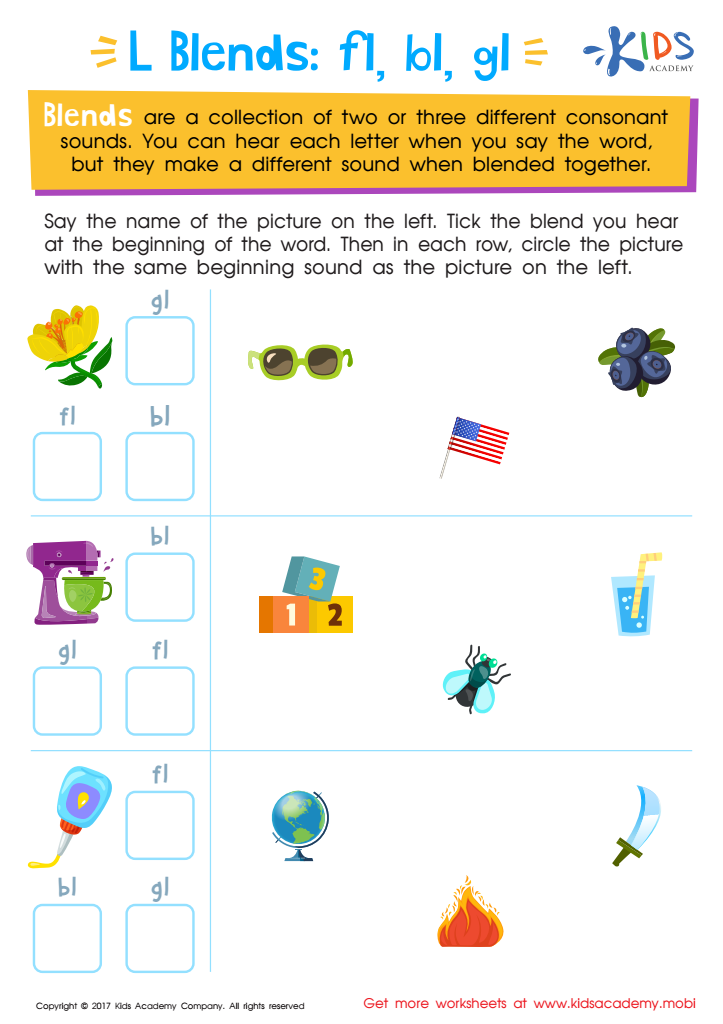
Blending Consonants: "Fl", "Bl" and "Gl" Printable
 Assign to My Students
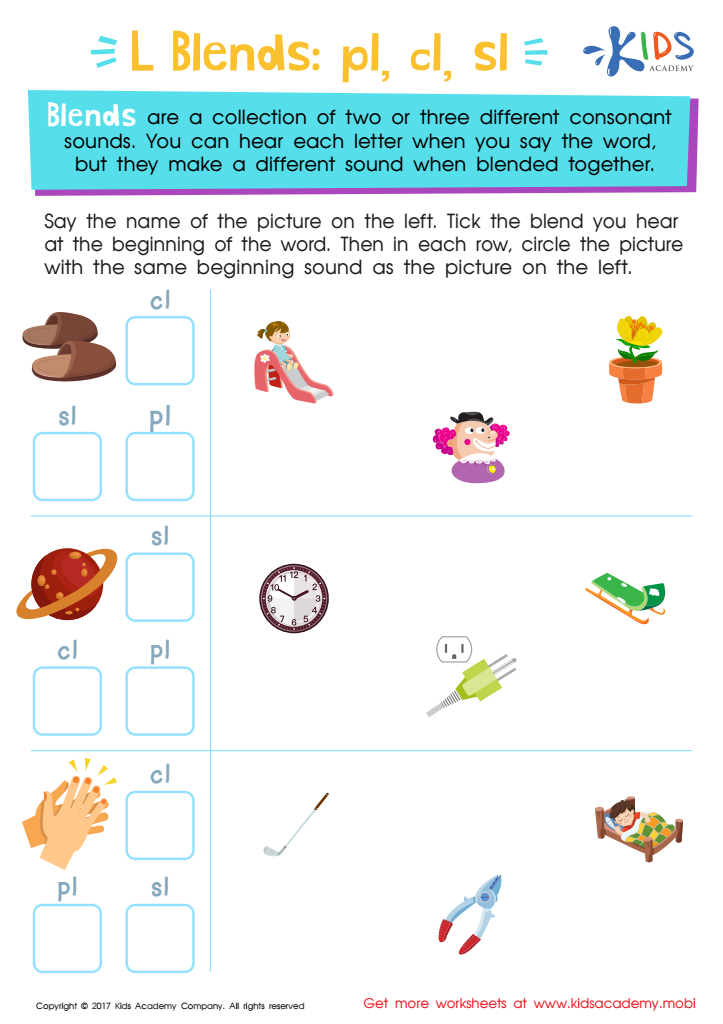
L Blends: "Pl", "Cl" and "Sl" Printable
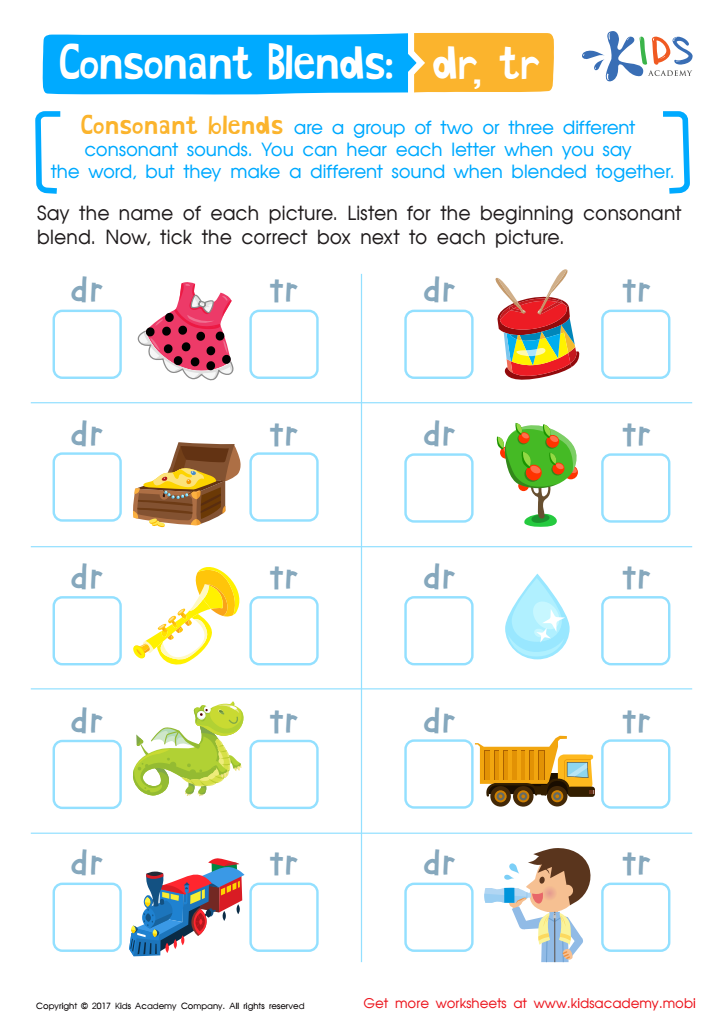
Consonant Blends: "Dr" and "Tr" Printable


Phonics skills, particularly the understanding of initial and final consonant blends, are crucial for children aged 5-6 as they lay the foundational building blocks for reading and writing proficiency. At this age, children are transitioning from recognizing individual letters and sounds to blending these sounds into coherent speech and text. Initial and final consonant blends refer to the combination of two or more consonants that appear at the beginning or end of a word, like "bl" in "blue" or "st" in "last."
Mastery of these blends helps children effortlessly decode new words, greatly enhancing their reading fluency and comprehension. This is because many common English words feature consonant blends, and recognizing them as units rather than isolated sounds can make the reading process faster and more intuitive. For example, understanding that "st" in "stop" forms a single blend as opposed to two separate sounds elevates their ability to read with more confidence and accuracy.
Moreover, phonics skills directly contribute to spelling capabilities. When children grasp how consonant blends function, they are better equipped to spell words correctly, giving them a sense of accomplishment and encouraging further engagement in literacy activities.
In summary, initial and final consonant blends are essential components of phonics instruction that help children decode words swiftly, improve reading and writing skills, and build a strong foundation for future academic success. Hence, both parents and teachers should place a strong emphasis on developing these critical phonics skills.








