Understanding number relationships Adding Up to 5 Worksheets for Ages 5-6
3 filtered results
-
From - To
Foster early math skills with our "Understanding Number Relationships: Adding Up to 5 Worksheets" designed for ages 5-6. These engaging, colorful worksheets make learning fun and effective as young learners explore adding numbers up to 5. They help children grasp fundamental concepts, such as number recognition and basic addition, by identifying number patterns, pairing numbers that sum up to 5, and completing simple, age-appropriate exercises. Perfect for classroom use or home practice, these worksheets build a strong mathematical foundation while enhancing critical thinking and problem-solving skills. Download now and watch your child thrive in their early math journey!
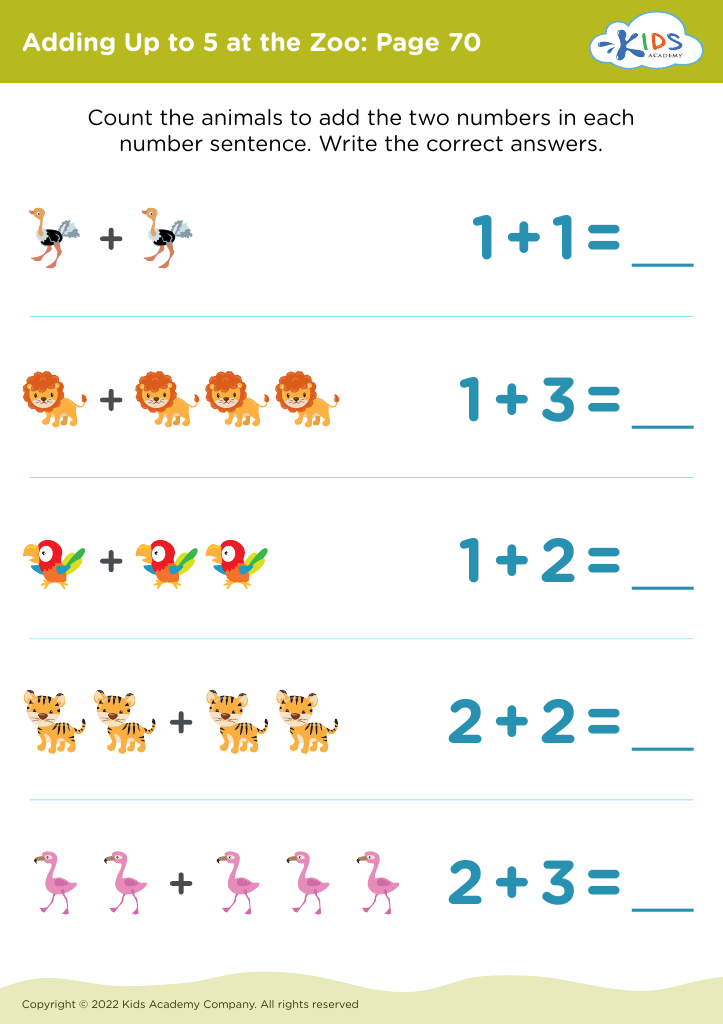
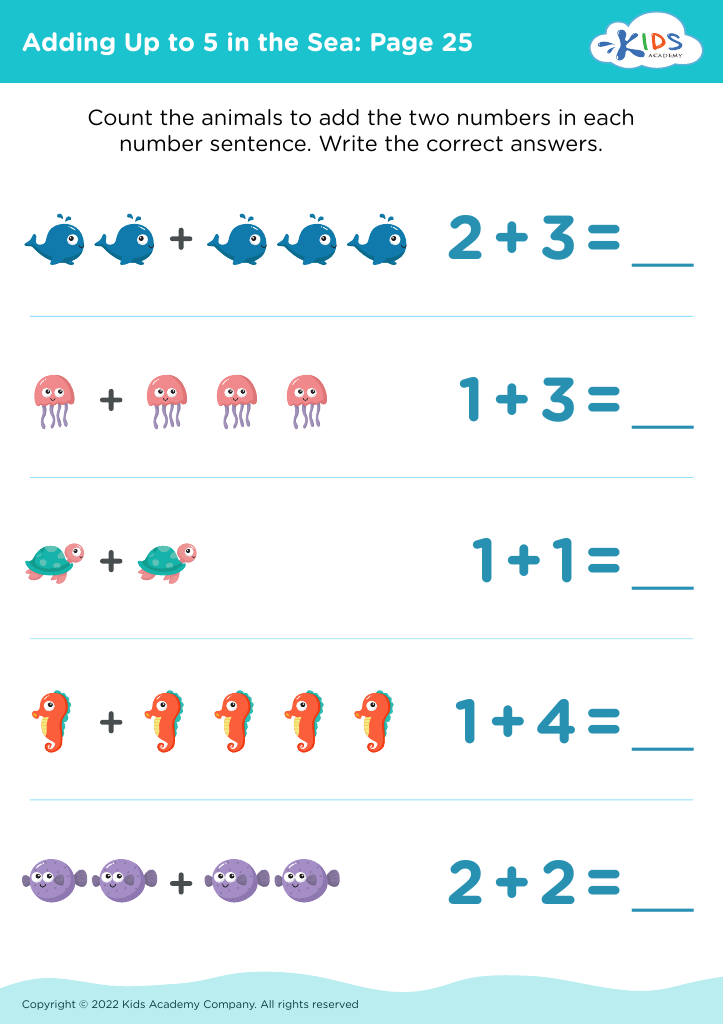
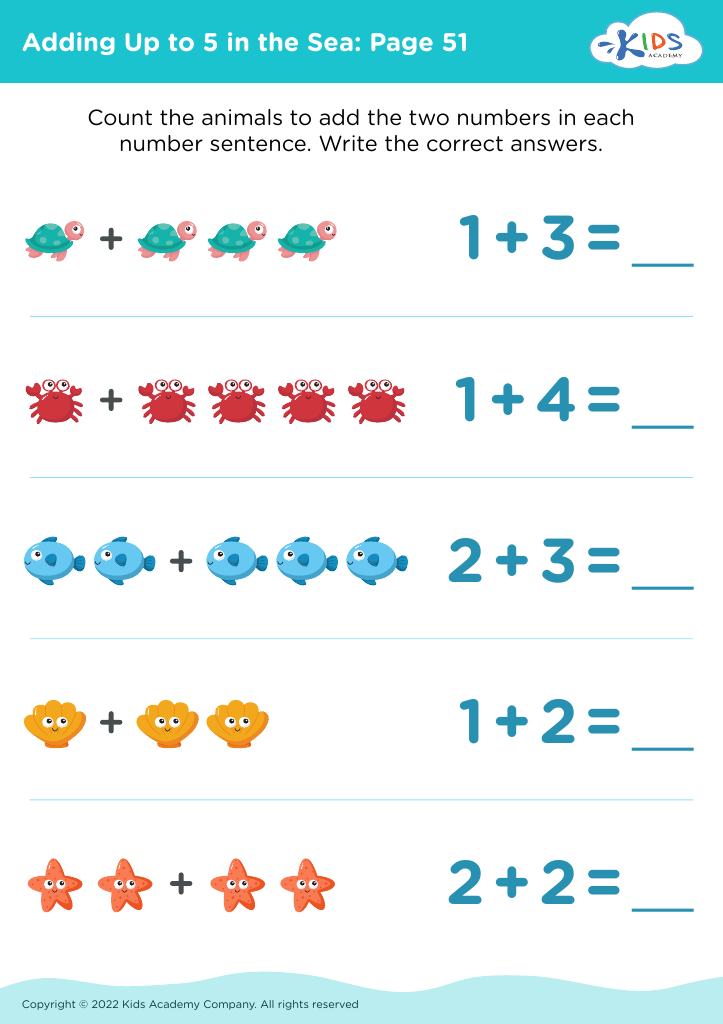




%20(1).jpg)



Understanding number relationships and addition up to 5 is fundamental for children aged 5-6 as it sets the foundation for future mathematical learning. At this age, children are developing their basic numeracy skills and cognitive abilities. Introducing simple addition helps them grasp the concept of combining quantities, which is a critical building block for more advanced arithmetic and problem-solving skills that they will encounter later.
Engaging with small numbers allows young learners to gain confidence and fluency in their mathematical abilities. When they can comfortably add numbers up to 5, they develop a positive relationship with math, making them more likely to approach further learning with enthusiasm and curiosity. This early success is crucial as it translates into a growth mindset—believing that effort leads to improvement.
Moreover, understanding these number relationships aids in their overall cognitive development. It enhances logical thinking and pattern recognition, which are skills applicable well beyond math, positively impacting reading comprehension and scientific reasoning.
For parents and teachers, nurturing these skills provides an opportunity to assess a child's understanding and readiness for more complex concepts. It also fosters a collaborative environment where children feel supported in their learning journey, ensuring they build a strong, enduring mathematical foundation.
In summary, focusing on number relationships up to 5 is not just about math—it’s about equipping children with essential life skills.








