Basic counting skills Addition & Subtraction Worksheets for Ages 5-6
3 filtered results
-
From - To
Discover our comprehensive collection of Basic Counting Skills Addition & Subtraction Worksheets designed specifically for ages 5-6. These engaging worksheets, available at Kids Academy, provide young learners with a fun and effective way to master essential math skills. Each worksheet features age-appropriate exercises that focus on simple addition and subtraction, using colorful visuals and practical examples to enhance understanding. Our expertly crafted materials are perfect for both classroom and home use, making them an ideal resource for building a strong mathematical foundation. Help your child develop confidence and proficiency in basic counting with these educational worksheets.
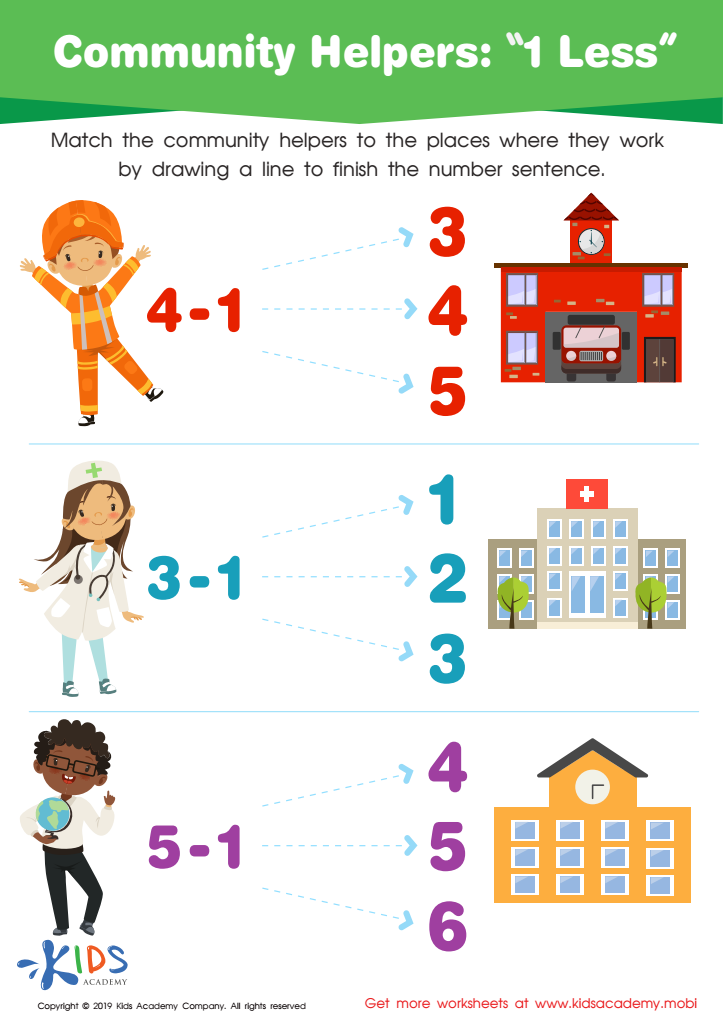
Community Helpers: 1 less Worksheet
 Assign to My Students








Basic counting skills, as well as addition and subtraction, are foundational in a child’s early development and have far-reaching implications for their future learning. For children aged 5-6, developing these skills offers several key benefits that highlight the importance for parents and teachers to be involved in nurturing them.
Firstly, basic arithmetic skills are crucial for everyday functions. Being able to count, add, and subtract lays the groundwork for understanding money, telling time, and even following recipes or game rules. These skills facilitate independence and problem-solving capabilities.
Secondly, competence in early math boosts confidence and promotes a positive attitude toward learning. Children who master these basic concepts early on are more likely to enjoy and engage with math as they progress in school, reducing anxiety and resistance they might encounter otherwise.
Moreover, early mastery of math fundamentals supports cognitive development. Skills such as counting, addition, and subtraction enhance logical thinking and pattern recognition. These cognitive skills are transferable to various subjects beyond mathematics, including science and reading comprehension.
Lastly, investing in these skills early creates a strong educational foundation. Struggling with basic math can lead to difficulties in more complex mathematical concepts later, hindering academic progress. Therefore, parents and teachers should prioritize teaching these skills to set children up for long-term success and confidence in their educational journey.








