Visualization skills Addition & Subtraction Worksheets for Ages 5-6
4 filtered results
-
From - To
Enhance your child's visualization skills with our engaging Addition and Subtraction Worksheets designed specifically for ages 5-6. These fun, interactive worksheets help young learners visualize mathematical concepts, making it easier to understand addition and subtraction. Through vibrant illustrations and hands-on activities, children can connect numbers with real-world scenarios. These resources not only boost arithmetic skills but also promote critical thinking and problem-solving abilities. Perfect for at-home learning or classroom use, our worksheets encourage practice and reinforce foundational math skills. Help your child build confidence and a strong mathematical foundation today with our comprehensive selection of visualization-focused worksheets!
 Assign to My Students
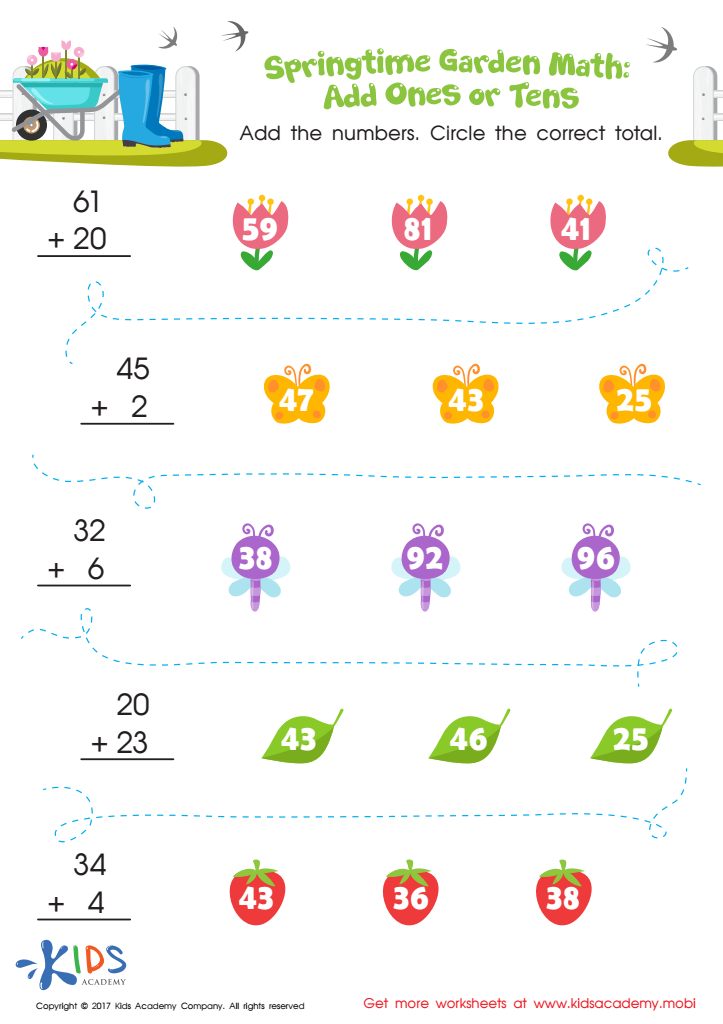
Springtime Garden Math Worksheet








Visualization skills in addition and subtraction are critical for children ages 5-6 as they lay the foundation for mathematical understanding and problem-solving abilities. At this developmental stage, children are transitioning from concrete operational thinking to abstract reasoning. By developing strong visualization skills, they can mentally picture mathematical concepts, allowing them to more easily grasp number relationships and operations.
These skills help young learners to understand quantities and can make the operations of addition and subtraction more intuitive. When children can visualize problems—whether through drawing, using manipulatives, or picturing numbers—they engage more deeply with the material, which can foster a love for math. Visualization also aids in the retention of information, allowing for better recall during assessments or in applied situations.
Additionally, emphasis on these skills prepares children for more complex mathematical concepts they will encounter in later grades, such as place value, mental math, and problem-solving strategies. By prioritizing visualization in early math instruction, parents and teachers not only enhance foundational math skills but also support cognitive development and encourage critical thinking—essential skills that extend far beyond the classroom. Overall, honing visualization skills equips children with the tools they need to become confident and capable learners throughout their academic journey.








