Fraction comparison Building Vocabulary Worksheets for Ages 5-6
9 filtered results
-
From - To
Discover fun and interactive Fraction Comparison Building Vocabulary Worksheets designed for children ages 5-6. These worksheets are crafted to help young learners grasp basic fraction concepts while enhancing their vocabulary. Through engaging exercises, kids will learn to recognize, compare, and describe simple fractions, offering a strong foundation for future math skills. Perfect for parents and teachers looking to blend math and literacy, these worksheets make learning fractions enjoyable and accessible. Boost your child's confidence and academic success with our expertly-designed resources, making complex topics simple and exciting!
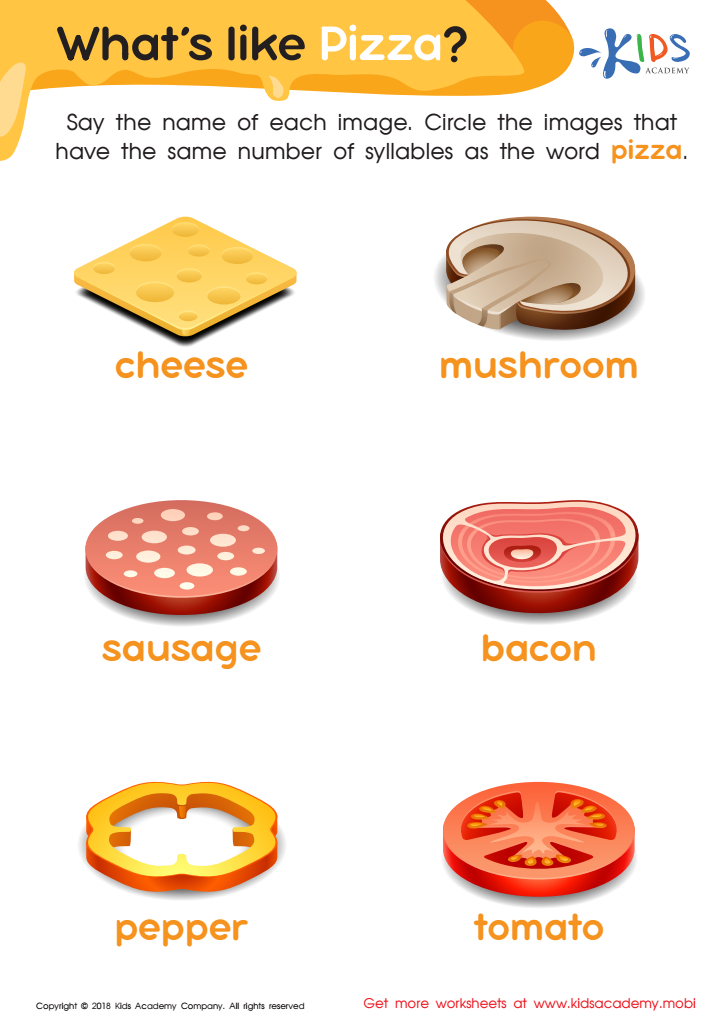
What's Like Pizza? Worksheet
 Assign to My Students


















.jpg)
Understanding fraction comparison and building the related vocabulary are foundational skills for young children that significantly influence their future mathematical development. At ages 5-6, children are at a critical stage for developing number sense and mathematical reasoning. Introducing basic concepts of fractions, such as understanding halves, thirds, and quarters, helps create a strong groundwork for more complex math problems they will encounter later.
Parents and teachers should care about fraction vocabulary for several key reasons. First, it nurtures a precise mathematical language, allowing children to articulate their reasoning and understand math instructions more clearly. Terms like "greater than," "less than," and "equal to" become part of their regular lexicon, essential not only for math but for logical thinking across various subjects.
Second, early exposure to fractions demystifies what is often perceived as a challenging topic. By learning through engaging activities at an early age, children view fractions as a playful and familiar concept rather than an abstract and intimidating one. This positive attitude towards fractions can boost their confidence and foster a lasting interest in mathematics.
Moreover, comprehending fractional parts reinforces their understanding of the world around them, enhancing their ability to make sense of daily situations such as dividing snacks, sharing toys, or understanding time. Thus, caring about fraction vocabulary development at ages 5-6 is pivotal for their academic growth and life skills.








