Numerical reasoning Worksheets for Ages 5-9
5 filtered results
-
From - To
Discover engaging numerical reasoning worksheets designed specifically for children aged 5-9! Our collection supports young learners in developing essential math skills through fun and interactive activities. These worksheets incorporate a variety of topics, including counting, addition, subtraction, and basic problem-solving, all tailored to strengthen students’ comprehension and confidence in numbers. Perfect for both classroom use and at-home practice, our resources align with early math standards to ensure effective learning. Help your child build a strong foundation in numerical reasoning while enjoying colorful illustrations and motivating exercises. Explore our worksheets today and set your child on a path to mathematical success!
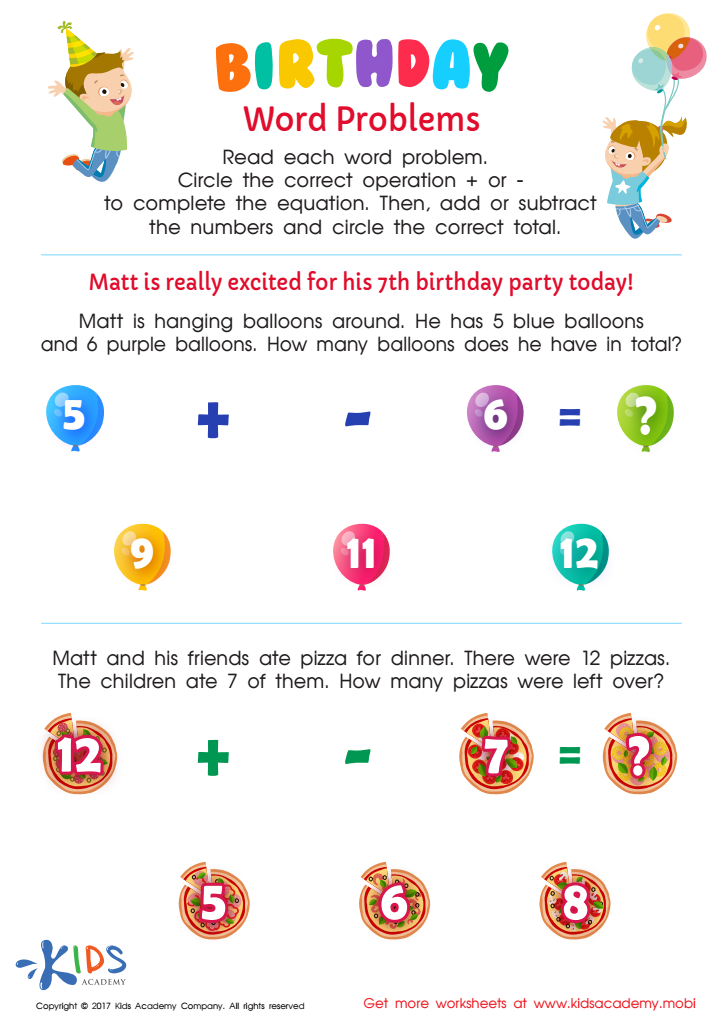
Birthday Word Problems Substraction Worksheet
 Assign to My Students







Numerical reasoning is a foundational skill that significantly impacts a child's future academic success and everyday problem-solving abilities. For children aged 5 to 9, developing numerical reasoning fosters a strong understanding of mathematics concepts that extend beyond simple calculations, preparing them for more complex thinking in later years.
At this stage, children learn to recognize patterns, make estimates, and solve basic arithmetic problems. These skills are essential for building confidence and promoting a positive attitude towards math, reducing the risk of math anxiety in later years. Parents and teachers should care about promoting numerical reasoning because it lays the groundwork for critical thinking and essential life skills.
Engaging children in activities that enhance their numerical reasoning—such as puzzles, games, and practical applications—makes learning enjoyable and memorable. It also encourages collaboration and communication among peers. Cultivating a rich numerical environment at home or in the classroom not only nurtures natural curiosities but also fosters resilience, enabling children to tackle real-life challenges innovative ways.
Effective numerical reasoning sets children on a path to success, ensuring they are well-equipped to meet educational demands and fostering lifelong mathematical competencies that are invaluable in an increasingly data-driven world.








